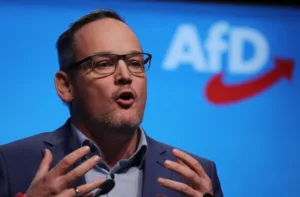



The Alternative for Germany’s (AfD) landslide victory in Saxony-Anhalt has exposed a growing divide within Italy’s governing coalition, with the three parties forming Prime Minister Giorgia Meloni’s government taking sharply different positions on the rise of Germany’s Right, and revealing competing strategies for responding to the growing strength of right-wing parties across Europe.
The AfD won 43.8 per cent of the vote in the September 6 regional election, emerging as the strongest political force in the eastern German state. It more than doubled its 2021 score but fell three seats short of an absolute majority in the 83-seat regional parliament, while the Christian Democratic Union (CDU) of Minister-President Sven Schulze dropped to 17.2 per cent.
In Italy, the reaction has highlighted differences between the three parties in Meloni’s coalition: her Brothers of Italy (FdI), Matteo Salvini’s League and Antonio Tajani’s Forza Italia.
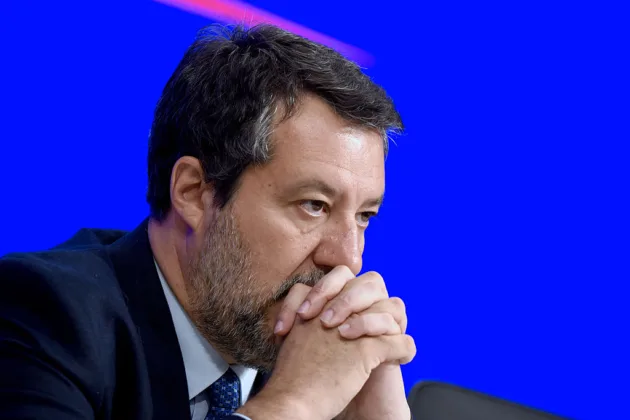
Salvini, who is also deputy prime minister and transport minister, openly celebrated the AfD’s success. He congratulated AfD co-leader Alice Weidel and described the result as a “stunning success”, saying it reflected voters’ desire for “change, security and work”. “Fear? Terror? Danger? No, it’s called democracy. Another Europe is possible,” Salvini wrote, according to Avvenire and ANSA.
According to La Repubblica, Salvini also spoke with Weidel following the election, underlining the political proximity that has survived a split at the European Parliament. From 2019 until May 2024, Salvini’s League and the AfD sat together in the Identity and Democracy (ID) group.
The relationship broke down in May 2024, when the AfD was expelled from the group following remarks by its then lead European election candidate Maximilian Krah, who said not all members of the SS had been criminals. The League backed the decision.
After the 2024 European elections, the two parties ended up in different parliamentary groups. The League joined Patriots for Europe, while the AfD helped form the separate Europe of Sovereign Nations (ESN) group.
The institutional split, however, did not eliminate their political proximity, with the two parties continuing to share positions on a number of issues and sometimes voting in the same direction in the European Parliament.
Tajani has taken the opposite position. The foreign minister and leader of Forza Italia described the AfD’s success as “very bad news”, which he said he hoped would prove “a local exception”, saying the party was “diametrically opposed” to the liberal and Western values of his party.
He also called for political measures to prevent populist and nationalist forces from spreading across Europe, according to ANSA and Sky TG24.
Forza Italia’s position is closely linked to its European affiliation: the party belongs to the European People’s Party (EPP), the same political family as German Chancellor Friedrich Merz’s CDU. Brothers of Italy, meanwhile, belongs to the European Conservatives and Reformists (ECR), a more conservative European political family that remains separate from both the EPP and Patriots for Europe.
Meloni has so far avoided publicly commenting on the result. Brothers of Italy limited itself to a low-key reading, with party deputy Emanuele Loperfido saying the vote showed a clear demand for a change of direction, according to Il Sole 24 Ore.
But according to La Repubblica, her concern may extend beyond the AfD’s positions themselves to the potential impact of its success on competition to her right. A stronger AfD could reinforce the appeal of a more nationalist political space in Italy at a time when Meloni is seeking to consolidate her position as the country’s dominant conservative force.
That concern is amplified by Roberto Vannacci. The former general left the League in February and founded his own party, Futuro Nazionale, before quitting Patriots for Europe and joining the ESN on February 24, making him a direct political ally of Weidel’s party at EU level.
Vannacci welcomed the AfD’s result, writing that “Europe is changing” and, referring to Merz, “Merz has an ulcer”. He concluded with “Nessun dorma”, “let no one sleep”, according to ANSA.
Vannacci’s growing support makes the link increasingly relevant for Meloni. In the latest YouTrend poll for Sky TG24, conducted between August 31 and September 3, Futuro Nazionale reached 7.9 per cent, overtaking Forza Italia at 7.1 per cent and the League at 4.4 per cent, while Meloni’s Brothers of Italy remained by far the largest party at 26.5 per cent.
Futuro Nazionale, on 5.9 per cent in June, is now the fourth-largest party nationally, according to YouTrend. The combination of Vannacci’s electoral growth and his alignment with the AfD could therefore strengthen a nationalist pole to Meloni’s right, adding a domestic dimension to the significance of the German party’s breakthrough.
The Saxony-Anhalt result therefore does not necessarily threaten the stability of Meloni’s government, which on September 4 reached 1,413 consecutive days in office, surpassing the 1,412 days of Silvio Berlusconi’s second government between 2001 and 2005 and becoming the longest-serving government in the history of the Italian Republic.
But the changing balance of power across Europe could have a significant impact on Italy’s political landscape ahead of the 2027 general election. As Europe’s Right continues to realign, the rise of forces such as the AfD and Vannacci’s Futuro Nazionale could reshape the balance within Italy’s conservative camp, and test Meloni’s ability to maintain her dominance on the right.