

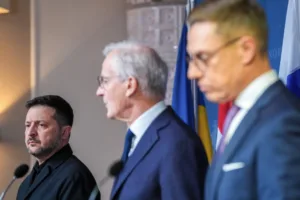

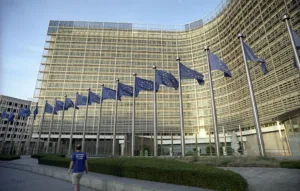

Armenia is in the heady days of early European courtship. Brussels, for its part, has been stoking its membership ambitions: Yerevan was chosen to host the European Political Community summit on May 4, followed the next day by the first bilateral EU-Armenia summit. It was a conspicuous show of support for Prime Minister Nikol Pashinyan ahead of the June 7 election. Yet the country risks sharing the fate of the Western Balkan hopefuls: promised a path into the Union yet stuck on a road to nowhere.
Armenia joins Moldova and Ukraine among the countries offered the prospect of EU membership as a palliative for Russian pressure, though, unlike them, it holds no candidate status and has yet to lodge an application. But that offer could backfire.
All, not least Armenia, have further to travel in meeting EU requirements on reforms than the more advanced Western Balkan candidates, some of which have been pursuing membership for over two decades. Voters may endure years of sacrifice, only to find accession perpetually out of reach. Prolonged disappointment could discredit the democratic leaders who championed integration, weaken trust in fragile institutions and give Russia an opening to reassert its influence.
Brussels puts faltering enlargement down to insufficient reform. But from the Western Balkans, the accession impasse looks rather different. Many in the region, where optimism has curdled into disillusionment, blame member states’ continually moving the goalposts.
In 2019, North Macedonia had met the reform conditions for opening negotiations, as the European Parliament itself confirmed. It had even prefixed its name with “North” under the 2018 Prespa Agreement, settling a long-running dispute with Greece, whose northern region shares the name Macedonia, and persuading Athens to drop its veto.
But fresh hurdles were erected. France blocked the opening of negotiations, seeking changes to the overall accession process. North Macedonia then secured approval under the revised process, only to be blocked again by Bulgaria over Macedonian history and language, followed by a demand to amend its constitution to recognise its Bulgarian minority. More than two decades after it was granted candidate status, its accession process remains stalled, with European Commission President Ursula von der Leyen pressing Skopje again in October to amend that constitution.
The EU’s major eastward enlargement came in 2004, when 10 countries joined, followed by Romania and Bulgaria in 2007. Since then, only Croatia has joined, in 2013.
Post-Cold War enthusiasm for enlargement has given way to fatigue. Western Europe became disappointed with Romania and Bulgaria, where corruption and weak judiciaries persist to this day.
Nowhere is enlargement fatigue more entrenched than in France. Fearful of Turkey joining in the mid-2000s, France changed its constitution in 2005 to require any new accession to be approved in a national referendum, a requirement that can be avoided only with a three-fifths majority in parliament. But with large Eurosceptic blocs now occupying both flanks of the National Assembly, Jean-Luc Mélenchon’s left-wing La France Insoumise and Marine Le Pen’s right-wing National Rally, few candidate countries can expect to clear this hurdle.
This creates a Catch-22: accession depends on reform, but governments have little incentive to undertake difficult reforms if the peg of accession itself no longer looks credible. As enthusiasm wanes on both sides, weary cynicism finds expression in a familiar quip across the Balkans: “We pretend to reform, and you pretend to want us.”
Still, the Commission, the EU’s executive, pretends to continue the march towards enlargement, encouraging aspirants to join as a solution to their own problems, while seeing it as part of the European project’s ultimate destiny: an entire continent united around its values.
The widening gap between the Commission’s enlargement ambitions and member states’ willingness to admit new members is producing ever less credible membership prospects. Armenia is the latest and perhaps starkest example.
The difficulties begin with geography.
Unlike Moldova or Ukraine, Armenia does not share a land border with Europe. This is not in itself disqualifying. But with no direct EU maritime access either, its geographical isolation and dependence on transit countries that are not EU members would complicate integration, making it less a natural extension of the EU than a distant outpost of it.
Before its reform record is even considered, two fundamental obstacles stand in the way. The first is Armenia’s deep entanglement with Russia. Its geography, in part, explains its web of economic, security and military ties with Moscow. A war with neighbouring Azerbaijan in the 1990s over the territory of Nagorno-Karabakh left Armenia’s borders with Azerbaijan and Turkey closed, as they have been since 1993, cementing and deepening its isolation and dependence on Russia.
This puts Armenia’s existing memberships of international blocs directly at odds with EU membership. Armenia belongs to the Kremlin-led Eurasian Economic Union, which grew out of an earlier Russian customs union. Armexit would need to precede joining the EU. Yet no member has withdrawn since the union took its present form in 2015, and Russia would take a bleak view of any departure.
Ukraine was not a member of the Russia-led customs union when it prepared to sign an Association Agreement with the EU in 2013, offering economic and political integration, but still far short of membership. Even so, Russian President Vladimir Putin warned that Russia would have to take “protective measures”. Barely six months later, Russia’s unmarked “little green men” were seizing Crimea. On April 5, Russian Deputy Prime Minister Alexei Overchuk told Yerevan that “opening markets with the European Union will mean closing markets with the Eurasian Economic Union”, noting that Armenian trade with Russia was worth $12 billion (€10.4 billion) last year, several times its trade with the EU.
Armenia is also a member of the Collective Security Treaty Organisation, the Russia-led mirror to NATO, another alliance incompatible with EU membership. Armenia has frozen its participation and announced its intention to leave, yet remains a formal member. Russia’s Federal Security Service, the successor to the KGB, guarded Armenia’s frontiers with Turkey and Iran until Yerevan took over the last of its checkpoints at the start of this year, while Moscow maintains a military base at Gyumri, in the north-west of the country, under a lease running to 2044. How Armenia can unwind this security architecture without provoking Moscow, particularly on the long road to Europe, is a question with no obvious answer. Nor has the EU explained how it expects Yerevan to resolve it.
Even if such a disentanglement were possible, it would come at a steep price. Armenia’s economy and energy supply remain deeply dependent on Moscow, while EU membership would still lie years of reform away. Armenia would therefore be forced to give up the benefits of its existing ties with Russia, while likely weathering punitive measures, long before Europe was able to replace them.
The second obstacle lies within Armenia itself: there is no settled national consensus behind the re-orientation towards Europe. In the June 7 election, pro-Russian opposition forces won a third of the vote between them: 23.3 per cent for Samvel Karapetyan’s Strong Armenia and 9.9 per cent for the Armenia Alliance. This is a strain of political opinion that cannot simply be waved aside. Nor will it necessarily subside with time, despite some groupthink in Brussels. Support for EU membership does not follow a one-way trajectory, as the long erosion of that support in Serbia demonstrates.
Moreover, while many recognise dependency on Russia has not served the country well, few would like to see the great power to its north as an adversary. According to a May 2026 poll, 57 per cent of Armenians favoured what is commonly described in Eurasia as a “multi-vector” foreign policy that preserved good relations with both Russia and the West. Joining an EU that imposes extensive sanctions on Russia would ultimately make that position harder to sustain.
Brussels risks damaging the fragile democracy it seeks to draw closer. Having encouraged Armenia’s membership ambitions and lent Pashinyan support ahead of the election, it has been reluctant to challenge conduct that runs counter to the democratic values it professes.
The election was preceded by the arrests of Armenian Apostolic Church clerics widely seen as pro-Moscow, and fought with Karapetyan, the main opposition leader, under house arrest. The crackdown continued afterwards, with pro-Russian opposition leaders detained or placed under house arrest. Yet Brussels has remained silent as Pashinyan moves against an opposition that collectively won around a third of the vote.
Political power remains highly personalised in Armenia; its institutions are weak. Pashinyan has wrapped himself in the EU flag. But Brussels’ reticence misses a chance to distinguish support for Armenia’s European future from support for Pashinyan. By remaining conspicuously at his side as abuses unfold, it risks tying the European project’s fortunes to him: when voters turn against Pashinyan, they may turn against Europe too.
Some argue this is just realpolitik: throwing its weight behind a European-friendly government in Russia’s backyard. Instead, the EU is tolerating behaviour that weakens Armenian democracy, despite having the leverage to challenge it. In doing so, Brussels allows Armenia to slip further below the standards it must meet to join the very Union drawing it in. Meanwhile, that indulgence discredits the EU’s professed values in Armenian eyes and strengthens the opposition’s charge of double standards.
Brussels is tolerating Armenia’s democratic abuses today while storing up disillusionment for tomorrow. The Commission must reconcile its enlargement ambitions with member states’ willingness to admit new members. Otherwise, Armenia could be left with weakened institutions, more antagonistic relations with Moscow and no EU membership to show for either.
The EU needs a credible alternative: closer integration that delivers tangible benefits without requiring either side to make the commitments of full membership, a prospect that remains out of reach in practice. The Commission’s pre-enlargement review, published on October 6, gestures in that direction, proposing to draw candidates into the single market, energy, transport and defence ahead of accession, though it still treats that as a staging post to membership rather than a substitute for it. The EU’s influence can extend beyond its borders without promising that those borders will follow. An offer intended to strengthen Armenian democracy and reduce its vulnerability to Russia must not end up doing the opposite.