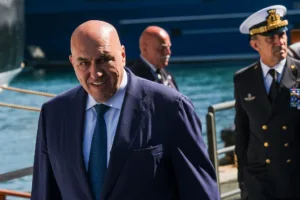

Italian defence minister Guido Crosetto has acknowledged that most Italians oppose military aid to Ukraine, highlighting the domestic political challenges facing Prime Minister Giorgia Meloni’s government as Rome prepares to continue supporting Kyiv.
“The majority of public opinion is against aid,” Crosetto said in an interview with the BBC broadcast in full on October 18, 2026. He added that a government could not give way to public opinion when it was convinced that opinion was wrong.
Despite this opposition, Crosetto indicated that Italy would probably approve a 13th package of assistance for Ukraine before the end of the year. Italy has provided 12 packages since Russia invaded Ukraine in February 2022, the minister said.
No package has yet been formalised for 2026. Crosetto said in August that parliament had authorised assistance for the year but that no measure had been drawn up, any decree going before the Copasir parliamentary intelligence committee first.
Meloni has maintained Italy’s support for Kyiv, aligning Rome with its European and NATO partners in responding to Russian aggression. Public opposition to weapons deliveries presents a political challenge, though, as the government approaches the next general election, which must be held by the end of 2027.
Crosetto also warned that Russia’s ambitions could extend beyond Ukraine. “I think Putin doesn’t want to stop at Ukraine,” he told the BBC, according to reporting published on October 17. He said Europe and NATO were preparing for this possibility, adding: “We are preparing for madness, hoping to never have to face it.”
In the same interview he said Ukraine would “never win the war”, adding that his objective was to ensure the country survived and the fighting ended.
The minister also criticised US restrictions on Ukraine’s access to satellite capabilities and intelligence. Rai News reported on October 17 that Crosetto described the restrictions as “a complete mistake, a major mistake”. He argued that depriving Kyiv of resources could encourage Moscow to believe it could win the war, prolonging the conflict rather than bringing peace.
He said it was impossible to read Washington’s strategy on Ukraine until the US midterm elections were over.
Crosetto said Italy’s military support would continue “for as long as this government is in place”, in the same BBC interview. He also warned that obtaining parliamentary approval for further assistance would become more difficult as elections approached.
He attributed part of that shift to foreign influence, saying voters struggling with fuel costs were hard to persuade that no concessions could be made to Moscow.
Public opinion polling provides further context for the government’s position. An Ixè survey published by Il Fatto Quotidiano on September 10, 2026, found that only 18 per cent of respondents supported continuing military assistance to Ukraine for as long as necessary.
The survey, conducted between September 3-10, 2026, among 1,000 Italian adults, also found that 24.8 per cent supported continued political and economic assistance while ending weapons deliveries. A further 26.7 per cent favoured gradually reducing Italy’s involvement, while 26.8 per cent favoured negotiations, including territorial compromises.
The poll gave a margin of error of 3.1 percentage points.
Resistance runs through the governing coalition’s own electorate. The same survey found 28 per cent of Meloni’s Brothers of Italy (FdI) voters and 31 per cent of League voters favoured scaling back Italian involvement, against 34 per cent of Forza Italia voters who backed continued arms supplies.
The findings suggest that support for continued military assistance remains limited, although opposition to weapons deliveries should not be equated with opposition to every form of support for Ukraine.