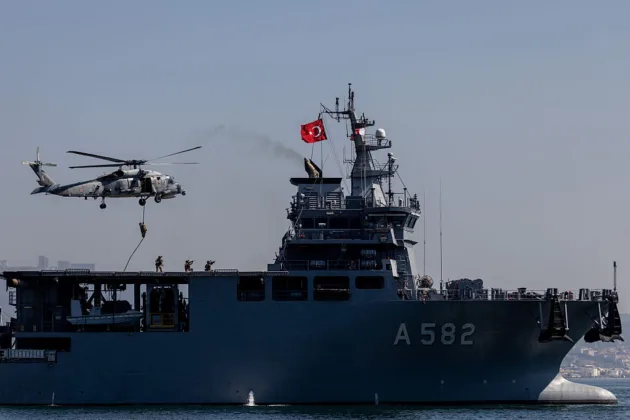







Italy has begun preparing to use its naval assets already deployed in the Red Sea under the EU’s Aspides mission to escort Italian merchant vessels through the Bab el-Mandeb Strait, with Rome considering placing them under national command rather than waiting for the EU operation to decide when and how to act.
Italian defence minister Guido Crosetto criticised European bureaucracy and delays when he announced the plan on September 17 while speaking at the Risorsa Mare Forum in La Spezia, northwest Italy.
He spoke following recent Houthi advances around the Bab el-Mandeb Strait, which links the Red Sea with the Gulf of Aden, and growing concerns over the safety of merchant shipping. According to Il Fatto Quotidiano, the corridor had fallen under the control of Yemen’s Iran-backed Houthi militias in recent weeks.
Crosetto said Italy had decided “not to wait for Aspides” to determine whether ships could pass.
Rome would “likely take action” to allow Italian vessels to transit the strait, he said, “without waiting for European bureaucracy” to slow the process. Delaying action, he added, risked holding back the economy and worsening the situation.
“When a sea route is interrupted, goods arrive late, costs rise and prices increase for families and businesses,” Crosetto said, according to La Nazione.
Aspides, formally EUNAVFOR Aspides, is the EU’s defensive maritime security operation established in February 2024 in response to repeated Houthi attacks on international commercial shipping in the Red Sea. Its mandate is to accompany and protect vessels and safeguard freedom of navigation along key maritime routes, including the Bab el-Mandeb Strait.
The EU extended the operation in February 2026 until February 28, 2027, allocating nearly €15 million to cover its common costs, according to the Council of the European Union.
Aspides has no permanent EU-owned fleet. Its naval forces are provided by participating member states, including Italy, and placed under the operation’s EU chain of command.
Each contributing country bears most of the cost of the ships it sends, Italian media have reported. The operation is headquartered in Larissa, Greece, and has been led since its launch by Greek Rear Admiral Vasileios Gryparis.
As of September 2026, Italy’s main naval asset in the operation is the frigate Carlo Bergamini, while Italian personnel also serve aboard the minehunters Rimini and Crotone.
Some 269 Italian military personnel serve under the mission, according to Il Sole 24 Ore.
The issue raised by Rome is whether Italian military assets already deployed in the Red Sea should remain under the EU operation’s chain of command or be reassigned to a national mission to protect Italian merchant vessels.
The Defence Ministry said on September 18 it had instructed Italy’s military leadership, including chief of defence staff General Luciano Portolano, to assess the operational and security situation and prepare a plan to guarantee the passage of vessels of national interest through Bab el-Mandeb. The plan was also to determine whether a new parliamentary authorisation would be required.
The plan could therefore involve temporarily shifting an Italian asset already assigned to Aspides from the EU chain of command to national command, rather than sending an entirely new force into the region.
The Carlo Bergamini had been docked in Djibouti with the two minehunters, the Italian news agency ANSA reported. On September 18, Aspides commanders authorised the frigate to escort the Italian merchant ship Jolly Oro, operated by the Ignazio Messina shipping company, northbound through the strait at the firm’s request.
At the same time, Crosetto has called for Aspides to be strengthened, urging other EU countries to contribute additional naval vessels in a letter to EU High Representative for Foreign Affairs and Security Policy Kaja Kallas.
Italy is prepared to provide a second frigate if requested, according to ANSA, while Rome is pressing other member states to share more of the military and financial burden.