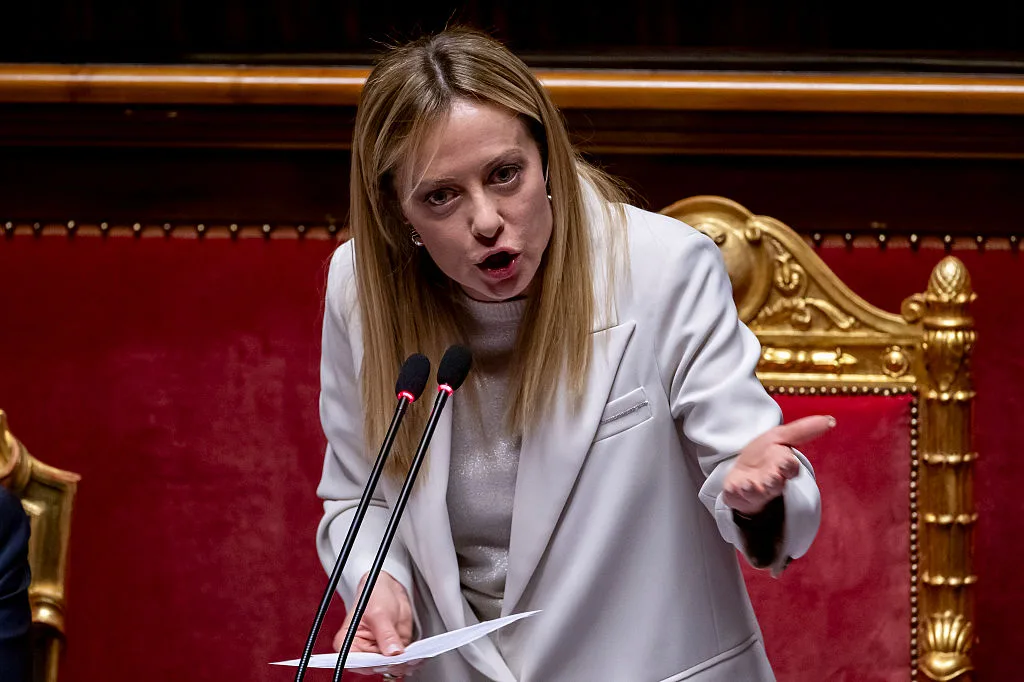


Italian Prime Minister Giorgia Meloni has ruled out an alliance with political forces that oppose Italy’s support for Ukraine, drawing a clear red line for the future of the Italian Right ahead of the 2027 general election.
In an interview with Il Foglio editor Claudio Cerasa, published on September 12, Meloni said she was not prepared to change her position on Ukraine for political or electoral convenience.
“Giorgia Meloni is certainly not willing to do the opposite of what she has done so far, or what she believes in, for political or electoral calculation,” she said. “I am a serious person, and I am not good for all seasons.”
She added: “Anyone looking for a prime minister who changes her mind according to the support of this or that party, always and only for personal gain, should look elsewhere. And I think I also know where, because we have already been there.”
Since taking office in October 2022, Meloni’s government has maintained a consistently pro-Ukraine position, backing Kyiv politically, financially and militarily while supporting the EU sanctions regime against Russia.
Italy has backed successive rounds of EU sanctions and the government has repeatedly authorised new military aid packages for Ukraine. Rome has also contributed billions of euros in financial, humanitarian and military assistance, although the exact value of military aid remains classified.
The government has consistently argued that supporting Ukraine is necessary to defend European security and the rules-based international order.
The warning is particularly significant ahead of Italy’s general election, expected in the autumn of 2027, when the Right is currently well placed in the polls but increasingly divided over its approach to Russia and the war in Ukraine.
The message is directed primarily at Matteo Salvini and Roberto Vannacci, whose positions on the war increasingly differ from Meloni’s pro-Ukraine line.
Deputy Prime Minister and League leader Salvini, despite being part of the government, has repeatedly called for negotiations to take precedence over further military escalation. On August 25, speaking at the Rimini Meeting in Emilia-Romagna, northern Italy, he said: “Diplomacy must take precedence over weapons,” adding that once the war is over, restoring “good relations from every point of view” with Russia would be “fundamental”.
Salvini also described as “foolish” the idea that Italy should have no relations with Moscow after the war, arguing that severing them would hand Russia to China.
Vannacci represents a more substantial electoral challenge. The MEP and former army general left the League on February 3, 2026, breaking with the party that remains part of Meloni’s governing coalition.
He subsequently launched Futuro Nazionale (National Future), positioning himself as an opposition force further to the Right of the government. Expelled from the Patriots for Europe group in the European Parliament, he joined the sovereigntist Europe of Sovereign Nations (ESN) group later that month.
Ukraine has been one of the clearest points of confrontation, even before Vannacci left the League. On January 16, 2026, while still a League MEP, Vannacci called for an end to Italy’s military assistance to Kyiv, warning: “Enough with giving money and weapons or we will enter into war with Russia.”
On February 6, his parliamentary supporters announced that they would vote against continued arms deliveries to Kyiv, in what La Repubblica described as his first challenge to the government. Five days later they backed the government in a confidence vote while opposing the Ukraine decree, which passed with 229 votes in favour.
More recently, on August 26, Vannacci again challenged the government over military support for Ukraine, demanding that ministers “tell the truth” about the procedures governing further arms supplies to Kyiv, according to ANSA.
Meloni’s unequivocal position on Ukraine is particularly revealing for Italy because it exposes a potential electoral dilemma. An Ixè poll published on September 10 put her Brothers of Italy (FdI) party at 26.1 per cent, Futuro Nazionale at 8.1 per cent, Forza Italia at 7.6 per cent and the League at 4.6 per cent.
Carried out between September 3 and 10 among 1,000 respondents, the survey also showed FdI down from 27.5 per cent in July, while Futuro Nazionale has risen from 2.7 per cent in February. Together with Noi Moderati, another small centrist party supporting Meloni, the main right-wing parties reached about 47.4 per cent, compared with about 42.9 per cent for the main centre-left parties.
The figures show that the Right has a substantial advantage when united. But if disagreements over Ukraine prevent Meloni from bringing all the main forces of the Right into a common electoral and governing coalition, that advantage could narrow considerably.
The question appears to concern Vannacci more than Salvini. Salvini has shown no intention of leaving the governing coalition and, despite his repeated criticism of the government’s Ukraine policy and his calls for a future rapprochement with Russia, the League has so far continued to support the main government measures on Ukraine in the Italian parliament.
The party has voted in favour of successive extensions of the authorisation for Italy to provide military equipment to Kyiv and, as recently as February 2026, the League’s Senate leader confirmed that the party would support a new decree providing assistance to Ukraine. The divergence from Meloni has therefore so far been more political and rhetorical than a break within the governing majority over the government’s core decisions.
There are, though, important limits to this alignment. The League’s position has not always coincided with Meloni’s, particularly at the European level.
In February 2026, for example, League MEPs voted against the EU’s €90 billion loan for Ukraine for 2026-2027. The package cleared the European Parliament on February 11 by 458 votes to 140, with 44 abstentions, Brothers of Italy and Forza Italia MEPs voting in favour.
Salvini has also repeatedly opposed the use of Western weapons against targets inside Russia and has argued that diplomacy should replace further military escalation.
For Meloni, therefore, the challenge is not simply to maintain Italy’s support for Ukraine. It is to prevent the issue from becoming a fault line capable of fragmenting the broader Italian Right before the 2027 election.