



European airline passengers face ticket price increases of up to 20 per cent over the next year as carriers pass on rising jet fuel costs, Ryanair chief executive Michael O’Leary has warned.
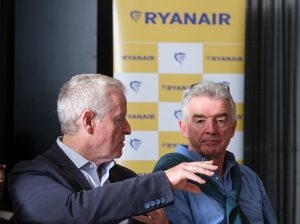
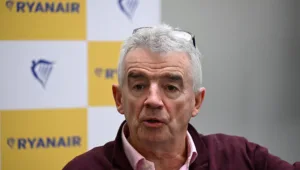
Speaking at a press conference in Brussels today, the head of Europe’s largest budget airline said carriers can no longer absorb rising operating costs, predicting what he described as the steepest fare jump in the continent’s aviation history.
O’Leary attributed the expected price surge primarily to elevated crude oil and kerosene prices linked to the conflict in the Middle East, which has pushed jet fuel costs higher since fighting with Iran began in late February.
Most European carriers have little or no fuel hedging in place for 2027, leaving operating margins directly exposed to swings in the global energy market. Ryanair is among them.
“We’re 85 per cent unhedged next year,” O’Leary said, adding that most of his competitors were in a similar position.
The sector also faces mounting compliance costs under European Union climate rules.
O’Leary pointed to the phase-out of free carbon allowances under the EU Emissions Trading System (ETS), which requires airlines operating flights within the European Economic Area to purchase permits for every tonne of carbon emitted. Those free allowances disappeared altogether this year, leaving carriers to buy permits for all their intra-European emissions at prices of between €70 and €100 a tonne.
Beyond fuel and European emissions schemes, the Ryanair boss criticised national aviation taxes across the bloc, taking specific aim at fiscal policies in Belgium and France.
“And all because of the stupid aviation tax increase by the federal government of Bart De Wever,” he said of Belgium.
Ryanair said it would cut 20 routes and more than 1.1 million seats from its Belgian schedule this winter, moving six aircraft out of the country.
Brussels South Charleroi Airport will lose 13 routes and 200 locally based jobs, with the Ryanair fleet there falling to 13 aircraft.
At Brussels Airport in Zaventem, only the connection with Dublin will remain, seven other routes (Barcelona, Madrid, Málaga, Marrakech, Porto, Rome and Valencia) are being cut.
Belgium would lose one million seats, and in the summer of 2027, if the tax stays, another million might follow, O’Leary said.
If the country dropped the tax, O’Leary said Ryanair would open 100 new routes over seven years and create about 1,000 jobs.
The levy rises from €2 per departing passenger, where it stood in January 2025, to €7 in January 2027. Charleroi has added a municipal charge of €3 per departing passenger since April 2026.
The Ryanair boss criticised Belgium over what he called its “anti-growth” policies, stating, “The Draghi Report warns that Europe must improve its competitiveness, yet the Belgian Govt is doing exactly the opposite.”
“PM De Wever’s 250 per cent tax hike on air travel from €2 to €7 is a textbook example of how to discourage investment, collapse traffic and tourism and lose jobs as it hands growth to lower cost competitor EU States, who have abolished aviation taxes and are lowering costs to improve their competitiveness and stimulate rapid traffic and tourism growth.”
Ryanair called on De Wever to scrap the tax before more damage was done.
In France, Ryanair responded to a 180 per cent increase in the national solidarity tax on air tickets, which rose from €2.63 to €7.40 on domestic and intra-European flights in March 2025, by cutting its regional capacity by 13 per cent.
The low-cost carrier pulled out completely from several smaller regional platforms, including Strasbourg, Bergerac and Brive, declaring services there commercially unviable under the higher tax burden, withdrawing 25 routes and some 750,000 seats while transferring aircraft and seat capacity to lower-tax European markets such as Italy, Sweden and Hungary.
O’Leary argued that several member states continue to treat the sector as a revenue source through ticket levies and airport surcharges rather than fostering passenger growth.
He added that even a 20 per cent rise in fares, which would be the biggest increase the European aviation market has ever seen, may fail to fully protect airline margins, predicting that protracted cost pressures will accelerate consolidation across the European market by pushing financially vulnerable carriers into mergers or insolvency.
Irish airline Ryanair will cut more than one in five flights in Belgium in response to the Belgian Government’s decision to double aviation tax to €10 per passenger embarkation. https://t.co/gRS2D3XhU5
— Brussels Signal (@brusselssignal) December 10, 2025