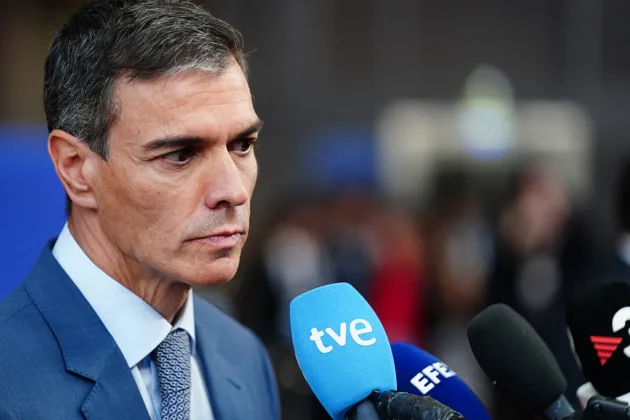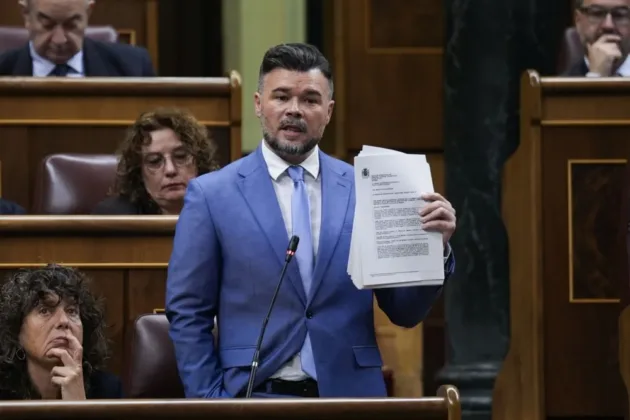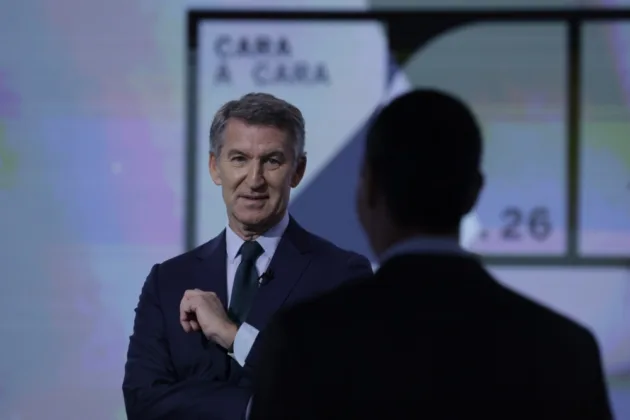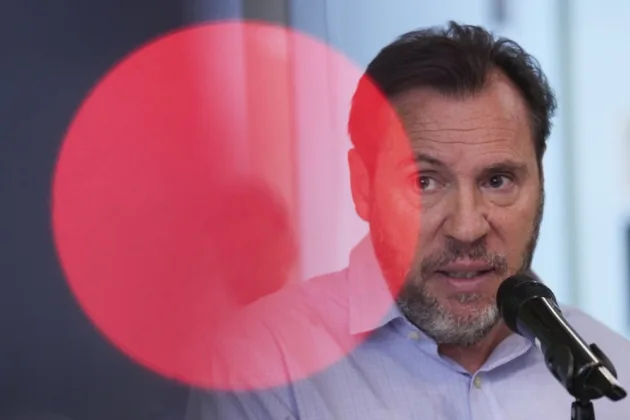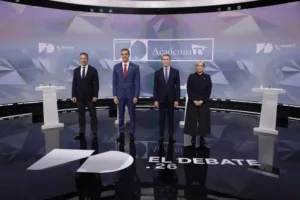

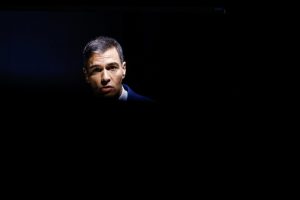
Spanish Prime Minister Pedro Sánchez has come through the last televised debate before the November 29 parliamentary elections largely intact, despite being challenged on the issues that have defined his time in office.
His two right-wing rivals, Alberto Núñez Feijoo of the People’s Party (PP) and Santiago Abascal of Vox, confronted him with that record. Sánchez met most of it with attacks of his own.
The record is extensive. Both men Sánchez chose as organisation secretary of the Spanish Socialist Workers’ Party (PSOE), José Luis Ábalos and Santos Cerdán, have been caught up in corruption proceedings, and Ábalos was convicted in June.
Sánchez’s brother David and former attorney general Álvaro García Ortiz have also been convicted. His wife, Begoña Gómez, is awaiting trial on charges including influence peddling and embezzlement.
On July 30, Spain suffered the invasion of Ceuta, its enclave in North Africa. Up to 50,000 people entered from Morocco in a single night, according to Interior Ministry figures, and 43 bodies were later recovered from its coast.
Two high-speed rail crashes, at Adamuz near Córdoba on January 18 and at Urda in Toledo province on October 28, have killed more than 110 people between them. The central government’s handling of the October 2024 dana floods in the Valencia region, which killed more than 220 people, remains in dispute.
All of it was put to him at the Academia de Televisión in Tres Cantos, north of Madrid. Sánchez answered with counter-accusations, with silence or by turning an exchange against his accuser.
Feijoo and Abascal attacked him over corruption, housing, inflation, migration, Ceuta, tax rises, public services, relations with Morocco and the state of the railways. They did so separately.
The two did not address each other once during the evening, leaving Sánchez to deal with each in turn.
Both raised Ceuta, which Sánchez himself called an attack on Spain’s territorial integrity in July. Both raised the rail crashes. After the second, on October 28, protesters outside the transport ministry in Madrid demanded that Sánchez and transport minister Óscar Puente resign.
Where the exchanges grew sharpest, Sánchez set the terms. Feijoo asked repeatedly who had paid for Sánchez’s primary campaigns inside the Socialist party.
Sánchez said party members had, that the Court of Auditors had endorsed the accounts and that the PP’s own headquarters had been financed with dinero B (off-the-books money). Feijoo invited him to repeat the claim looking into the camera.
When Feijoo asked whether the left-wing candidates were covering for one another, Sánchez raised Marcial Dorado, a Galician smuggler later convicted of drug trafficking, with whom Feijoo was photographed in the 1990s.
Sánchez stayed silent when Feijoo asked whether he would tell former Socialist prime minister José Luis Rodríguez Zapatero to return a commission that, according to Feijoo, he had received over the 2021 State rescue of airline Plus Ultra.
The floods produced the sharpest moment of the night, though not at Sánchez’s expense. Feijoo reproached Ada Colau of the left-wing alliance Frente Amplio (Broad Front) for having kept calladita, roughly “nice and quiet”, when Sánchez declined to take charge of the national emergency and left the town of Paiporta.
Sánchez turned the remark into a charge of sexism. He appeared more offended by it than Colau herself.
Colau then demanded that Feijoo explain why Carlos Mazón, the PP’s Valencian regional president at the time of the floods, still enjoys aforamiento, the privilege that reserves the trials of elected officials for higher courts.
The former Barcelona mayor, Sánchez’s most likely coalition partner, pressed him three times on rents and housing. On corruption she stood by him, offering her solidarity to Begoña Gómez and describing her as a victim of lawfare.
Abascal spent part of the evening on the defensive. Sánchez asked whether it was true that the Vox leader was receiving the bono social térmico, a State heating subsidy for vulnerable households, despite his income.
Abascal replied that he had five children at home and that no one could be discriminated against for their ideas. He was also challenged over a €112 billion cut in public spending suggested by José María Figaredo, Vox’s economic spokesman.
In his closing statement, Sánchez argued that Feijoo and Abascal “come from the same party, defend the same ideas and have the same masters”.
Feijoo asked for a vote “with memory”. Abascal called on Spaniards to back Vox so that Spain could “reconquer its future”.
The polls still favour the Right. As Brussels Signal reported when the campaign opened, all 15 private surveys released up to November 12 gave the PP and Vox a combined average of 50.6 per cent, while the State-run Centre for Sociological Research (CIS) put the PSOE first on 33.3 per cent.
Whatever the result on November 29, Sánchez left the studio no weaker than he entered it. The questions over Ceuta, the courts and the more than 330 people killed in the floods and the two rail crashes left with him, unresolved.