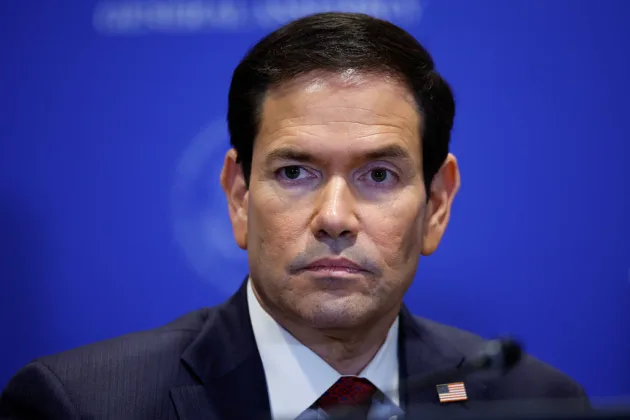


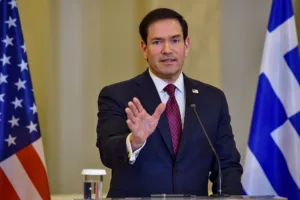

US Secretary of State Marco Rubio went to considerable lengths to give a comprehensive address on the American-European relationship on October 7, with the Acropolis and the Parthenon as his background and the Pnyx hill, where the Athenian assembly once met, as his platform. It is becoming the habit of North American statesmen to make recondite comments about eminent intellectual figures of the past, secure in the knowledge that only a tiny percentage of those whom they reach will have any idea of whether the people they are citing are being accurately invoked.
Canadian Prime Minister Mark Carney dazzled gape-mouthed Europeans at Davos on January 20 snapping like mackerels at his anti-American remarks and purporting with doubtful accuracy to be quoting Thucydides (one of the founders of the study of history but a man frequently guilty of considerable liberties on historical fact). At Strasbourg on September 17 he invoked Goethe, as if he were a celebrated champion of democracy and a placatory international order, which is again thoroughly debatable. In Athens, Rubio lumped the Greeks and Romans together as if there were perfect continuity between them and credited the Greeks in particular with the invention of democracy and the liberal society and consistent and obligatory civilised relations between states.
There is no doubt that the Athenians advanced a long way with a concept of the rights of accomplished male citizens. They were happy with the concept of slavery, did not wish to accord any rights to women, but they did recognise a level of collegiality in the elevation of public officials and the adoption of public policy. They showed little aptitude for expanding Athenian territory in the way Romans did several centuries later by occupying adjacent territory, improving infrastructure, especially roads and aqueducts, reducing taxes, improving security and reducing crime and promoting supportive locals to Roman institutions including the Senate. Athens attempted to turn the Delian League, a confederation of consenting autonomous states, into an outright colonial enterprise which subordinated the other members to Athens.
Most of the other Greek states apart from Athens have no claim whatever to the kind of enhancements of civilisation claimed for Athens. Sparta was a city state without a currency, outright communism based on a culture of strict boarding schools for boys and girls in which they were frequently severely whipped, frequently in the approving presence of their parents, and compulsory military service extended to all men up to middle-age. Greece was also an envious place where even the great Pericles was temporarily removed from office despite his immense public service. Socrates was put to death, although he perversely declined to amplify the chances of his survival, and Demosthenes committed suicide to avoid execution and a number of Athenians cooperated with their Macedonian conquerors in inflicting this fate upon him. Even Pericles has a slight air of the Gorbachev about him for having launched the Peloponnesian War which he conducted well but ended in disaster. The Roman proconsul in Greece in the second century BC was the extraordinarily capable, suave, cultured and diplomatic Titus Quinctius Flamininus, who courted every Grecian sensibility. But after a time, the Romans tired of the ingratitude and agitation of the Greeks, who proved almost as ungovernable as the Jews, even though the early Roman presence was entirely respectful and protective of Greek autonomy.
None of this detracts from the point that the Secretary of State was making, which is that the Americas and Europe have essentially the same ethnic and philosophical foundations, and it is ultimately essential to the security of the entire West, that the Americas and Western and Central Europe cooperate with each other and take the essential measures necessary for the defence and strengthening of their societies. He particularly emphasised the need for rational immigration, a revived birthrate, strong military defence, and uncompromising attachment to the basic principles that in their finer moments, have guided the political leadership of the West from Greek and Roman times through the rise of Christianity to the highlights of the last five centuries of the nation-state.
Rubio is correct in his analysis and he offers a worldlier programme than JD Vance’s quasi-isolationism. Franklin D Roosevelt built a consensus that has endured to this time that the United States must have a presence in Western Europe and the Far East to prevent Eurasia from falling into the hands of democracy’s enemies and putting Western civilisation at risk every generation. In the tense early years of the Second World War, he had virtually to tar the isolationists as stooges of Hitler, which was a bit severe, but all in a good cause. Of the candidates for the succession to President Trump that are visible from both parties, Marco Rubio appears to be the most probable effective guarantor of continuity in that strategic imperative. There is no greater public policy issue in the West, including its more recent adherents, such as Japan and even India.