



A spat has erupted inside the Brussels European bubble after the director of a major EU-funded homelessness organisation publicly accused European Commission staff of “dehumanising” rough sleepers by resisting office relocations to the capital’s crime-ridden North District.
The clash was triggered by a position paper published by Renouveau & Démocratie (R&D), one of the most influential trade unions representing European Commission personnel and staff across the EU institutions.
In the note, dated September 29 and addressed to Budget and Public Administration Commissioner Piotr Serafin, the union formally protested plans by the EU executive to expand the presence of its executive agencies in Brussels’ North District, a massive redevelopment zone surrounding the Gare du Nord railway station, citing persistent security, health and personal safety risks for EU officials.
“There can be no second-class staff within the European public service,” wrote R&D chair Cristiano Sebastiani. The note cited a firearm being discharged at the glass entrance of a building already housing agency staff and claims by Schaerbeek municipality that crime and drug dealing had shifted to daytime hours. It does not explicitly mention homeless people.
This pushback drew an angry rebuke from Freek Spinnewijn, director of FEANTSA, the European Federation of National Organisations Working with the Homeless.
FEANTSA serves as the European Union’s primary civil-society partner on housing exclusion and receives substantial direct EU backing, including more than €1.2 million from the European Social Fund Plus (ESF+) in 2026 and a similar amount in 2025, or more than 85 per cent of its total annual funding.
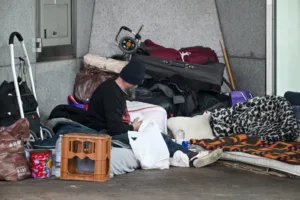
“Read and be disturbed,” Spinnewijn wrote in a public statement on LinkedIn. “One of the biggest unions of European Commission staff resist relocation to the Bruxelles north station area… because they might encounter vulnerable homeless people on their way to and from work.”
Accusing the union of stoking prejudice, Spinnewijn added: “Exaggerating the security risks is one thing, but equating street homelessness with disease, violence, and crime is quite another. These people are not a danger, they need care and support. Definitively not another attempt to dehumanise them.”
He further noted the irony that EU officials drafting housing exclusion and homelessness recommendations for member states appear unwilling to work alongside the reality on the ground.
The Commission coordinates the European Platform on Combatting Homelessness, launched with the Lisbon Declaration of June 2021, in which member states pledged to work towards ending homelessness by 2030.
A count by Brussels homelessness agency Bruss’help on the night of November 6-7, 2024 recorded 9,777 people homeless or without a home of their own in the Brussels-Capital Region, 25 per cent more than in 2022. Of these, 992 were sleeping rough.
Still, the union’s resistance reflects acute, everyday security realities in the Belgian capital that have long unnerved commuters and local public servants.
The North District, particularly around the Gare du Nord and adjacent Maximilian Park, has for years served as an open-air hub for drug trafficking, gang turf wars and undocumented transit migration.
Public transport staff and municipal workers have repeatedly staged wildcat strikes to protest rampant street crime, muggings and open drug use in the station’s subterranean transit halls.
In April 2019, trade unions at Flemish bus operator De Lijn filed a strike notice over hygiene and safety at the station’s bus terminal, where migrants hoping to reach the UK were sleeping.
The urban decay has already forced Belgian institutions to adapt.
At the nearby Tour & Taxis complex, trade unions representing civil servants working for the Flemish Government have protested a cost-cutting decision to withdraw staff access, from January 1, 2027, to the shuttle bus connecting their offices at the Herman Teirlinck building directly to Brussels-North station.
Jan Van Wesemael, general secretary of the ACOD public services union, called the move “scandalous”, saying staff would pay for it with their safety. The Flemish Government’s facilities agency has argued the route is easily walkable.
The shuttle service was introduced in 2017, after the Flemish administration moved to the site, to make the roughly one-kilometre journey safer, allowing workers to enter the station through a secure sub-level sliding door rather than navigating the exposed Solvay Square and Maximilian Park on foot, corridors where employees have routinely faced intimidation, theft and harassment by aggressive street groups.
Despite the European Commission’s broader “greening” and real estate rationalisation drive, which has seen the executive offload 23 prime European Quarter properties to consolidate personnel in cheaper, high-density hubs, the resistance from R&D highlights a persistent rift with its own staff.
Awkward! After complaining about moving to Brussels Nord, the EU Commission's staff union is now backpedalling.
An (obviously) EU-funded homelessness NGO accused them of stigmatising the homeless, so now the line is: “It was never about avoiding anyone.” Just late working hours,… pic.twitter.com/5ipI62nkX9— Richard J. Schenk (@RichardJSchenk) November 4, 2026