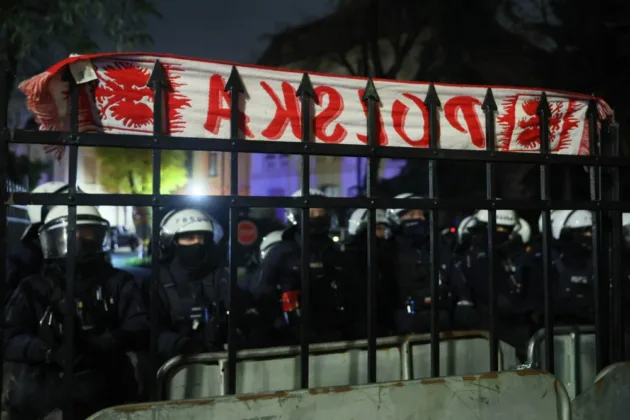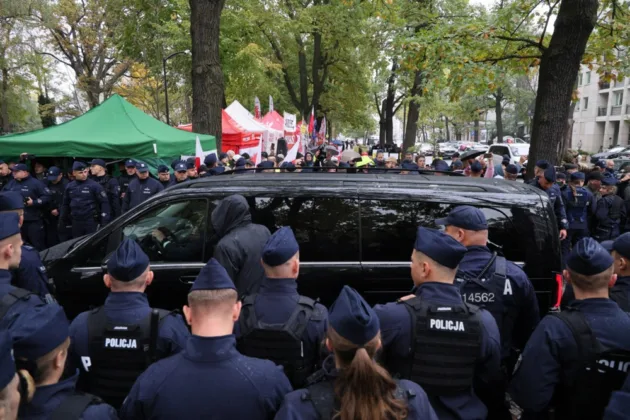





No matter what the experts say as they muddy the waters with legal quibbles, sending the police to the Constitutional Tribunal on a Friday evening (October 30), the eve of All Saints’ Day, while President Karol Nawrocki has just flown off to Senegal, looks very much like an attempted coup—from near and from far. It is deplorable that a European country, and one of the safest and most economically successful, should have reached this point. A judicial conflict that was initiated, let us not forget, by Donald Tusk himself in 2015 and has since escalated until it produced this brutal and astonishing decision.
An internal conflict? Not only, because its European dimension is undeniable: the EU in general, and the European Commission and the Court of Justice of the European Union (CJEU) in particular, have taken sides with Tusk for a decade. The support expressed in recent days is therefore hardly surprising, and for good reason: the Union is both judge and party in this confrontation, because its own model of functioning depends directly on it. Indeed, for some thirty years Brussels has developed the bad habit of usurping national competences without an explicit mandate and of placing its interests and its “values” above the rules of the game. And, precisely, its activism on the rule of law is the perfect example of this drift.
Before looking at the substance of the conflict, let us first ask whether the EU even has the competence. Is there a legal basis in the Treaties by which the member states delegate to the Union the control of the rule of law in their countries? The answer lies in Article 19(1), second sentence, of the Treaty on European Union, according to which “Member States shall provide remedies sufficient to ensure effective legal protection in the fields covered by Union law.” Nothing else. A couple of dozen words requiring the states to apply European law, on which Brussels has built an empire and claimed the right to have the last word on the organisation of national judicial systems, including at constitutional level. Between the literal interpretation of this provision and what the Union makes of it there is a gulf that shows that the text of the Treaties no longer means anything.
A usurpation all the more shameless because it is applied in a totally arbitrary manner. For 15 years the thunderbolts of Brussels have been directed exclusively against two conservative and sovereigntist governments: Poland under Law and Justice (PiS) and Viktor Orbán’s Hungary, in Orwellian proportions. Tusk has been the main beneficiary of this double standard: in 2024 he recovered €137 billion in European funds without any counterpart, imprisoned opponents and literally stormed the national broadcaster TVP to the applause of Brussels, which saw in it a “restoration” of the rule of law. Hungary’s new Prime Minister Péter Magyar is doing no better: he dismissed the legitimate President with a stroke of the pen, he too literally switched off the public media for weeks and prevented the appointment of the new leadership, and the former culture minister, Balázs Hankó, and his state secretary are abusively held in pre-trial detention. To top it all, he introduced measures with retroactive effect barring Orbán and the majority of the opposition from standing in the next elections. It is hard to imagine a more blatant violation of the rule of law and yet Brussels once again showed itself generous and, all smiles, returned the funds confiscated from the previous government. A striking benevolence compared with the zeal with which the Commission and the Court harassed Orbán, going as far as excluding 205,000 students from Erasmus (don’t worry, the sanction was miraculously lifted after the elections) and intervening even in the internal allocation of cases at the Supreme Court. The height of arbitrariness: Magyar also changed the retirement age of Constitutional Court judges with retroactive effect. For strictly identical facts, Mateusz Morawiecki had been prosecuted by the Commission and condemned by the EU Court in 2019 in record time; yet nobody in Brussels lifted a finger against Magyar. Meanwhile Spanish Prime Minister Pedro Sánchez, the most corrupt Prime Minister in Europe, who collects violations of the rule of law and whose party is accused by the police of wanting to liquidate (again in the literal sense) the judge who indicted his brother, has never been troubled by Brussels.
It is already surprising that the Union should lecture the member states, because if there is one political organisation whose shortcomings in the rule of law are structural, it is the EU. If, on top of that, this bad pupil exercises its control according to its political affinities with such cynicism, then there is cause for concern, because the Union would no longer be a vector of concord but a factor of confrontation inside the member states themselves. As in Poland, a polarised country in which the Commission and the Court have taken sides for one camp on the basis of usurped powers that they apply arbitrarily according to their own interests.
The shadow of the EU over Poland is therefore very long, and above all toxic. Captive of the messianism and militancy of its current leadership, it is urgent to reform it so that it returns to its origins and serves the countries of Europe instead of taking sides to impose its own political agenda. Otherwise it will die of it.