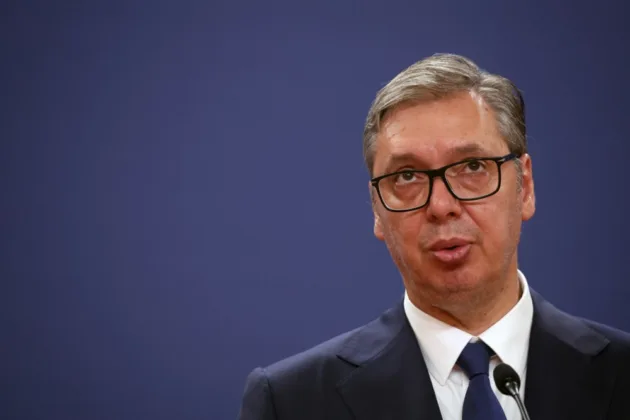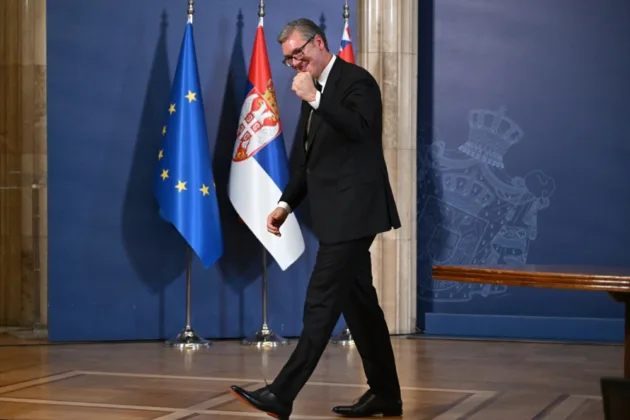

Serbia’s long-dominant leader Aleksandar Vučić has conceded defeat on the night of October 25 after snap parliamentary elections handed a clear majority to a student-backed list that emerged from two years of anti-corruption protests.
Vučić, who resigned the presidency on September 27 to lead his Serbian Progressive Party (SNS) into the vote and seek the premiership, told supporters that preliminary samples showed the Student List — Students Win taking between 135 and 140 of the 250 seats, against roughly 105 for his United Serbia coalition.
Independent projections put the students at around 52 per cent of the vote (roughly 2.2 million) to the SNS’ 39-40 per cent (about 1.7 million). By the morning of October 26, with 96 per cent of polling stations counted, the Republic Electoral Commission (RIK) had the Student List on 52.54 per cent and United Serbia on 39.29 per cent. Pollsters CeSID and Ipsos projected 140 seats for the students and 103 for the SNS-led list.
Turnout reached the highest level in more than three decades, approaching 70 per cent by the close of polls. RIK put it at 68.78 per cent, or 4,211,957 voters from an electorate of about 6.45 million.
The result ends the SNS’ uninterrupted hold on power since 2012.
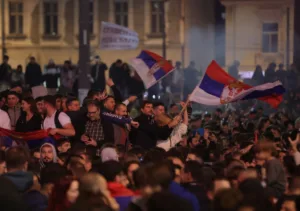
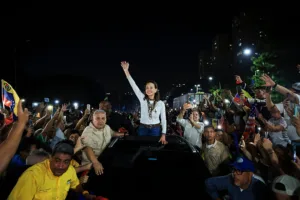
Celebrations filled Belgrade and other cities within minutes of the concession. Ana Brnabić, the former speaker of parliament, is serving as acting president until a presidential election that must be held by the end of December.
🎉🎉 Serbia celebrates Vučić's defeat all night — now he's warning the country about sanctions against Russia
After 14 years of Aleksandar Vučić's political dominance, his bloc has lost the snap parliamentary elections. The opposition Student List, which emerged from mass… pic.twitter.com/8x7nZ5wGDM
— NEXTA (@nexta_tv) October 26, 2026
Because the winners were a largely leaderless, student-backed movement of mostly non-politicians that emerged from anti-corruption protests, they did not have a traditional single-person “winner”.
The main public election-night address came from Radomir Saičić, a chemistry professor at the University of Belgrade and a member of the Serbian Academy of Sciences and Arts (SANU), speaking at the Student List headquarters.
“Tonight the citizens of Serbia have shown that no obstacle is greater than their will, that no fear is stronger than their courage, and that no force can forever overpower a people who have decided to take their destiny into their own hands,” he said.
“Thanks for every step, hour, sacrifice, and moment of not giving up; the future belongs to all citizens, not a select few. This victory is no one’s personal trophy; it belongs to all of us.”
Ilija Srdanović, a doctor from Novi Sad who topped the list, told the media that the result was expected and that they would build a better Serbia with improved relations with neighbours and the international community.
He said that Vučić had “deservedly gone to the dustbin of history”.
Vučić blamed unnamed European countries and an “American deep state — the one that is against President Trump” for the loss, while insisting he would not contest the outcome in court.
“Some people may leave us, but our structure is very solid. We are very united, we are very strong. We are used to opposition: Most of us have spent more time in opposition than in power,” he said.
“I know that tonight is difficult for many people. I know how much some are rejoicing. I wish them success. Only I will tell you, as you can see: unlike them, who in 14 years never managed to congratulate even once, I congratulate them, even though they are only the executors of dirty work that someone else devised in order to bring down a sovereign country.”
Vučić warned that soon the new people in power would show their true colours.
“By March or April you will have sanctions imposed on the Russian Federation. They will do everything they did not want to tell you, everything they lied about, because, I repeat, they are only the executors of the work and nothing more.”
He also had harsh words for parts of the press, saying they were foreign-funded or close to the opposition.
N1 and Nova S he labelled “the dirtiest scum”.
“Every word they uttered was a lie. They only did dirty work for someone else, thinking they would achieve I don’t know what.” He was particularly angry about accusations of the use of a sonic weapon against peaceful protesters during a large demonstration in Belgrade on March 15, 2025.
Vučić said his party would now be the target of persecution, but that they were ready for it.
🇷🇸 It's well past midnight in SERBIA, and students are still CELEBRATING their election VICTORY over Vučić
After months of political confrontation, they're taking the celebrations deep into the night.
For a generation that has spent so much time protesting in the streets,…
— Mario Nawfal (@MarioNawfal) October 26, 2026
The snap election followed the collapse of a canopy at Novi Sad railway station on November 1, 2024, which killed 16 people and triggered nationwide student-led demonstrations against perceived corruption, impunity and institutional capture.
The movement, formally organised as a list of academics, professionals and public figures rather than students themselves, campaigned on an 11-point platform centred on purging graft, reforming the media and depoliticising the state.
Conventional established parties were virtually wiped out. A string of contenders, including the long-standing ruling partner Socialist Party of Serbia (SPS) and the pro-EU European Serbia list, failed to clear the 3 per cent threshold, leaving them with no seats in the new parliament.
The SPS, led by Ivica Dačić, took 2.18 per cent and European Serbia 0.28 per cent. Only minority lists, which are exempt from the threshold, broke the two-bloc pattern: three seats for the Alliance of Vojvodina Hungarians, two for the Albanian coalition and one each for Rasim Ljajić’s list and the SDA of Sandžak.
On the issues that have long defined Belgrade’s relationship with Brussels, they promised continuity.
The Student List programme affirms military neutrality, treats Kosovo and Metohija as an inalienable part of Serbia under the Constitution and United Nations Security Council Resolution 1244, and opposes both Kosovo’s independence and its membership of international organisations.
It pledges to review previous agreements and preserve the traditional partnership with Russia, explicitly rejecting sanctions.
The EU is described primarily as Serbia’s most important economic partner; the programme emphasises progress on Chapters 23 and 24 (judiciary and fundamental rights) to secure interim benchmarks, but does not commit to full membership.
European Commission President Ursula von der Leyen welcomed the outcome and offered support for rule-of-law reforms, in a joint statement with European Council President António Costa that also cited media freedom and the fight against corruption.
Today, the people of Serbia turned out in record numbers to shape their country’s future.
Congratulations to the Student List on its victory in the parliamentary elections.
We stand ready to support reforms on the rule of law, media freedom, the fight against corruption and…
— Ursula von der Leyen (@vonderleyen) October 25, 2026