


A new bill has been introduced in the United States Congress that could trigger sanctions and visa restrictions against Serbian officials over Belgrade’s ties with Russia, China and Iran.
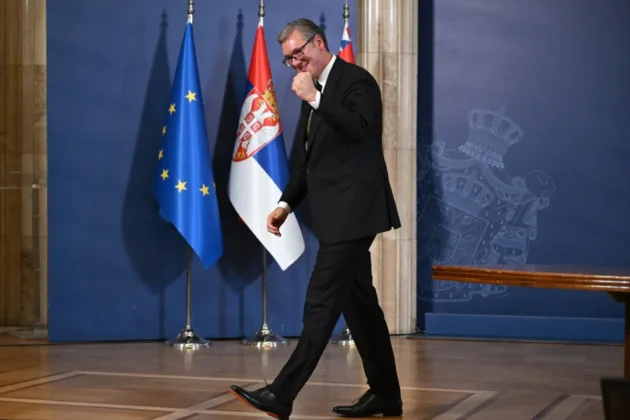
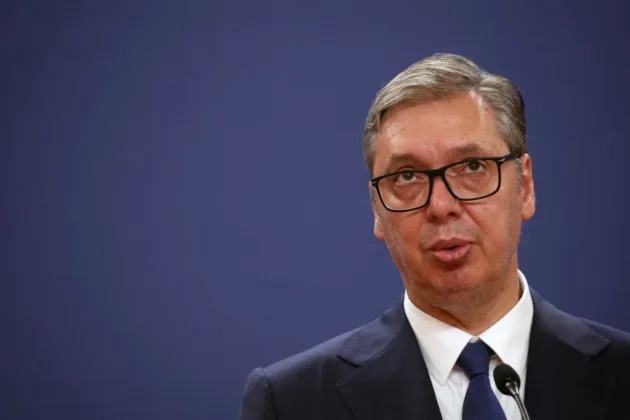
Republican Joe Wilson of South Carolina and Democrat Bill Keating of Massachusetts, both members of the US House of Representatives and of the House Foreign Affairs Committee, introduced the bipartisan SRBIJA Act on August 27, putting fresh pressure on Serbian President Aleksandar Vučić amid nearly two years of anti-government protests and growing scrutiny of his government.
The measure is formally titled the Supporting the Rule of law, Building Institutional Justice, and Accountability Act.
While the bill includes provisions addressing democracy, corruption, human rights and the rule of law, it also carries a clear geopolitical message. It reflects growing concern in Washington over Serbia’s willingness to maintain and deepen relations with countries that the United States increasingly views as strategic competitors or adversaries, particularly Russia, China and Iran.
The bill would make it US policy to impose financial and visa sanctions on malign actors considered to generate instability in the Western Balkans, including individuals undermining democratic institutions, territorial integrity or regional security frameworks. It also calls for the US to examine “the extent of Russian political, economic, energy, and security influence in Serbia” and the extent of Chinese investment, infrastructure and political and security ties with Belgrade.
Iran is explicitly included as well. The bill notes that Serbia and Iran have deepened technological and political ties, including cooperation on information and communications technology and artificial intelligence.
It also points to a diplomatic gesture: in July 2026, Serbia sent information and telecommunications minister Boris Bratina to Tehran as Vučić’s personal envoy to the funeral of Iranian Supreme Leader Ali Khamenei, killed in US-Israeli strikes on February 28, alongside Russian and Chinese delegations.
Wilson has been outspoken in his criticism of Vučić. He has taken a hard line on Russia, Iran and other US adversaries and serves on the House Foreign Affairs and Armed Services committees.
Introducing the bill on August 27, Wilson said Serbia under Vučić had moved away from the rule of law and closer to “enemies of freedom”, naming Vladimir Putin, the Chinese Communist Party and the Iranian leadership.
Under the bill, the Secretary of State, together with US intelligence and defence officials, would have to report to Congress on Russian political, economic, energy and security influence in Serbia and on Chinese investment and political and security ties. The report would assess whether these relationships pose risks to US interests, including in defence, telecommunications and national security.
It would also require Washington to suspend the US-Serbia Strategic Dialogue, inaugurated on July 17, if Secretary of State Marco Rubio cannot certify progress on elections, corruption and Belgrade’s relations with Moscow, Beijing and Tehran.
The initiative comes as Serbia faces continuing anti-government protests following the November 1, 2024 collapse of a railway station canopy in Novi Sad, which killed 16 people. The disaster triggered student-led demonstrations that have become the most sustained challenge to Vučić’s government in years, with protesters accusing the authorities of corruption, lack of accountability and pressure on demonstrators.
Vučić has said early parliamentary elections will be held on October 18 or 25, more than a year ahead of schedule.
At the same time, Vučić has continued to pursue a balancing strategy between the EU and the US on one side and Russia and China on the other.
Serbia applied for EU membership in 2009, received candidate status in 2012 and opened accession negotiations in 2014. By 2026, 22 of the EU’s 35 negotiating chapters had been opened, with two provisionally closed and none opened since December 2021.
Brussels is also a major financial backer, through pre-accession funding and the bloc’s Reform and Growth Facility, which provides an indicative €1.58 billion in grants and concessional loans, conditional on reforms. In January 2026, the European Commission approved the first release, including around €16.2 million in net grants and €40.3 million in net loan support.
Payments were then halted. Enlargement Commissioner Marta Kos said on April 30 that disbursements had stopped over judicial laws adopted in Belgrade that the Venice Commission found weakened the independence of the courts.
The EU is Serbia’s largest trading partner, investor and source of financial assistance. Yet Belgrade has refused to fully align itself with EU sanctions on Russia and continues to maintain close political, economic and energy ties with Moscow. China has meanwhile become a major investor in Serbian infrastructure, mining and industry.
The SRBIJA Act therefore connects Serbia’s domestic political trajectory with its broader geopolitical positioning.
That balancing strategy has given Serbia room for manoeuvre. But the new bill suggests that Washington may be becoming less willing to tolerate what it sees as geopolitical ambiguity from a country that formally seeks closer integration with the West.
The pressure is not entirely new. In January 2025, the US Treasury sanctioned Serbia’s Russian-owned oil company Naftna Industrija Srbije (NIS) as part of broader measures targeting Russia’s energy sector, though the designation took effect only in October that year after a series of postponements. Belgrade has since sought repeated waivers while attempting to resolve the ownership of the company.
On August 28, Washington extended the NIS waiver until September 30, allowing the company to continue operating while negotiations continue over a possible sale of the Russian stake to Hungarian energy company MOL. Gazprom Neft and an affiliated Gazprom entity hold 56.15 per cent of the company.
The NIS dispute has highlighted Serbia’s dependence on Russian energy and demonstrated how the confrontation between Washington and Moscow can directly affect Belgrade.
The legislation does not itself impose sanctions and is not currently in force. Introduced in the House on August 27, it has been referred to the House Foreign Affairs Committee and the Judiciary Committee. It must still pass both chambers of Congress and be signed by the President before becoming law. There is currently no announced date for a House vote.
Even if enacted, the bill would not automatically sanction Serbian officials. Rather, it would establish a framework for the US government to use existing sanctions and visa authorities against individuals meeting specified criteria.