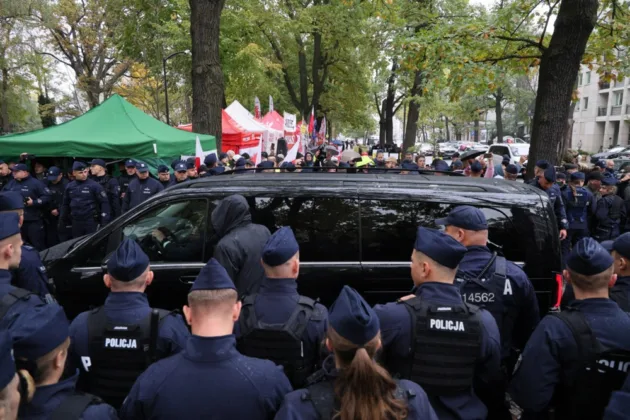
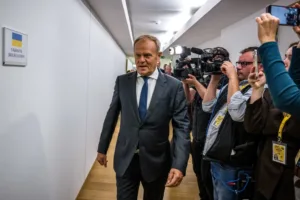





Returning from a meeting of EU leaders in Brussels, Polish Prime Minister Donald Tusk has said that Poland would not repeat the mistakes made by western European countries and that it was unwilling to pay any price for those errors.
On October 16, at the invitation of the leaders of Italy, Denmark and the Netherlands, Tusk took part in an informal meeting on migration before joining the European Council’s working session.
Tusk set out his centre-left coalition government’s position on October 18 in a post on social media platform X listing what he described as Poland’s tough approach to migration.
“We are firmly defending the border against illegal migration; we have our own asylum policy of not accepting applications and we deport those who break Polish law,” he wrote.
“On security, we will be ruthless,” he continued. “That is what European leaders heard from me in Brussels.”
The Polish government argues that its measures have been effective in preventing the illegal trafficking of migrants, with its own data showing that attempted border crossings from Belarus fell from around 15,500 in the first half of 2025 to fewer than 250 in the same period this year, a drop of over 98 per cent.
Tusk’s administration also now boasts of achieving a 100 per cent success rate in apprehending migrants who manage to cross into Poland illegally.
The present government also claims that it has secured an exemption for Poland from the EU migration pact because of Poland’s absorption of a high number of refugees from the ongoing war in Ukraine.
In fact Poland has received a waiver that runs for one year but is not, unlike the southern Europeans, a country that is to receive solidarity as a result of a heightened risk of illegal migration. The European Commission placed it instead among the member states it judged to be under cumulative migratory pressure, alongside Austria, Bulgaria, Croatia, Czechia and Estonia, and is to reassess the exemption each year.
It is therefore possible that in future years Poland will either have to absorb redistributed illegal migrants from other EU states or will have to make a financial contribution to those countries if it refuses the reallocation of migrants.
In another move, the Tusk government’s interior ministry on October 16 withdrew a proposal to make it a criminal offence, punishable by up to three years in prison, to provide support to migrants who are in the country illegally.
It did so following opposition from the Left Party inside the government and criticism from human rights organisations.
Under current Polish law, anyone who facilitates the illegal stay of a person in Poland in exchange for financial or personal benefit can be jailed for up to five years.
The interior ministry had proposed to toughen up the law by penalising anyone who knowingly “enabled or facilitated” the illegal stay of someone in Poland, even if not for financial or personal benefit. The offence would have been punishable by up to three years in prison.
The interior ministry had argued that the legislative proposal had been intended to clamp down on migrant smuggling. But activists feared it would criminalise humanitarian aid, such as that provided to migrants who have irregularly crossed the border from Belarus.
The government felt that the existing legislation provided a loophole under which, under the pretext of helping migrants, it was possible to aid them in their illegal stay, providing an incentive for further illegal migration.
That prompted protests from the human rights lobby, which argued that the law could be used against volunteers and residents of border areas who provide humanitarian aid, in the form of food, water, medical treatment, clothing or shelter, to migrants who have crossed illegally from Belarus.
Agnieszka Dziemianowicz-Bąk, MP, who serves as labour and social policy minister for the Left Party, a junior member of Tusk’s governing coalition, expressed her “strong opposition” to the interior ministry’s proposals on social media on October 14.
Poland’s commissioner for human rights (Ombudsman-ed.), Sylwia Gregorczyk-Abram, wrote to the justice ministry that same day to “express concern” that the proposed changes “could lead to criminal liability for charitable or humanitarian activities undertaken towards individuals whose residence status has not yet been regulated”.
In response to the interior ministry’s proposal, 61 organisations, including Amnesty International, the Helsinki Foundation for Human Rights and the Auschwitz-Birkenau Foundation, signed a joint statement condemning the plans, which they said “violate international standards binding Poland”.
The organisations warned that the proposed wording could expose medical staff treating migrants, lawyers providing legal assistance, facilities working with children, and organisations supporting victims of human trafficking to criminal liability.
They rejected the argument that the interior ministry’s proposed legislation was aimed at smugglers but rather at activists and residents of border areas who provide humanitarian aid to individuals who enter Poland.
Five such Polish activists who were prosecuted for providing food, clothing and shelter to a group of Middle Eastern migrants who had entered Poland from Belarus in 2022 were acquitted in September 2025, with the ruling becoming final in March this year after an appeal.
The government’s legislative proposal to criminalise any aid to illegal migrants would have ensured in future that in such cases the activists would be convicted.
In response to the growing criticism, the interior ministry announced on October 16 that it was withdrawing the proposal, saying it decided to do so “to eliminate any doubts and prevent the misinterpretation of regulations”.
“From the beginning, the ministry’s sole objective has been to tighten the system and target the organisers of this practice [of migrant smuggling],” stated the ministry in announcing its U-turn on the proposal.
“Legal provisions must effectively protect the state’s borders against organised crime, while simultaneously fully safeguarding humanitarian values and life-saving activities.”
Both the former Conservative (Law and Justice, PiS) Polish government (2015-2023) and the current Tusk administration, which took power in December 2023, have regularly faced criticism from human rights groups over their response to the migration crisis on the Belarus border. Those groups have maintained that the illegal migrants are often victims of trafficking groups and desperate individual plight.
Research carried out by both the last PiS government and the present Tusk administration though suggests that most of the migrants who had reached the border with Belarus had done so after paying large amounts of money to travel by air to Belarus from the Middle East and then to traffickers for helping them across the frontier.
Though the Conservative (PiS) opposition and other right-wing parties have supported the Tusk government in its border clamp-down, Tusk’s Civic Coalition (KO), when it was in opposition to PiS, had challenged PiS’s border policies, claiming that they were cruel and inhuman.
Several KO deputies visited the border with human rights groups and in one case a Tusk party MP attempted to run past border guards to deliver aid to illegal migrants standing on the other side of the border. The party also questioned the need to build a border fence to stop the illegal migration.
Tusk signalled a shift in his attitude to migration in 2023, just ahead of the parliamentary elections that saw him and his coalition partners win a parliamentary majority, when he attacked the PiS government for having issued hundreds of thousands of work and Schengen visas.
After coming to power he doubled down on the PiS policies on illegal migration by fortifying the border fence and later suspending asylum claims on Poland’s border with Belarus. These policies have been praised by the European Commission, whereas less stringent measures taken by the PiS government and the last Hungarian conservative administration led by former Hungarian prime minister Viktor Orbán drew infringement action from Brussels — in Hungary’s case a €200 million fine imposed by the European Court of Justice in June 2024 for breaches of EU asylum law.
Earlier this year, the previous human rights commissioner, Marcin Wiącek, expressed concern over the ban on asylum claims introduced in March 2025. He noted that the measures had been described as a temporary solution, but have remained in place ever since and that there were no signs that they would be lifted.
Since 2021, tens of thousands of illegal migrants, mainly from Asia and Africa, have attempted to cross Poland’s eastern frontier with the encouragement and support of the Belarusian authorities.
Poland and the EU have consistently accused Belarus of weaponising migration as part of alleged “hybrid warfare” waged by Russia and its allies against European countries.
The illegal migrants have sometimes used violence against Polish border guards and soldier, with two fatalities among the security forces resulting from those assaults. Human rights groups have alleged that several illegal migrants had died during their attempts to reach Poland in the forests and the river on the border because of the “push-back” policy pursued by the PiS and Tusk governments.
The crisis on Poland’s border with Belarus has eased not only because of the tough stance taken by the Polish authorities. The Belarusians themselves have of late attempted to enter into dialogue with both the US and Poland.
As a result several Polish minority activists who were in jail in Belarus have been released and Polish and Belarusian foreign ministers have met for the first time since the allegedly fraudulent presidential election in Belarus in 2020 that led to mass protests against the government led by President Alexander Lukashenko.
Belarus remains a close ally of President Vladimir Putin’s Russia, but it has kept its troops out of Ukraine and has maintained relations with Ukrainian President Volodymyr Zelensky as Lukashenko attempts once more to be a potential broker in future peace talks to end the war in Ukraine.
The Tusk government’s U-turn on criminalising aid to illegal migrants comes ahead of discussions within the ruling coalition about fielding a joint slate of candidates in the 2027 parliamentary elections and at a time when the border with Belarus has become much calmer than was the case at the height of the crisis in 2021-2023.