



As Poles were preparing for All Saints Day on November 1, the day when Polish families honour the dead by visiting their graves, the ruling centre-left coalition government has been accused of seizing the constitutional court with the use of force exercised by the police.
Rumours had been circulating that the government would implant judges it supported and the opposition-aligned President Karol Nawrocki had opposed into the constitutional court by force. Law and Justice (PiS) supporters have been camped outside the top court’s grounds for weeks with the aim of preventing that from happening.
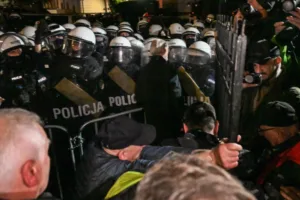
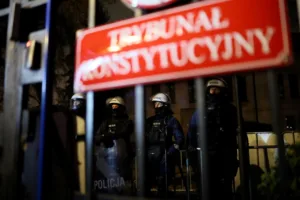
On the evening of October 30, police in full riot gear carrying shields and batons entered the grounds of the constitutional court from the direction of Prime Minister Donald Tusk’s chancellery and secured the gate from inside with a chain. Police later said no officers had entered the building itself.
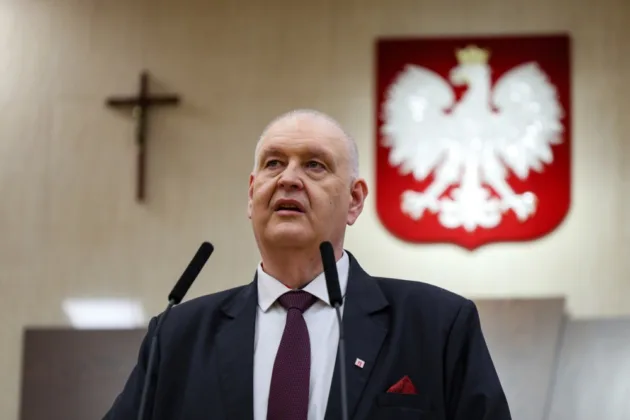
The chief justice of the top court Bogdan Święczkowski was prevented from entering the building of the court he leads, even after his supporters had cut through the chain on the gate with a power tool.
The police authority issued a statement claiming that the operation was carried out in response to requests from justice minister and prosecutor general Waldemar Żurek and one of the individuals elected onto the court by parliament as a result of alleged threats to the security of the building and safety of judges. The same evening, Żurek said he had sent the court five motions to lift the immunity of Święczkowski and his deputy.
Judges elected during the lifetime of the previous conservative PiS government were prevented from entering the building while individuals elected by Tusk’s majority in parliament but who were refused the oath of office by Nawrocki took over the court. Security staff of the court and many other members of staff remained outside.
On learning of events unfolding in Warsaw on October 30, Nawrocki ordered the head of state’s plane, which was on the way to a state visit in Senegal, to turn back home. The aircraft turned around over Málaga, southern Spain, and landed in Warsaw shortly before 10pm.
”At such a moment, the President must be in Poland. I am cutting short my flight to Senegal. I am returning,” Nawrocki said on X amid a long-running dispute over the constitutional court.
On arriving back in Poland Nawrocki immediately went to meet with his aides and with the First President of the Supreme Court (SN) Zbigniew Kapiński and the chief justice of the constitutional court Bogdan Święczkowski, who both called the action taken by the government a “coup d’état”.
Poland’s Supreme Court is the top court in matters of all criminal, civil, labour and family law whereas the constitutional court (Trybunał Konstytucyjny, TK) adjudicates on the constitutionality of legislation and the use of executive powers.
The President later went to visit the constitutional court building, during the night of October 30-31, where he was jostled by two judges-elect of the constitutional court while entering the building, according to presidential aide Marcin Przydacz, who named them as Krystian Markiewicz and Anna Korwin-Piotrowska.
Tusk’s former cabinet minister Maciej Berek, who was recently elected to serve on the constitutional court, accused the head of state of physically attacking Korwin-Piotrowska while entering the building. Film footage of the incident suggested that there had been an attempt to block the head of state from entering, despite the fact that Korwin-Piotrowska had told the media in advance of the President’s visit that he would be allowed into the building.
Politicians from Tusk’s ruling Civic Coalition (KO) though persisted in distributing an AI-generated image which showed Nawrocki in an aggressive posture. Among those who shared it was Paweł Olszewski, the deputy digital affairs minister, whose brief includes combating disinformation. The Polish fact-checking organisation Demagog confirmed the image was not genuine.
The lack of intervention by Nawrocki’s bodyguards during the incident was commented on by Krzysztof Stanowski, the owner and founder of broadcaster Kanał Zero. On X he said he did not understand “how the state security service did not stop a woman who calls herself a judge trying to manhandle the head of state. Why did they not apprehend her?”
In Poland the head of state is protected by the State Protection Service (SOP), which is controlled by the government rather than the head of state.
Żurek though accused the President of having used force to enter the building and sent a prosecutor to the building, saying that “immunity does not excuse illegal use of force”. In Poland the President can only be held criminally liable before the Tribunal of State (TS), a body elected by parliament which has the power to put on trial the highest officials of state for violations of law and the constitution. An indictment requires a two-thirds majority in the National Assembly, the Sejm and Senate sitting jointly.
Tusk wrote on X in defence of the action: “Restoring the rule of law is our duty. After years of lawlessness under PiS this is a difficult—at times painful—process that requires decisive action. There is no other way.”
On October 31, in a televised address to the nation, Tusk attacked Nawrocki and accused him of attempting to take over the constitutional court with the use of force, claiming that politicians, even if they are the head of state, cannot enter any public building at will.
His party and two other groups in the ruling coalition — the Left and the Centre (Centrum) club — did not meet Nawrocki, who had invited all parties to meet him on October 31. They argued that it was Nawrocki who had caused the crisis in the constitutional court.
Two more parties that make up the Tusk government, the centre-right Polish People’s Party (PSL) and the centrist Poland 2050 party, did meet the head of state and told reporters that there was a need for compromise. PSL leader and deputy prime minister Władysław Kosiniak-Kamysz said he had long proposed a “constitutional reset” of the court.
Tusk rejected any such notion in his address to the nation. “In certain matters there can be no compromise,” he said, meaning with the former ruling PiS, which he alleged had usurped power when it was in office.
In fact some politicians from the opposition Confederation and Development Plus (Rozwój Plus) parties had proposed a constitutional reset by which a new membership of the constitutional court would be elected by a three-fifths majority to ensure compromise between government and opposition. Their proposals were rejected some weeks ago. Confederation, PiS, Development Plus and the left-wing Together (Razem) party also met Nawrocki on October 31.
One of Poland’s senior diplomats, Jakub Kumoch, who was until October 30 Polish ambassador to China, decided to resign over the government’s move.
“In light of developments at home, I have concluded that I can no longer continue serving as Poland’s ambassador. Today, I submitted my resignation and requested to be recalled,” stated Kumoch on X. He later told Nawrocki that he had been instructed to convey a diplomatic note on the events in Warsaw which, in the view of the ambassador, was a false account of events.
On October 31 Poland’s ambassador to Romania Paweł Soloch resigned in protest at the Tusk government’s takeover by force of the constitutional court.
Deputy prime minister and foreign minister Radosław Sikorski described Kumoch’s departure as an “unprofessional” end to his mission and accused the presidential palace of pressuring diplomats to quit.
Kumoch’s and Soloch’s move recalled events in 1981, when the then Soviet-backed communist authorities imposed martial law in Poland to crush the Solidarity movement. The crackdown led to dozens of deaths and some 10,000 people being interned, and Poland’s ambassadors to the US and Japan resigned and defected to the West.
“As of today, Poland is becoming a police state, and from there it is only a short step to authoritarianism and then totalitarianism,” said Jarosław Kaczyński, leader of PiS, the largest opposition party, commenting on the police entering the constitutional court.
“I had serious doubts about whether chief justice Bogdan Święczkowski’s assessment of a creeping coup d’état by the Tusk government was correct, but today I no longer have those doubts,” the constitutional court’s deputy chief justice Bartłomiej Sochański told reporters.
Jerzy Kwaśniewski, who leads the Ordo Iuris conservative legal think tank, condemned the action taken by the Tusk government.
He called it an action “taken under the cover of the night in the absence of the head of state” in which Korwin-Piotrowska, one of the judges elected by parliament who has not taken her oath of office in front of the President, signed an order under which she claimed she was taking over running the court. The order imposed a one-month suspension on Święczkowski and Sochański, citing provisions that apply to ordinary judges.
Korwin-Piotrowska, who declared herself the acting chief justice of the top court, said her actions were justified by “overriding constitutional necessity” and accused Święczkowski of a range of improprieties including preventing the court’s General Assembly from being convened.
She also accused Święczkowski of preventing five judges — whose status Święczkowski does not recognise — from adjudicating, as well as of violating the rules for appointing judges to hear cases and of sidelining cases of civil importance to prioritise others for political reasons.
Critics argue there is no legal basis for Święczkowski’s suspension from office. Under the constitution, it is the President as the head of state who appoints the chief justice of the TK from candidates nominated by the members of the court.
Some of Tusk’s former allies such as law professor Marcin Matczak opposed the move, saying it was illegal because the minister and the common courts had no right to exercise oversight and control over the TK.
“I consider Bogdan Święczkowski to be the worst person to serve as the president of the TK,” wrote Matczak. “I never thought I’d end up defending him, but the legal basis for suspending Święczkowski is nonexistent.”
“Images of armed police and legal interpretations according to which the minister of justice can remove the president of the Constitutional Court by decree will have a powerful, anti-rule of law backlash for years to come,” he added.
According to Ordo Iuris, the government’s actions have “violated the principles of the separation and balance of powers and bear the hallmarks of intervention by force of the executive in the functioning of the judiciary”.
Kwaśniewski added that no one can be a justice of the TK until they have taken their oath of office before the President and that there was no legal process for suspending the chief justice of the TK. Therefore, Korwin-Piotrowska was a self-declared usurper, he said.
Kwaśniewski reminded those responsible for the action taken in the TK that Polish law imposes penalties of up to 20 years’ imprisonment for “removing a constitutional organ of state by force”.
The Ordo Iuris lawyer though admitted that he had little hope that international bodies such as the EU, the Council of Europe and the Organization for Security and Co-operation in Europe (OSCE) would take a stance on the matter, despite past expressions of concern over the state of the rule of law in Poland.
This point was also made by Wojciech Konieczny, an MP from the opposition left-wing Together party, who told Kanał Zero that “if these actions that we saw in Warsaw tonight had been taken by the previous PiS government Ursula von der Leyen and the European elites would be up in arms issuing protests and making threats of sanctions.”
He was referring to the fact that ever since the return to power of Tusk, European institutions have been silent on alleged breaking of the law and the constitution by the liberal government. Only the present US administration has expressed any concerns.
The European Commission withheld tens of billions of euros in funding for Poland over accusations of democratic backsliding and politicisation of the judiciary under PiS. In February 2024, weeks after Tusk returned to power, European Commission President Ursula von der Leyen announced in Warsaw the release of up to €137 billion in frozen EU funds.
The Commission’s response to the latest events came within hours. On October 31 the EC in its statement backed Tusk’s action.
“It is for the Polish authorities to ensure that the Constitutional Court can function in accordance with the Polish constitution and in respect of the relevant case law of the European Court of Justice,” a Commission spokesperson told Euronews.
“The appointment of eight new members of the Constitutional Tribunal lies within the constitutional power of the Sejm,” the spokesperson added, referring to the lower house of parliament.
The spokesperson also pointed to the European Court of Human Rights, which on May 5 issued interim measures requiring the competent Polish authorities “to refrain from hindering the taking up and exercise of judicial duties by judges appointed by Parliament in March 2026”. The case was brought by four of the judges concerned, including Korwin-Piotrowska and Markiewicz.
US ambassador to Poland Tom Rose took a different line and expressed concern at events unfolding in Poland.
“The events unfolding tonight at Poland’s Constitutional Tribunal are very serious indeed. We appear to be witnessing an unprecedented confrontation over the government’s use of state power and the independence and authority of a constitutional institution,” he wrote on X on October 30. He added that he hoped the situation would be resolved peacefully and, in contrast to the EC, said that it was a matter for Poland internally to agree on its judicial arrangements.
Judicial independence became one of Tusk’s main campaign pledges in the 2023 parliamentary election that brought his coalition government to power.
Tusk has been accused by domestic critics of creating more judicial chaos because his government has questioned all judicial appointments made during the lifetime of the last PiS government. This is despite the fact that both the European Court of Justice and the Venice Commission of the Council of Europe have said that there should be no collective responsibility in dealing with any doubts over the legitimacy and independence of judges.
The political dispute over the Polish constitutional court, which has been ongoing since 2015, has effectively paralysed the institution.
It started in 2015 when the outgoing parliamentary majority led by Tusk’s Civic Platform (PO) decided to elect two justices ahead of schedule, ie before the expiry of the terms of office of the judges leaving the court. Tusk had by then left Polish politics to serve as President of the European Council.
In response the incoming PiS majority in parliament decided to nullify that election along with three other justices elected by the previous parliament, whose election it claimed was flawed because of procedural irregularities.
This was contested by both the liberal opposition and EU institutions.
On returning to office in December 2023, Tusk’s liberals decided to stop publishing constitutional court rulings on the grounds that the membership of the court was illegitimate. The government stopped publication following a Sejm resolution in March 2024.
After losing the presidential election in 2025, when their candidate Rafał Trzaskowski was defeated by Nawrocki in the June 1 run-off, Tusk decided that instead of boycotting the court he would take advantage of a number of vacancies having built up over the previous two years. Parliament has elected eight new nominees to the top court: six on March 13, one in June and Berek on September 4.
Nawrocki has refused to take the oaths of office from five of these appointees on the grounds that four of them were being elected well after the terms of office of their predecessors had expired and one, Berek, did not meet the legal criteria of having served the required 10 years of experience as a practising attorney.
The President’s decisions have led Święczkowski to refuse to allow the five judges to take up their offices at the court.
In doing so, he ignored the interim measures issued by the European Court of Human Rights, arguing that the ECHR had no authority to issue such a ruling.
The Tusk government argues that the President had no right to refuse to take oaths of office and that it is up to parliament to elect whom it wants to the court and that it alone decides whether the candidates are qualified for office.
The PM said the judges had been chosen “in accordance with the law, the Constitution and good practice,” and that Nawrocki’s refusal to receive their oaths meant the President was “renouncing the duties” imposed on him by the Constitution.
That remark has led PiS to argue that Tusk was planning to use his majority on the constitutional court to strip the President of his powers and even to suspend him from exercising his office, since the TK does have the power to rule that the President is unable to perform the duties of office.
Former PiS-aligned president Andrzej Duda told Kanał Zero that the stand-off over the constitutional court would damage Poland’s international position at a time when the country was negotiating the setting up of a permanent US military base and seeking membership of the G20 group.
The opposition in Poland now fears that Tusk will move to take over the central bank (NBP) after parliament votes to prosecute the bank’s head Adam Glapiński before the Tribunal of State. Sejm Speaker Włodzimierz Czarzasty has said the vote is planned for the second half of November. The opposition asserts this will mean Glapiński will be suspended, whereas the central bank and the European Central Bank maintain that no suspension is possible without violating the independence of the NBP.
Since Tusk is blocking the appointment of Nawrocki’s nominees to the board of the NBP, it is feared the government could appoint its own commissioner to govern the central bank in the run-up to the 2027 parliamentary elections. Critics say it could thereby seize the gold and currency reserves of the country in order to give itself headroom for popular spending ahead of the poll.
Some, such as Stanowski, question whether Poland will remain a democracy because of the Rubicon that has been crossed by the use of force in the taking over of the top court.
“For the first time in my adult life I fear that our democracy may not survive because what has been done by Tusk’s government means that its officials now face the danger of going to prison if they lose the election and therefore may not wish to take the risk of holding one, or of using the apparatus of the state to ensure the result the government seeks,” he said.
The constitutional court, now under the control of judges elected by Tusk’s majority, is refusing to admit judges elected during the lifetime of the PiS government to the building. It is due to hold a General Assembly of judges on November 3, to adopt the court’s budget.
In the meantime right-wing opposition politicians have been pleading with parts of the ruling coalition to back a constructive vote of no confidence in the Tusk government in order to stop what they consider to be a creeping coup.
According to the Polish constitution, for a government to be voted out of office in parliament there has to be a constructive vote of no confidence which names the new Prime Minister. Since the current constitution was adopted in 1997 there has not been any instance of a constructive no-confidence motion succeeding.
The President can only dissolve parliament if it fails to agree the state budget, if it fails to form a government or if it votes by a two-thirds majority for its own dissolution. There has only been one instance in the last 30 years, in September 2007, when parliament voted to dissolve itself and hold an early general election.