




The Central European Visegrad Group (V4), composed of Poland, Hungary, Czechia and Slovakia, has signalled that it plans to work together to challenge any proposed policies within the EU that lead to higher energy prices.
The Visegrad Group was established on February 15, 1991, in the Hungarian town of Visegrád by Poland, Hungary and Czechoslovakia. Czechia and Slovakia inherited Czechoslovakia’s place after its 1993 split.
The group has no formal institutional structure, relying instead on consultations among prime ministers and government ministries, with cross-border initiatives forming a central pillar of its work.
The informal structure means that its effectiveness depends on the political will of the four governments to work together. That will was reduced after the Russian invasion of Ukraine when relations between Poland and Hungary, two key members of the Visegrad Four, cooled markedly and when Donald Tusk, who is Prime Minister of a centre-left government in Poland, clashed regularly with the then Hungarian PM Viktor Orbán.
But with the arrival of the new Prime Minister in Hungary, Péter Magyar, whose Tisza party won the April 12 general election, Tusk has decided to try to revive the grouping in order to pursue some common goals inside the EU on energy policy and migration.
Slovakia, which currently holds the rotating V4 presidency, organised a gathering in its capital Bratislava on September 10 with the aim of restoring the group’s visibility and influence within the EU. As part of that push, Bratislava extended an invitation to Irish Prime Minister Micheál Martin under the so-called V4+ format, which brings outside leaders into selected talks.
The Bratislava meeting followed a late-June gathering in Gödöllő, northeast of Budapest, held as Budapest wrapped up its one-year term at the helm of the group. That session, coming soon after a change of government in Hungary, was widely viewed as reviving regional cooperation after a period of dormancy.
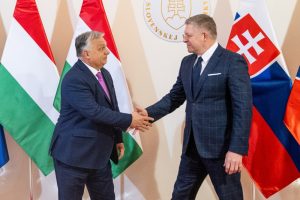
Tusk was joined by Slovak Prime Minister Robert Fico, Czech Prime Minister Andrej Babiš and Magyar, who all used the meeting to warn Brussels against any measures that would raise energy costs in the region.
The Polish PM said the bloc’s emissions trading schemes, which he named as ETS1 and ETS2, would face resistance if they threatened to push up prices.
“Anything that introduces the risk of more expensive energy for us will be blocked by us,” he said, describing the stakes as “a matter of life or death” for both the Visegrad Group and the EU.
ETS2, an extension of the EU’s Emissions Trading System to fuels used in buildings and road transport, is due to start on January 1, 2028. Its launch was postponed by a year under a deal agreed in November 2025 to win over member states including Poland.
Fico echoed that message, saying the four countries were aligned on electricity prices and emissions trading rules and would keep pressing Brussels to bring costs down. He said Slovakia generated about 85 per cent of its electricity without emissions and was a net exporter, yet companies there paid more than €100 per megawatt-hour.
Hungary’s Magyar went further, telling the gathering that state subsidies propping up fuel prices across much of Europe were no longer sustainable given the prolonged crisis in the Strait of Hormuz.
“State budgets don’t have the means to keep subsidising and keeping prices lower. We agreed we cannot continue in this direction,” he said.
The energy dispute formed the backdrop to broader talks on the EU’s next multiannual budget, covering 2028 to 2034, which Martin attended as part of his country’s six-month presidency of the Council of the European Union.
The European Commission’s original proposal amounts to nearly €2 trillion. Net contributors such as Germany, the Netherlands and Denmark want hundreds of billions of euros cut from it, according to Irish broadcaster RTÉ.
Fico said that the four leaders wanted the bloc’s cohesion and agricultural funding left intact, insisting that “the specificity of each of our countries” be taken into account.
Babiš called for a budget that is “fair and balanced” and that reflects differing levels of economic development among member states.
Martin, for his part, said finalising the budget was among the presidency’s most urgent tasks and that Ireland would circulate a fresh proposal within weeks based on consultations with member states, ahead of a meeting of EU leaders in October.
He also placed EU enlargement high on his agenda, saying candidate countries should be able to advance “as quickly as possible” once they complete the necessary reforms, and calling enlargement “a great investment for the whole of Europe”.
The enlargement issue is one that is complex for the Visegrad countries. While there are few objections to enlargement in the Balkans, there are question marks about the proposed enlargement to Ukraine, centred on the size of the country, the ongoing war, corruption, historical disputes about past conflicts and the fear of competition from its huge agricultural sector.
Magyar said in Bratislava it would be unfair for Ukraine to progress towards membership faster than other candidate countries.
Migration also featured prominently in the talks held by the Visegrad Four with Martin.
Babiš argued the Visegrad states had flagged the problem of illegal migration to the rest of the EU as far back as 2016 without being heeded. “They only woke up now, after 10 years, and for some countries that may already be too late,” he said.
Tusk, meanwhile, pointed to what he said were nearly two million Ukrainian refugees Poland has taken in and to what he called continuing Russian pressure, sabotage and provocation, arguing the war remains “a real problem” rather than an abstraction for the region.
He also said Poland had cut illegal crossings on its eastern border from nearly 20,000 a month when he took office to almost zero.
In order to signal his desire to make the group more important inside the EU, Tusk declared that it could shape the future of the EU.
“The future of the Union will largely play out in Warsaw, Budapest, Prague and Bratislava,” Tusk told reporters at Bratislava Castle, crediting the Visegrad Group’s cohesion with helping the region integrate into the EU “not only politically, but also in economic and civilisational terms” after the fall of communism.
The meeting seems to point to a revival in the desire of all four countries to use the Visegrad Group within the EU to lobby for common goals. The history of these four states since the fall of communism, though, is of looking to the West to build alliances with the stronger EU states rather than among each other.
The Three Seas Initiative, launched in 2016 by former Polish President Andrzej Duda and his then Croatian counterpart Kolinda Grabar-Kitarović, attempted to inspire the countries that lie between the Baltic, Adriatic and Black Seas to work on common projects to give the EU a north-south as well as an east-west axis. It never took off despite considerable efforts from the then Law and Justice (PiS) government in Poland, including the presence of US President Donald Trump at its summit in Warsaw in 2017.
Undoubtedly it is the thaw in Polish-Hungarian relations which has opened the door for increased cooperation. Tusk and Magyar are both members of the same European political family, the European People’s Party (EPP), and although Babiš and Fico are not, they have no problem in working for common goals.
To increase its effectiveness, the group will need to join others to rally broader support, including informal groups such as the existing coalition of EU countries known as the Friends of Cohesion, which favours continued funding for cohesion policy.
That will not be easy as the countries may agree in principle about the direction of travel but not necessarily about the details, with some wanting more for cohesion while others may wish to concentrate on agriculture or other matters.