



Katarzyna Pełczyńska-Nałęcz, who until October 22 was Poland’s minister of development funds and regional policy in the centre-left coalition government led by Prime Minister Donald Tusk, has been recorded telling her party colleagues that the government knew that Maciej Berek, the former Tusk minister elected to the constitutional court, did not meet the legal criteria to be a member of that court.
Her account is likely to strengthen the resolve of opposition-aligned Polish President Karol Nawrocki to maintain his position of refusing to sign the nomination for Berek after the Speaker of the Sejm — Poland’s lower house of parliament — Włodzimierz Czarzasty refused the President access to data on Berek’s qualifications.
Tusk and his government claim that the President has no right to refuse to take the oath of office from someone elected by parliament to the constitutional court, whereas the head of state argues that he can only accept candidates who fulfil legal criteria for membership of the constitutional court.
According to the law any candidate to be a member of the top court should have at least 10 years’ worth of practice in the legal profession. According to reports in the Polish media Berek does not meet that criterion but argues that his time in public administration amounts to equivalent experience, even though the law does not envisage such a transfer of skills. Berek stood down as Tusk’s minister for parliamentary affairs in August 2026, when he was put forward for the court.
In recordings revealed on October 25 by the independent opposition-leaning television broadcaster wPolsce24, Pełczyńska-Nałęcz is heard protesting at the way the Berek case was handled by the government. Their authenticity has not been independently confirmed and she has not publicly commented on them.
“I respect Maciej Berek, but he is a politician who has gone straight out of government to the constitutional court. We have called for the depoliticisation of the top court and then elected an active politician to it. What’s worse, one that does not meet the formal criteria for the membership of that court,” she says.
According to deputy Speaker of the Sejm and a joint leader of the libertarian nationalist Confederation party Krzysztof Bosak “the ruling majority has broken the law and an outgoing minister from the Tusk government has confirmed it.”
Bosak also accused Berek of behaving in an arrogant manner by refusing President Nawrocki’s request to submit evidence of his qualifications and by taking the oath of office without the President’s presence.
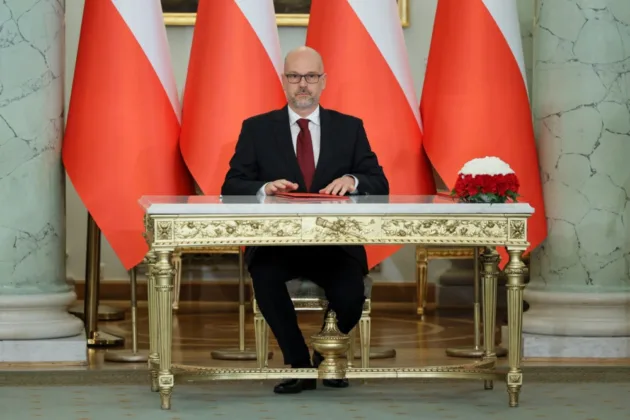
On October 14 Berek had gone to the Sejm to take an oath of office claiming that he was in this way fulfilling the legal requirement to take the oath of office. Though Nawrocki and the opposition as well as many lawyers claim that the law does not envisage the taking of the oath of office in front of anyone other than the head of state.
Berek immediately attempted to enter the constitutional court, but along with four other judges the President has refused to take the oath of office from, on the grounds that parliament had failed to elect them in line with the expiry of the terms of office of the outgoing justices to the top court, they were prevented from taking up office by the current chief justice of the court Bogdan Święczkowski.
The Tusk government has since 2024 been refusing to recognise the current composition of the top court, all of whose justices were elected during the lifetime of the last right-wing government, and has failed to publish any of its rulings. The stand-off is the latest phase of a rule-of-law dispute that has run since 2015.
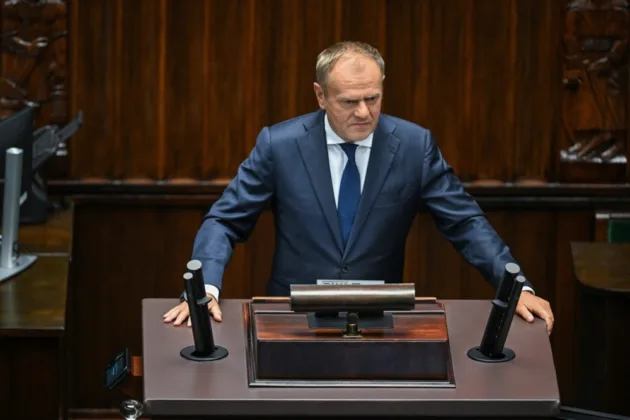
Tusk has on several occasions said that he would ensure that now that the majority of judges were elected by this parliament in which he has a majority the constitutional court “would resume to function properly and legitimately” and commentators expect that the Tusk majority on the court will attempt to invalidate a whole raft of judicial legislation passed during the last PiS administration and could attempt to constrict the powers of President Nawrocki.
Katarzyna Pełczyńska-Nałęcz was until October 22 leader of the centrist Poland 2050, a junior party in Poland’s ruling coalition, who announced her resignation from the government and the leadership of her party. A career diplomat, she served as Poland’s ambassador to Russia between 2014 and 2016.
She did so having lost control of her party which failed to take her lead in a parliamentary vote which attempted to remove the limitation of two five-year terms on local mayors. The Sejm rejected that bill, tabled by the PSL, by 215 votes to 213 with nine abstentions on October 22; six Poland 2050 MPs backed it, three opposed it and three abstained. Those limits had been introduced in 2018 with the aim of reducing corruption and cronyism by preventing local officials from becoming entrenched in power.
Even though the measure was not carried, Pełczyńska-Nałęcz felt strongly enough about the fact her party backed the rest of the Tusk coalition that she resigned from her posts.
“The coalition, unfortunately including a significant portion of MPs from Poland 2050, stood against the people and in favour of backroom political deals,” she wrote. “I am leaving Donald Tusk’s government because values are more important to me than government posts.”
Her party has remained in the Tusk government, thereby maintaining Tusk’s parliamentary majority and its leadership has now returned to the founder of the party, Szymon Hołownia who served as Speaker of the Sejm between 2023 and 2025.
Hołownia founded Poland 2050 as a centrist alternative to Tusk’s larger Civic Coalition (KO) just after running for President in 2020, an election in which he came third with 14 per cent of the vote.
Poland 2050 in 2023 allied itself with the centre-right Polish People’s Party (PSL) in the Third Way electoral alliance which managed to poll almost 15 per cent of the vote in the 2023 parliamentary election and entered the coalition government with Tusk’s KO and the Left Party with Hołownia becoming Speaker of the Sejm.
In 2025 Hołownia again ran for President with the backing of the Third Way alliance but came fifth with 4.99 per cent of the vote, which triggered the alliance to fall apart.
As his party fell sharply in the polls well below the 5 per cent threshold required for representation in a future election Hołownia gave up the Speaker’s chair — a requirement of the coalition agreement, which stated that in the second half of this parliamentary term the leader of the Left Party Włodzimierz Czarzasty would take it over — unsuccessfully sought the post of UN High Commissioner for Refugees and announced in September 2025 that he would not seek re-election as party leader, standing down when his term expired in January 2026.
Pełczyńska-Nałęcz’s election to lead Poland 2050 was contested bitterly and her unsuccessful rival for that position, climate minister Paulina Hennig-Kloska, on losing the election split the party and established her own grouping Centrum (Centre), which by February 2026 had 15 MPs. The first run-off, on January 12, was annulled after the party reported more than 26,000 unauthorised votes, and Pełczyńska-Nałęcz won the re-run on January 31 with 53.3 per cent.
Pełczyńska-Nałęcz’s position became untenable when the founder and former leader of Poland 2050 in the summer decided to come back and lead the parliamentary caucus of his party. There were also rumours afoot that he might replace Pełczyńska-Nałęcz in the Tusk government.
The outgoing leader of Poland 2050 had clashed repeatedly with Tusk on a range of issues and the PM made no secret of the fact he wanted to see her leave his administration.
On October 22 Tusk got his wish and Hołownia returned to lead Poland 2050.
“I am leaving the party in the hands of its founder, who stepped away but then returned”, said Pełczyńska-Nałęcz on leaving in a reference to Hołownia, adding that she hoped that he remembers what values he came to power in the name of.
On October 23 Tusk, who was visiting India, responded sarcastically to Pełczyńska-Nałęcz’s resignation by saying, “I thought she’d at least call before she left”.
He admitted that “cooperation with her has not been the easiest for a long time” adding that he “does not think her leaving will have any impact on the future work of the coalition. My intuition tells me that this is her individual decision”.
As Pełczyńska-Nałęcz departs Hołownia has to work fast to try and recover political ground for his party and to re-establish a partnership with the PSL or find a berth for him and his people on the joint government slate that Tusk is attempting to construct for the 2027 parliamentary elections.
His first move over the weekend of October 24-25 was to expel Pełczyńska-Nałęcz from Poland 2050 for “acting against the party’s interests and contrary to resolutions adopted by its statutory bodies”.
Pełczyńska-Nałęcz hit back at Hołownia portraying him as over-eager to please Tusk but that “the supreme leader will not be impressed”.
She took to social media platform X to claim that she had been “sentenced to exile for a thought crime”, promising recidivism in further free thinking.
Tusk’s KO leads in opinion polls on between 30 and 33 per cent but his current coalition partners are doing poorly with both Hołownia’s party and the PSL failing to reach the 5 per cent electoral threshold and the Left scraping together around 7 per cent of the vote.
The parties of the right — the former ruling Conservatives (PiS), Confederation, the Polish Crown Party led by Grzegorz Braun MEP together with the break-away Rozwój Plus (Development Plus) movement led by former PiS Prime Minister Mateusz Morawiecki — together took just over 50 per cent in a Social Changes survey published on October 24, though an Opinia24 poll conducted on October 5-7 put their combined support at 44 per cent.
Though should Tusk create a joint government list he would benefit from Poland’s d’Hondt seat allocation, which awards any party that establishes a big lead over its rivals, as PiS had done in 2015 and 2019 when it won parliamentary majorities even though it had not polled anywhere near 50 per cent of the vote.
While it is not yet certain Tusk will be able to achieve a unified government slate for the 2027 elections no one expects the parties of the right to stand on one slate, despite the efforts of President Nawrocki who sees all parties of the right as his potential allies.
Confederation and PiS are longstanding adversaries and Braun’s Polish Crown is positioning itself as an anti-system party. Only Morawiecki’s Rozwój Plus movement may prove willing to consider an electoral alliance with PiS.