


The Polish Government has blamed the country’s President for the stand-off over the Constitutional Tribunal, claiming that forces from abroad are backing the opposition’s campaign.
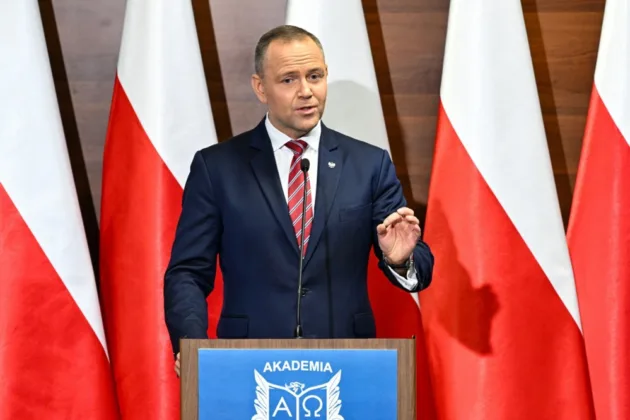
In a post on X on November 2, Prime Minister Donald Tusk said President Karol Nawrocki could end the dispute without any change to the Constitution. All he had to do, Tusk said, was recognise the judges elected by parliament and let them take their seats.
Instead, the Prime Minister claimed, Nawrocki had chosen a forced confrontation that could cost Poland dearly. He said a democratic state could not bow to violence, however powerful the outside forces supporting what he called an attack by Law and Justice (PiS), Confederation, right-wing politician Grzegorz Braun and the President.
Tusk had already pointed to Moscow on October 31. He cited former Russian president Dmitry Medvedev, who had described events in Warsaw as a coup and claimed that Tusk’s liberals, protected by Brussels, were oppressing PiS conservatives.
Foreign minister Radosław Sikorski echoed the claim on X, writing of an unprecedented level of online co-operation between Russian accounts, propagandists and right-wing movements around the world. He called it an evident alliance, or at least collaboration.
The crisis erupted on October 30, when Anna Korwin-Piotrowska suspended the tribunal’s chief justice Bogdan Święczkowski and his deputy Bartłomiej Sochański for a month. Korwin-Piotrowska is one of five judges elected by Tusk’s majority whose oaths Nawrocki has refused to receive.
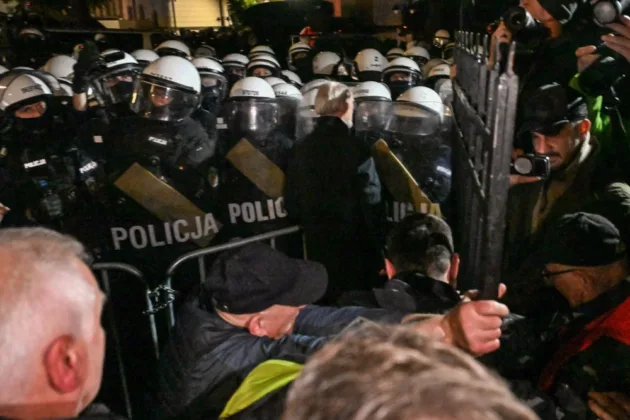
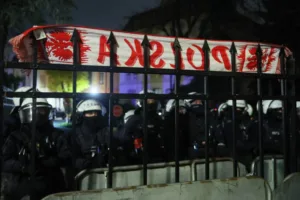
Riot police then sealed off the court grounds, though they said officers did not enter the building. Nawrocki, who turned back his plane en route to Senegal, called the move a forcible takeover of a constitutional body, while PiS leader Jarosław Kaczyński said Poland was becoming a police state.
The President argues that four of the five judges were elected long after their predecessors’ terms had expired. He says the fifth, former Tusk minister Maciej Berek, lacks the 10 years of legal practice required by law.
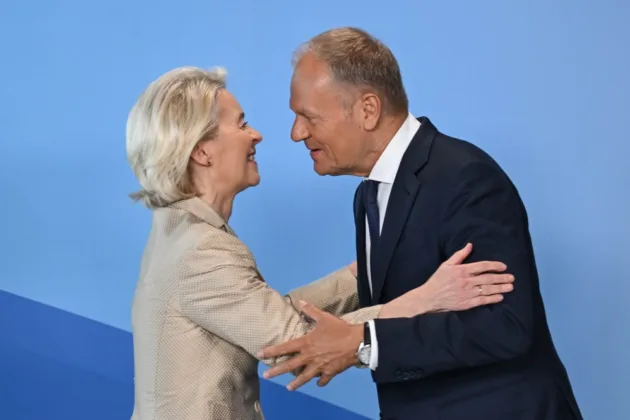
The European Commission has sided with the Polish Government in the dispute, saying the appointment of eight new judges fell within the powers of the Sejm, the lower house of parliament. Its statement did not address the suspension of the court’s president or the police deployment.
Critics have contrasted that with the Commission’s stance under PiS, when tens of billions of euros in EU funds for Poland were frozen over the independence of its courts.
Not everyone has been so accommodating. The Helsinki Foundation for Human Rights, a long-standing critic of PiS’s judicial reforms, said it saw no clear legal basis for the suspension.
US ambassador to Poland Tom Rose also voiced concern, describing an “unprecedented confrontation over the government’s use of state power”.