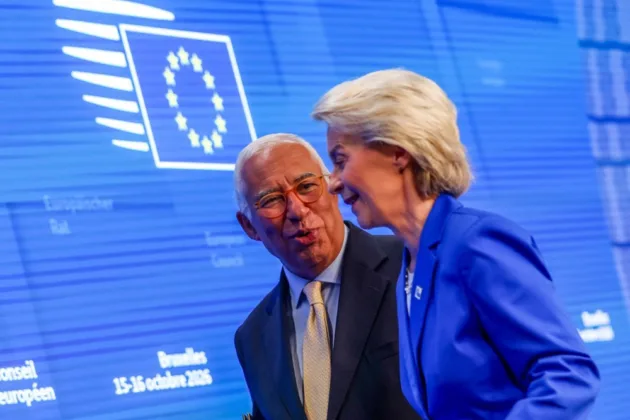





European Council President António Costa announced his goal for participation in upcoming talks over ending the war in Ukraine: “Europe must speak with one clear and united voice in all discussions that shape the future of Ukraine and the security of our continent.” A united voice generally requires a single representative with a single negotiating position. Sadly, the crack diplomats of Europe couldn’t agree on one or two delegates, so they compromised on seven: the national security advisers from Germany, France, Poland, Italy, Britain and reps from the European Council and Commission. Like the old saw about military prowess being inversely proportional to the splendour of the uniforms, so will Europe’s power at the negotiations be inversely proportional to the number of its representatives.
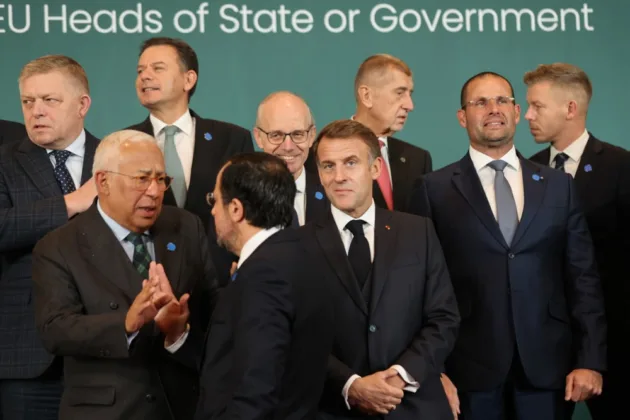
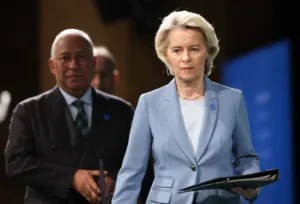
You may imagine a Europe that couldn’t figure out which of two EU presidents got to sit next to Turkish President Erdogan back in 2021 will have great difficulty in harmonising seven different opinions as the talks proceed. Who gets a chair at the table? France will never defer to an EU rep, Poland will never trust other Europeans to represent its particular suspicions of Moscow, while Germany believes its financial support for Ukraine should translate into diplomatic primacy. One can foresee protracted interludes during which Europeans meet separately to iron out a collective position while Russians and Americans play cards, check their phones, and wonder who the hell invited the Euros anyway. The only real agreement among Europeans was that under no circumstances would the EU’s ostensible foreign minister Kaja Kallas take part in the talks. Instead, Ursula von der Leyen will send her personal pit bull Björn Seibert, who may find his skill at twisting arms in Brussels overmatched by the feral ferocity of Sergei Lavrov. It’s not even clear at this point whether Russia will accept more than a single European delegate, which could mean a bench at the back of the room and a rotating European rep up with the adults. We may need a FIFA referee with an illuminated board to wave in the next substitute.
The failure to agree on a single rep reflects the absence of a unified, pragmatic European position on ending the war. Europe insists its views must not be ignored in any ceasefire talks, but doesn’t offer a goal more realistic than complete defeat of Russia, the restoration of all Ukrainian territory, and full reconstruction funded by Russia. This “deus ex machina” negotiating position may appeal to the moral vanity of European leaders, but obscures the painful tradeoffs needed to conclude any difficult negotiation. “Our adversary loses and its leader overthrown” is not a credible goal unless an alliance is actively at war and willing to pursue military victory, neither of which Europe is willing to contemplate. Instead Europe prefers to finance Kyiv and keep Ukraine in the fight indefinitely. How many more Ukrainians must die in the service of this policy?
Europe has yet to contemplate the consequences of its preferred outcome, the defeat of Russia. The last time Russia lost a major war, Europe got the Bolsheviks and the Gulag. Is there any real doubt that a total defeat in Ukraine and the demise of Putin would lead to a violent contest between the different factions vying for power, this time with a few thousand nuclear warheads rattling around? The relatively benign demise of the Soviet state in 1991 did not engender the docile, democratic oil and gas exporter of Europe’s dreams, despite the substantial aid and guidance provided by the West. Average Russians became convinced that economic reform meant immiseration for them and private jets for criminals. Gang shootouts across Russia, epic levels of corruption, and the impoverishment of citizens stripped of their employment and social support paved the way for an authoritarian response.
What is Europe’s plan this time, should Russia be defeated? Putin is no Gorbachev and his successor will be no Yeltsin. We are more likely to see a Kremlin dominated by the siloviki or the military, two groups marinated in toxic victimhood and the paranoid hostility to the West that Putin elevated to state religion. The “Common European Home” and a “rules-based order” hold no appeal to these men. They consider the arms control agreements reached in the immediate post-Soviet era a treasonous betrayal and the willful destruction of the only thing that the West respected: Russia’s military might. They will continue to employ antipathy toward the West as a useful means of imposing social and political cohesion on Russia. Defeat of Russia may bring down Putin, but will replace him with an equally brutal successor or unleash a civil war. Think Libya after Gaddafi, writ large across Russia, for the next decade.
Obviously, Putin is not preparing to negotiate his own demise, nor is he yet willing to concede Ukraine to the West. Conversely, Europe will not defeat Russia through negotiation. The participation of the EU-7 confers their acceptance of Russia as a negotiating counterpart and requires a willingness to act as something more than a proxy for Ukraine’s maximalist demands. At best the talks will ratify a ceasefire and a frozen conflict in the Donbas. Ukraine will remain dependent on cash subventions from the EU indefinitely. Will Europe consider this deal worth a relaxation of sanctions and the resumption of oil and gas sales? Seven different representatives may have seven different opinions.
Which is the great danger posed by this seven-headed European hydra: the opportunity it offers Putin to divide the Europeans with conditions acceptable to, say, France and Italy but anathema to Poland. The fissures in European support for Ukraine are clear, shown most recently in Germany’s threat to veto the EU budget over aid to Kyiv, and Russia will seek to exploit them. Tormenting the EU by revealing its diplomatic disunity is considered great sport in the Kremlin. A European negotiating team collapsing in acrimony would count as a victory.
Europe desperately wants to be “in the room where it happens” but enters not as a unified negotiating partner but as a fissile group of competing interests. Over 30 years after it was announced to the world, the common foreign and security policy remains a distant dream.