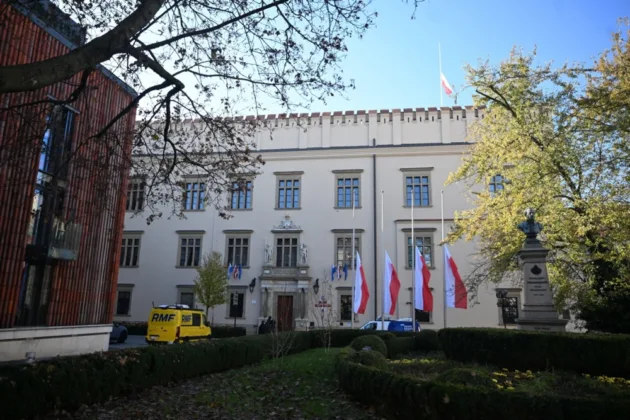
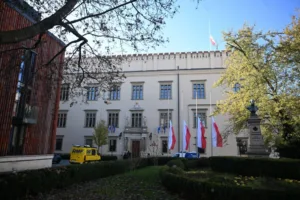

Every hour, a trumpeter on the taller tower of St Mary’s Basilica plays the hejnał over Kraków’s Main Square, and every hour the tune breaks off mid-phrase. According to legend, in 1241 the watchman sounding the alarm as the Tatars approached was shot through the throat by an arrow before he could finish.
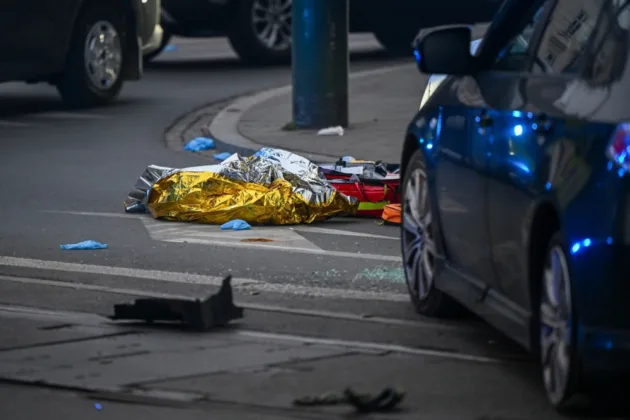
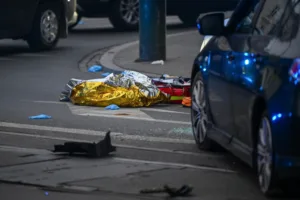
On November 7, at about 3pm, a masked young man in military-style fatigues drove a black Subaru onto that square and opened fire. Six people were killed, foreigners among them. On November 8 the regional governor’s office put the number of wounded at 17; two police officers were among them. Police say the first patrol began responding 23 seconds after the call; at about 3.03pm, officers exchanged fire with the gunman several streets to the south, wounding and subduing him. He died in hospital in the early hours of November 9, police said. In his family’s home in Ostrowiec Świętokrzyski, some 150km northeast of Kraków, police found three bodies: his parents and his sister. He held a firearms licence, and so did his father. The same day, prosecutors opened an investigation, treating the shooting as a terrorist offence; it also covers the three deaths in Ostrowiec. They have yet to disclose a motive.
By 6pm, Prime Minister Donald Tusk had appealed to politicians of all parties not to play politics with the tragedy. That evening his interior minister Marcin Kierwiński, who oversees the police, said that according to preliminary findings the attacker had acted alone, and that “everything indicates that he was fascinated by far-right ideologies, although this will be subject to verification”. The Associated Press headline left the caveat out: “Polish gunman who killed 6 people in Krakow has ‘ultranationalistic’ views, authorities say.” Kierwiński did not say what evidence supported his assessment. If investigators confirm it, Europe should hear it. The minister in charge of the police might have let them finish first.
Polish authorities have disclosed no evidence linking the gunman to Moscow. In May 2024, fire destroyed Marywilska 44, a Warsaw market hall with some 1,400 shops and stalls; a year later Tusk said it had been “arson ordered by the Russian security services”. On one night in September 2025, Russian drones violated Polish airspace some 20 times, and a missile apparently fired by a Polish F-16 hit a house in the village of Wyryki-Wola, eastern Poland. In November 2025, an explosive charge damaged the Warsaw–Lublin railway line, a route used for supplies to Ukraine; Tusk told parliament that the suspects, two Ukrainians working with Russian intelligence, had fled to Belarus.
In 2025, by NATO’s estimate, Poland spent 4.25 per cent of its GDP on core defence, the highest share in the alliance. According to a May report by the Internal Security Agency (ABW), 48 espionage investigations were opened in 2025, up from 21 a year earlier. The 69 opened in those two years match the agency’s figure for 1991 to 2023 combined, though a 2023 change to the espionage law makes the comparison imperfect. The report said 82 people had been charged in cases handled since Russia’s full-scale invasion of Ukraine in 2022.
In October, within two days, knife attacks at schools in Ostrołęka and Leszczydół-Nowiny, in the Mazovia region, left a caretaker dead and several people wounded. In Ostrołęka, the attacker carried a homemade explosive device that, according to the National Prosecutor, had come close to detonating. In Sierpc, police detained a pupil after classmates reported his threats to a teacher.
Before driving a hijacked lorry into Berlin’s Christmas market in December 2016, Anis Amri shot dead its Polish driver, Łukasz Urban. Nice, where a lorry killed 86 people that July, has since fortified its seafront promenade against vehicles, and German Christmas markets, attacked again in Magdeburg in 2024, now spend heavily on barriers. On November 7, despite traffic restrictions, a car could still be driven onto Kraków’s Main Square. That evening, Warsaw’s mayor said barriers were going up at the entrances to Krakowskie Przedmieście, part of the capital’s Royal Route.
In January 2024, police acting on a court order arrested Mariusz Kamiński, a former minister, and his former deputy, Maciej Wąsik, inside the presidential palace; the president considered them pardoned. On the night of October 30, as I wrote in these pages, police cordoned off the Constitutional Tribunal while members elected by the governing majority entered the building.
A Sejm committee on the Pegasus spyware bought in 2017, whose remit the Constitutional Tribunal had ruled unconstitutional, made referrals to prosecutors involving 11 people, among them two former ministers; in June, prosecutors charged three current and former officers of the Central Anti-Corruption Bureau. In October, the news portal Wirtualna Polska reported that prosecutors acting on a complaint from a senator expelled from Tusk’s party had seized the phone of a hospital director whose phone records showed contacts with one of its journalists, who had reported on the senator. The prosecutors confirm seizing a phone but say they did not seek the journalist’s own records.
Some of these decisions were taken by a court, a parliamentary committee or prosecutors rather than by ministers, and each has its defenders. Most grew out of the governing coalition’s fight with its predecessors. Abuses, where they are proven, belong in court; Germany’s federal criminal police (BKA) bought a version of Pegasus too, as a BKA official confirmed to a Bundestag committee in 2021, according to Die Zeit. I worry that officers will hesitate to use surveillance even when they have good grounds for it, and that a state Russia keeps testing will spend its investigators’ hours on its own quarrels.
The officers who answered the November 7 call did their job. Tusk was right to offer “the highest praise for the heroic police officers who acted at the risk of their lives”. The question for their superiors in Warsaw is what they have been asking of those officers, and of the services behind them, since December 2023.
On the night of November 7 the hejnał fell silent for 12 hours. At 9am the next morning it sounded again, breaking off on the same note.