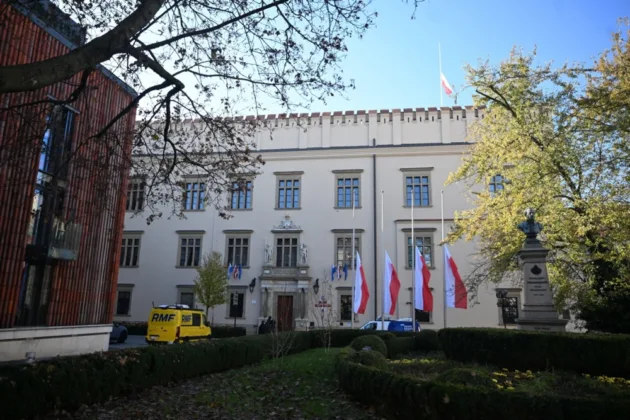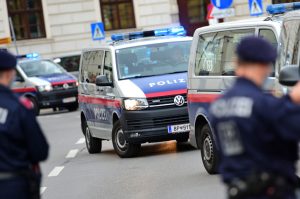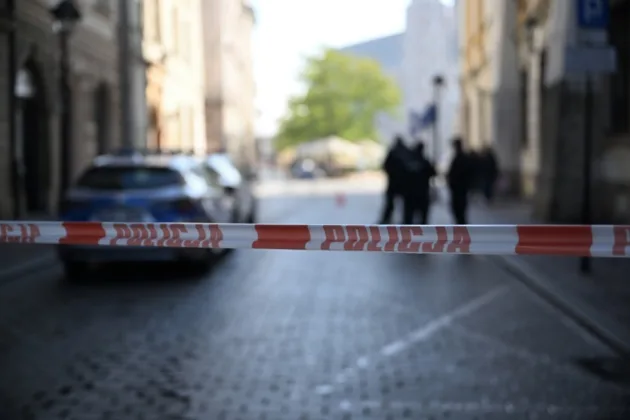





Six people, four women and two men, have been killed and 15 others wounded, including two police officers who were left in critical condition, during a shooting in the historic heart of Kraków, Poland’s second-largest city.
Among the dead were two foreign nationals, one from Britain and the other Austrian. There were also five foreigners among the wounded, from the UK, Germany, Portugal, Russia and Austria, according to the Polish interior ministry.
The Austrian victim, a 51-year-old woman from Lower Austria, was visiting the city with her husband, who was among the injured, Austrian authorities said.
It later transpired that the shooter had also killed his family back at home before launching his deadly attack on random passers-by in Kraków city centre.
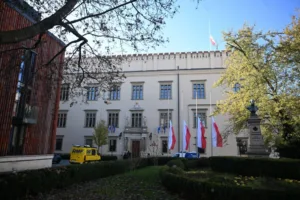
On November 7, at around 3pm, a man drove into the city’s Main Market Square, a tourist hotspot in Kraków’s UNESCO-listed Old Town that draws visitors from around the world, and opened fire at random from an automatic rifle at people from his vehicle.
The authorities have called the incident “terrorist” and police said the gunman had been shot by officers but survived and was taken to hospital. Police later said the assailant had died of his wounds.
National prosecutors have since opened an investigation into the killings as an act of a terrorist nature.
“According to information from police officers, the man was wearing military-style attire,” a police spokesperson told reporters. “During the arrest, officers used their weapons, but the man returned fire.”
Footage of the incident later showed that the two police officers confronted the gunman, who got out of the car after his vehicle was blocked at the junction of Stradomska and Dietla streets. Unlike the police officers, the gunman was wearing a bulletproof vest and a helmet.
One of the officers shot the gunman, who fell to the ground but continued firing, seriously injuring both officers in the process. Both were attended to by a surgeon who happened to be dining nearby.
He managed to help them to contain the bleeding from their wounds before the arrival of the ambulance, which rushed them to hospital.
The two officers, senior constables Jakub Kulik and Artur Morański, were operated on and were in a serious condition but on November 8 information was released that they had been awoken from medically induced comas and had been stabilised.
The police managed to stop the gunman just over three minutes after they had received notification of shots being fired.
“They are heroes,” said Krzysztof Klęczar, the government prefect of the Małopolska province in which Kraków is located. “Considering how many weapons were still in the perpetrator’s car, if it weren’t for the effective and selfless intervention of these two young men, the number of victims could have been significantly higher.”
A public fundraising effort launched by Krzysztof Stanowski, the owner of Poland’s most popular YouTube channel Kanał Zero, has raised more than 5.6 million złoty (€1.3 million) to support the police officers and their families.
The assailant was identified by police as Michał O., a 24-year-old Polish man, and a number of weapons were found in his vehicle, suggesting his actions were planned. No motive has as yet been officially established for the attack, though.
Footage from news channel TV Republika, whose cameramen had been present in the city centre to report on an anti-government protest being held that day, showed paramedics appearing to treat victims.
The station also broadcast footage appearing to show the car from which shots were fired driving through a street that leads away from the square. A police car can be seen behind it and the apparent sound of gunfire can be heard.
“I saw a black Subaru as the man drove away. He started firing an automatic weapon. I don’t think he was shooting randomly – he was firing at people from a considerable distance. I approached one woman. She was lying dead on the ground,” a witness to the shooting told TV Republika.
Further videos and photos shared on social media appear to show the alleged perpetrator being apprehended by a police officer, with both men injured and requiring medical treatment.
The suspect was wearing a military-style uniform and a balaclava, while what looks like an AR-15-style rifle can be seen on the ground alongside him.
An eyewitness to the shooting told private broadcaster Polsat News that he initially mistook the gunfire for fireworks before people began fleeing in all directions.
“We were walking through the square near a bar when suddenly shots rang out,” he said. “I thought they were fireworks. Suddenly, everyone started running in all directions.”
The witness recalled that he and his friend sought shelter inside a bar, from where they saw the attacker firing at people from his vehicle.
Another witness, a retired policeman, told government-controlled broadcaster TVP Info that he heard several gunshots before seeing people fleeing the square.
The ex-policeman said he shouted at people to take cover before seeking shelter inside a tram “but it turned out that a bullet struck the tram. It pierced a window next to the driver,” he told TVP Info. Kraków’s municipal transport company said neither the driver nor any passengers had been injured.
On entering the home of the assailant in the town of Ostrowiec Świętokrzyski, some 150km northeast of Kraków, the security services discovered three dead bodies, two women and one man, later identified as the father, mother and sister of the attacker.
Police said the bodies of the man, 53, the woman, 52, and their 21-year-old daughter bore gunshot wounds. Seven firearms were found in the flat.
According to reports in Polish media, the family were not of any interest to the security services and did not have a criminal record but both the father and the son were licensed to own firearms for sport shooting. The same reports said the black Subaru and the weapons used in the attack belonged to the father.
Defence minister Władysław Kosiniak-Kamysz denied claims that the attacker was a Polish soldier, saying he had never served in the armed forces or had any connection to the military.
On November 8, the Świt shooting club in the town of Starachowice, which media reports suggested had been used by the gunman and his father, issued a statement saying that the suspect “has never been trained in dynamic, tactical or combat shooting in our club”.
A club representative told broadcaster TVN that its records showed he had visited its range twice this year.
Prime Minister Donald Tusk praised the “heroic police officers who risked their lives” to stop the shooter and appealed to politicians “of all stripes: do not exploit this tragedy”.
Interior minister Marcin Kierwiński, who serves in Tusk’s centre-left government, later told reporters that “everything indicates” the man “was fascinated by far-right ideologies, though this will be subject to verification”. He did not specify further what he meant.
Łukasz Gibała, who became mayor of Kraków in October after winning a snap election, criticised the interior minister for premature speculation about the political nature of the attack.
“In my opinion, we are dealing here with the case of a madman, and claiming that it is linked to polarisation is unfounded,” Gibała told Kanał Zero. “I do not know what basis the minister is relying on.”
Since the targets of the shooting seem to have been random and the assailant had killed his family beforehand, a political motive for the killing was not obviously in evidence.
Nevertheless, thanks to the Polish interior minister’s comments, much of the world media and even the Austrian foreign minister picked up the unsubstantiated “far-right” narrative.
In a post on X on November 7, Austrian foreign minister Beate Meinl-Reisinger asserted that “the man was a right-wing extremist”, adding: “Right-wing extremism does not arise overnight.”
She had expressed sympathy for the victims’ families in a separate post and on November 8 confirmed that an Austrian woman was among the dead.
Until now, Poland had not suffered from mass public shootings, either of a terrorist or criminal nature, and the country’s rules on the ownership of firearms remain very strict.
Poland has about 2.5 civilian firearms per 100 inhabitants, the lowest rate in the EU, according to 2017 data from the Small Arms Survey, though the number of registered guns passed 1 million for the first time in 2025, according to police figures.
The country was shaken, though, by a series of knife attacks at schools in Masovia province in October that left one person dead and 14 injured, prompting authorities to step up security at educational institutions nationwide.
As condolences poured in from foreign leaders, Polish President Karol Nawrocki wrote on X: “My thoughts are with the victims, those injured and their families.” He later declared November 8 and 9 as national days of mourning. Kraków’s own period of mourning is due to run until November 11.
Poland’s Foreign Minister Radosław Sikorski said he had received “dozens” of messages from around the world offering condolences.
He wrote: “Millions of people from around the world who have visited Kraków’s Main Market Square feel our pain particularly deeply and are standing with us in solidarity.”
The European Union’s top diplomat Kaja Kallas said: “In this moment of grief, Poland does not stand alone.”
“The tragic loss of life in the shooting in Kraków is a tragedy that will be felt far beyond Poland,” she added.
European Parliament President Roberta Metsola, who had visited Poland last week, said she was “saddened” by the shooting on what should have been a “peaceful” afternoon, and added her thoughts were with the victims and their families.
“I thank the police and emergency services for their swift response and for bringing the situation under control. Stay strong, Kraków,” she wrote in a message on X in Polish.
German Chancellor Friedrich Merz said he had been “deeply affected” by the events in Kraków. “Germany stands by Poland as a friend and partner in these difficult times,” he said in a statement.
French President Emmanuel Macron said: “Our deepest solidarity, sincere condolences and sympathy go out to Poland, the victims, their families and their loved ones.”
Ukrainian President Volodymyr Zelensky condemned the shooting, describing it as “a shocking crime”.
“On behalf of the Ukrainian people, and personally, I extend my sincere condolences to the families and loved ones of the victims,” he wrote on X.
“Ukraine stands in solidarity with Poland and the Polish people,” he added.
The US ambassador to Poland, Thomas Rose, expressed his sorrow at the “savage and murderous attack” in Kraków and declared that “America stands with Poland at this dark hour”.