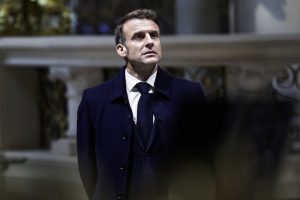

It will be Emmanuel Macron’s next grand “Republican Ceremony”. The French president has a seemingly insatiable thirst for leading the country into remembering past glories. It has led him to stage countless “memorial events” in which he stars (giving addresses in no fewer then 17 cities across France in 2018 to commemorate the end of the First World War, for instance.)
Early next year, on February 21 2024, at the Panthéon – originally a neo-classical church designed to rival St Paul’s on Paris’s Left Bank which was turned by the French Revolution into an official necropolis to France’s heroes – Macron will salute the life and death of Missak Manouchian, an Armenian refugee who led a Résistance network. He was shot with his group of partisans by the Nazis on February 21 1944. Manouchian’s mortal remains will solemnly join those of Voltaire, Jean-Jacques Rousseau, Victor Hugo, Marie Curie, Alexandre Dumas and 76 others, with speeches, honour guards, and yet another television-worthy address.
Orphaned aged 9 in the 1915 Turkish genocide, Manouchian reached France in 1925, working as a lathe operator in a Citroën plant where he joined the Communist Party’s foreign workers division, MOI (Main d’Œuvre Immigrée). There he was to make friends who would join with him in fighting the occupier. Of his network’s 22 members; all but three were like him foreigners or stateless: Poles, anti-Fascist Italians, a Spanish Republican, Hungarians, Romanians; about half of them Jewish.
This will be the fourth “Panthéonisation” of Emmanuel Macron’s presidency, and like some of his predecessors’ choices, his are eminently political. Manouchian ticks a number of boxes: a working-class migrant, a Resistant, a Communist. For the most divisive president in the history of the Fifth Republic, this will be an opportunity to reach across the aisle (and remind some of the grumbling French that he himself once came from the Left).
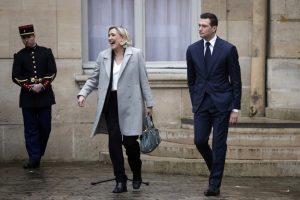
Among his previous Pantheon entrants were Josephine Baker, the African-American jazz singer, actress and Résistante, another reminder that France did diversity when segregation and discrimination reigned elsewhere. Ditto for Simone Veil, the Auschwitz survivor who as Health Minister passed the Veil Act legalising abortion. If you wanted to draw a list of official French heroes designed to annoy Marine Le Pen voters (and shake off your “président des riches” burdensome reputation), you’d go about it just like that.
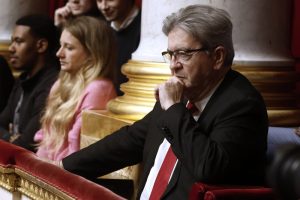
Squeezed between Jean-Luc Mélenchon’s hard-left red-green alliance and Le Pen’s National Rally rust belt strain, the French Communist Party, once a formidable, Moscow-compliant machine polling over a quarter of the French vote, has been reduced to a sad rump. Its last two-digit results date back to the 1980s. Its most recent presidential candidate, Party Secretary General Fabien Roussel, scored a measly 2.28% last year. Nonetheless, Emmanuel Macron sees possible pickings in that direction: the FCP tends not to play modern identity politics, cultural wars, or intersectional grievance games. Roussel defines himself as a “French universalist” in a recognisably Old Left way, and has recently been awarded the coveted Prix de l’Humour Politique, a rarity in his old political family. His 12 MPs could make a vote swing Macron’s way in an unstable National Assembly, and therefore must be cultivated.
Alas, the build-up to next year’s Panthéon event has stirred up uneasy memories (and feuds) among historians, which may derail the President’s cunning plans. Were Manouchian and his motley band of tailors, carpenters, cobblers and mechanics ultimately sacrificed by the wartime Communist resistance leadership? Why, against Party policy, weren’t they, for instance, “ventilated” separately, to relative safety away from Paris, from the moment their names were officially mentioned by Nazi propaganda, most famously in a propaganda poster known as “L’Affiche Rouge” (The Red Placard), with captioned photographs of ten of them, denouncing them as “terrorists”, “foreigners”, “criminals”, “bandits” and of course “Jews”, attempting to “strangle” France? Manouchian himself, in his last letter to his wife, a few hours before his execution, writes “I forgive all those who have harmed me or wanted to harm me, except the one who betrayed us to save himself, and those who sold us out.” For years, that line was omitted in published versions of Manouchian’s letter, mostly in Communist journals.
When, in the post-war years, the French Communist Party started seeking to capitalise on its role in the Resistance (hoping its relative inactivity in the years of the 1939-1941 Molotov-Ribbentrop pact would be forgotten), it omitted the existence of the entire MOI-FTP (Francs-Tireurs et Partisans) Communist movement, to which Manouchian belonged. The French Communist resistance was meant to be just that: French. The orders came from Stalin’s Kremlin: a Moscow-published 1951 edition of letters from French Communists shot by the Nazis, distributed in France, mentions no foreigners. The Party expelled those members who did remember them. Not many, in the rest of the Résistance, Gaullists or otherwise, had much time for scruffy aliens with strange accents
The history of the “Manouchian group” was later restored: books, a film, acrimonious television debates: French history is contentious by nature. Emmanuel Macron is now wading in, mostly with good intentions. He is about to discover that historical narratives are less simple than political communication plans.