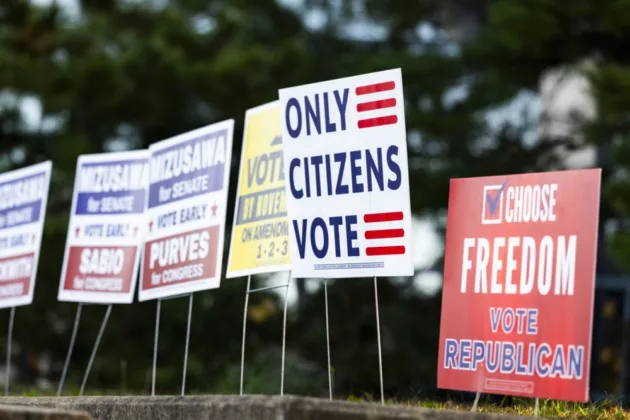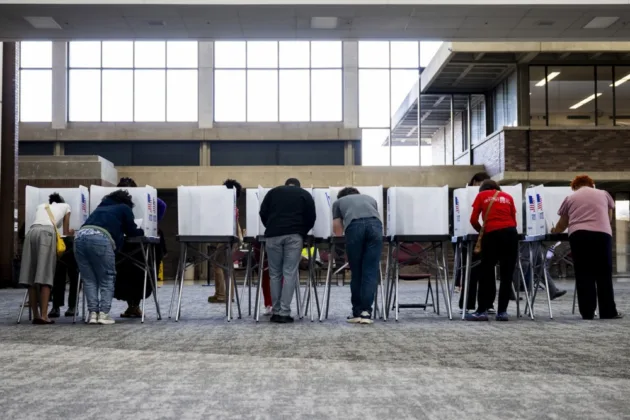




The Republican Party has lost control of both chambers of the United States Congress in the midterm elections held on November 3.
It has also lost the governorships of Texas and Ohio, and trails in the count for Alaska’s.
Going into the vote Republicans held 53 of the 100 Senate seats, so Democrats needed a net gain of four.
CBS News had rated the Republican-held seats in South Carolina, Kansas and Iowa as leaning Republican. It classed those in Texas, Ohio, Maine and Alaska as toss-ups.
Democrats won all three of the Republican-leaning seats and every toss-up called so far. They also took North Carolina and held Georgia and Michigan. The Alaska race remained too close to call.
The Associated Press called the Senate for the Democrats just after 11.30pm Eastern time. It called the House of Representatives early on November 4.
Democrats were on track for at least 224 House seats, against the 218 needed for a majority. By that count Republicans had lost 25 seats.
In South Carolina, Democrat Annie Andrews beat Senator Darline Graham, sister of the late Lindsey Graham. She is the first Democrat elected to the Senate from the state since 1998.
Adam Hamilton unseated Roger Marshall in Kansas and Josh Turek beat Ashley Hinson in Iowa. In Maine, Susan Collins conceded to Troy Jackson.
In Texas, Democrat Gina Hinojosa defeated Governor Greg Abbott, becoming the first Democrat to win the post since Ann Richards left office in 1995. James Talarico took the state’s Senate seat from Republican hands, defeating Ken Paxton.
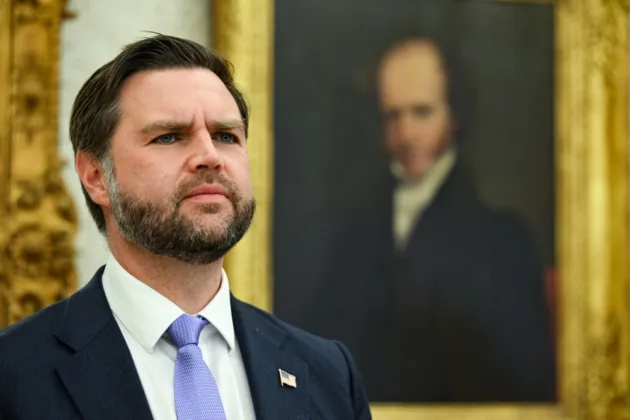
In Ohio, Democrat Amy Acton beat Vivek Ramaswamy, whom Trump and Vice President JD Vance had campaigned for in the final weeks. She is the first woman elected governor of the state and the first Democrat to win the post in 20 years.
Former senator Sherrod Brown also unseated Jon Husted in the state’s Senate race.
In Alaska, Democrat Jonathan Kreiss-Tomkins led the governor’s race with almost 50 per cent and about 27 per cent of the vote counted. Ranked-choice tabulation is due on November 18 if no candidate passes 50 per cent.
The seat is held by Republican Mike Dunleavy, who was barred from standing again.
Signs of a weakened Republican turnout had emerged before polling day. Democrats accounted for about 43 per cent of early voters in states that register party affiliation, against 24 per cent for Republicans, according to the University of Florida Election Lab.
Bernard Fraga, a political scientist at Emory University, told Time on October 27 that Republicans who voted in 2024 were “so far at least staying home”.
A Marist poll found 61 per cent of Republicans very enthusiastic about voting, against 71 per cent of Democrats.
Republican Congresswoman Nancy Mace had predicted heavy losses on CNN on November 2. They “started with the Epstein files and it’s going to end with the Iran war”, she said.
The NBC News Exit Poll found 62 per cent of voters believed Trump had made the wrong decision in starting the war with Iran.
Some 75 per cent described the economy as in rough shape and 65 per cent said Trump’s policies had made it worse. A total of 87 per cent were concerned about the cost of petrol and diesel. Trump’s approval rating among voters stood at 38 per cent.
Hispanic voters also moved away from the party. About a third backed Republican House candidates, against roughly four in 10 who voted for Trump in 2024, according to the AP Voter Poll.
One Republican strategist described the result to Roll Call as a “2006-style massacre”. Marc Short, chief of staff to former vice president Mike Pence, said on X it was “hard to think of a WH that’s sabotaged House and Senate candidates more”.
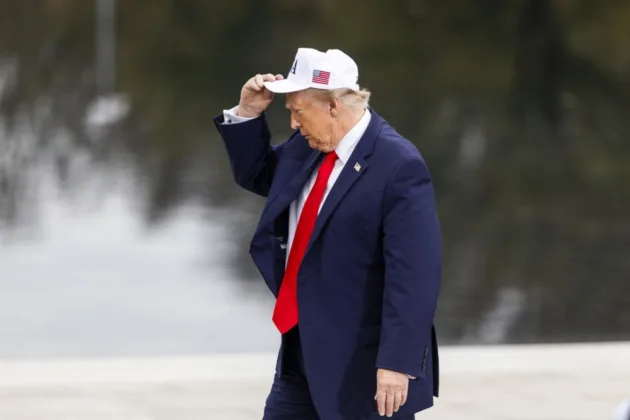
Trump responded on Truth Social on election night. “I wasn’t on the Ballot and if I was, we would have won IN A LANDSLIDE!” he wrote.
He later blamed Abbott’s defeat on the governor having become a “RINO”, or Republican in name only. In a call to Fox News early on November 4 he congratulated the Democrats.
House Speaker Mike Johnson said Republicans “will not be deterred by the outcome of one election”.
Democratic House leader Hakeem Jeffries, in line to replace him as Speaker, said voters had had “enough of the extremism, enough of the corruption”.
The new Congress is due to be sworn in in January 2027, for the final two years of Trump’s term.