
Some words should be sanctioned as racist within the many liberal discourses on the Black and Traveller contributions to multiculturalism. This ban would completely prohibit words such as “sanctioned”, “racist”, “liberal”, “discourse”, “Black”, “Traveller” and “multiculturalism”. Not sure about “contributions”, so we’ll spare it the guillotine for the moment. The rest get the chop.
These are key words in the cultural tyranny that has this century been sinking its jaws into the anglophone imperium. I am sanctioning “sanction” because it means both “punish” and “permit”, and so confuses everybody, which I suspect is its ulterior purpose. “Racist” is simple abuse for people whose opinions liberals dislike, as are “xenophobe”, “Islamophobe” and “misogyny”. As for that word “liberal”, it can mean almost anything: “Neo-liberal” means limitless capitalism, but without the neo – it can also mean full-term abortion, while many liberals (who by their own account are incredibly kind and tolerant folk) denounce Zionists but not Islamists, and now my brain hurts.
Next, “discourse”, a favourite word amongst liberals, so splat! – its head falls bloodily into the basket. The same fate befalls “Black” with a capital B, or without one when referring to anyone other than a Nubian: Its use as an approving metonymic collective for all people with a slightly off-white to dark- brown skin is uncompromisingly racist (qv). “Traveller”, with a T, is now a politically acceptable term for “Irish itinerant”, though the latter word, for some inscrutable reason, isn’t. “Multicultural” is a liberal (qv) synonym for paradise, though it is usually a violent, intolerant hell dominated by the loudest, most organised and most aggressive ethnic group.
I think I’ve offended – or at least hope I have – most of the various advocacy groups, busybody ombudspersonages and tiresome single-issue quangos that now police our thoughts and words, and who are our real government these days. These creatures are in command almost everywhere that speaks English, but especially so in Ireland. This was the last European country to experience large scale immigration, and has steadfastly refused to accept that the experiences of other societies might possibly be of use to it. The Irish really do believe that being Irish is “special”, a common piety amongst small ethnic groups with dominant neighbours, such as the Dutch and the Danes alongside Germany. In Ireland, this permits an ethnic boastfulness that would be outlawed elsewhere, as in the advertisements for Dunnes Supermarkets: “We’re Irish: We do it better.”
Imagine Britain’s racial equality quango hearing: “We’re English. We do it better.” Off with their heads…..
The taboo words that began this article have an almost radioactive authority in Ireland, which in a single bound leapt from being culturally the most conservative society in Europe to being the most “progressive” (whatever that might mean: Both communism and fascism were once regarded as progressive). That transformation was confirmed in 2015, when Ireland overwhelmingly voted to make homosexual and heterosexual marriages “equal”. Nobody knows what “equal” means here, any more than they do “progressive”, but what matter? Don’t all those nice words make everybody feel better? And isn’t feeling better the best way of solving society’s problems?
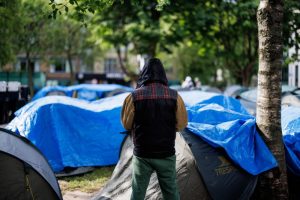
It was certainly how successive Irish governments dealt with immigration, showering incomers with the various goodies not available to natives, such as free healthcare, accommodation and tax-free welfare benefits. Naturally, the quango (quasi-autonomous non-government organisation) supporting these arrivals – the Migrant Rights Centre Ireland – speaks to its clients entirely in simpering victimese, its website never mentioning words such as “responsibility” “gratefulness” “duty” and “obligation”. However, that website does show a picture of migrants all manacled to balls-and-chains, over the slogan. “Break Us Free”. Alongside this picture of hell are assertions that 71 per cent of migrants in Ireland experience exploitation, (undefined, naturally), 61 per cent suffer severe exploitation, (ditto) with 51 per cent not daring to report this exploitation, and why would they, since only 9 per cent of those who complained ever get “resolution” (ditto)?
So quite clearly, Ireland is a 21st Century Alabama Chain Gang. Yet oddly enough, nearly 30 per cent of the Irish workforce are migrants. Not quite sure how this works: I mean, how many immigrants did Alabama attract in its chain gang glory-days? None? Yet 30 per cent of the Irish workforce freely left their native utopias to break rocks on Irish roads. All very puzzling.
Equally puzzling was the response to the death in the centre of Dublin last week of a Congolese immigrant, drug addict and shoplifter, Yves Sakila. He fled from a city centre department store after stealing some perfume – stealing is what he did for a living – and firstly ran into an 80-year-old street-trader, shattering the poor fellow’s leg. Sakila was finally stopped and detained by security guards who held him on the ground while waiting for the Irish police to arrive.
For reasons that remain unclear, Sakila died where he lay. However, despite the absence of any information whatever about his death, the Migrant Council immediately blamed it on racism. Similarly, the Nigerian specialist in “Black Studies” – sorry, no idea – Ebun Joseph, who is also Ireland’s supposedly neutral “rapporteur” on “racism and equality”, declared the death had caused “distress, fear, and outrage… among black and minority ethnic communities”. Yes, she intuitively divined the feelings of Ireland’s hundreds of thousands of immigrants.
However, she didn’t mention the 80-year-old man whose leg Sakila shattered, but then why would she? He was white and she studies things that are black, sorry, Black. The Irish media reported that following Sakila’s death, a wave of shock and anger over swept through the 120 million people of the Congo, a hitherto untroubled haven of peace and paradise. In its capital, Kinshasa, the French and American embassies were last year destroyed by armed mobs, and at the start of the century, in the country overall more than five million people were slaughtered in a civil war. Yes, and now this….
Of course, Sakila’s death is a tragedy. So too was that of Alexander Coughlan, an Irishman, who last week was knifed to death by two teenagers in Dublin, but with no condemnation from any quango or “rapporteur”. So what will these splendid people say once the ethnicity of Alexander’s killers is finally revealed? Is that why the Irish police have appealed for people NOT to share videos of this killing? Of course, no such appeal has been made about the video-footage of Sakila’s death.
The Irish are late into the business of immigration, but like so many countries that have been down this particular path, we have learnt absolutely nothing from other people’s experiences. But why would we? After all, we’re Irish: We do it better.
But before you go, what are those taboo words again?
Kevin Myers is an Irish journalist, author and broadcaster. He has reported on the wars in Northern Ireland, where he worked throughout the 1970s, Beirut and Bosnia.