


Almost the entire parliamentary group of Sahra Wagenknecht’s Bündnis Sahra Wagenknecht (BSW) has quit the party in the eastern German state of Thuringia, in a major blow to the party and its founder.
Ten of the 12 remaining BSW members of the Thuringian parliament announced on Friday that they were leaving the party.
However, they said they would initially remain together as a parliamentary group and continue supporting the state government, which the BSW forms with the centre-right CDU and centre-left SPD.
Among those leaving are all three BSW ministers in the state government: Deputy Minister-President and Finance Minister Katja Wolf, Digital Minister Steffen Schütz and Environment Minister Tilo Kummer. Parliamentary group leader Sigrid Hupach is also among the departing MPs.
The group will meet next week to determine its future structure.
The mass departure follows a long-running dispute between the Thuringian BSW leadership and the party’s federal leadership under Wagenknecht.
The BSW entered the Thuringian parliament after winning 15.8 per cent of the vote in the September 2024 state election. It subsequently joined the CDU and SPD in forming the so-called “Brombeer” coalition, named after the German word for blackberry because of the parties’ respective colours.
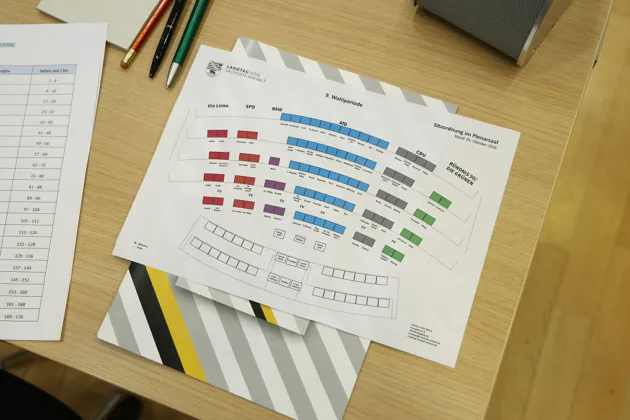
The coalition has never held a majority in the 88-seat parliament, controlling 44 seats. It has therefore relied on agreements with the opposition Left party to pass legislation.
Wagenknecht has increasingly opposed the BSW’s participation in the government, arguing that the party should leave the coalition and instead support an independent candidate for minister-president on individual votes and changing majorities, including the AfD.
The Thuringian leadership has rejected that approach and maintained that the coalition should continue.
Tensions intensified after controversy surrounding CDU Minister-President Mario Voigt, who is accused of plagiarism.
Wagenknecht’s federal leadership demanded that the BSW withdraw from the government, while the Thuringian MPs continued to support the coalition.
The dispute also became increasingly focused on the federal party’s relationship with the Right-wing Alternative for Germany (AfD).
Wolf said on Friday that the Thuringian MPs remained committed to the principles on which the BSW was founded, but believed the federal leadership had moved away from them.
“We are still convinced of the founding consensus, but the federal party has moved away from it,” Wolf said.
She added that the departing MPs had not been elected to parliament “for flirting with right-wing extremists”.
The latest departures follow three MPs, Stefan Wogawa, Roberto Kobelt and Dirk Hoffmeister, leaving the BSW and its parliamentary group earlier this week.
The three have announced plans to form a new party called “Deine Stimme zählt” (“Your Voice Counts”) and establish a parliamentary group of the same name.
With Friday’s departures, only two of the 12 MPs who remained in the BSW parliamentary group after Wednesday’s split – Anke Wirsing and Sven Küntzel – have chosen to remain with the party.
The BSW parliamentary group itself has not yet formally dissolved. Hupach said the departing MPs would initially remain together in the Landtag and discuss their next steps at a meeting next week.
The CDU-led state government has also insisted that the coalition remains intact.
“We stand together for reliable politics,” Minister-President Mario Voigt said, arguing that the government still had a common mandate and would continue implementing its programme.
The opposition Left party, however, said the coalition had effectively collapsed because its coalition agreement had been concluded between political parties rather than individual MPs.
“The governing coalition has collapsed from our perspective,” Left parliamentary leader Christian Schaft said.
The crisis could therefore leave the government even more dependent on opposition support to pass legislation.
The AfD, which is the largest party in the Landtag with 32 seats, has already called for new elections. AfD state leader Björn Höcke has said his party will submit a motion seeking the dissolution of the parliament.
Such a move would require a two-thirds majority, meaning the AfD cannot dissolve the parliament on its own.
For Wagenknecht, the developments represent a major setback. The BSW was founded in early 2024 around her personal political profile of a left-wing populist firebrand and rapidly established itself as a significant force in eastern Germany.
Thuringia was one of its most important successes and became the first state in which the party entered government.
The collapse of its parliamentary organisation there now raises questions about whether Wagenknecht can maintain control over the party’s state organisations and whether the BSW can remain a coherent political force beyond her personal leadership.
The timing is particularly damaging. Saxony-Anhalt is due to hold a state election on Sunday, with the BSW facing a battle to remain above the five-per-cent threshold required to enter the state parliament.
Wagenknecht has accused the Thuringian rebels of deliberately damaging the party immediately before the election. She has also argued that the departures provide an opportunity to rebuild the BSW in the state around a clearer political course.
“It is obvious that the majority of the parliamentary group is now also leaving the party because they know that they would no longer have received support for their course at the planned special party congress,” Wagenknecht told the dpa news agency.
The leadership of the BSW Saxony-Anhalt said it was happy with the resignations, so the party could pursue the policies for which it was founded, and not “continue the firewall policy of the CDU and the Left Party that kept Mario Voigt in office”.
Sahra Wagenknecht, leader of the left-wing populist Bündnis Sahra Wagenknecht (BSW) party, has said her movement would do everything possible to prevent the Christian Democrats (CDU) from retaining power in the eastern German State of Saxony-Anhalt, even if that requires…
— Brussels Signal (@brusselssignal) June 1, 2026