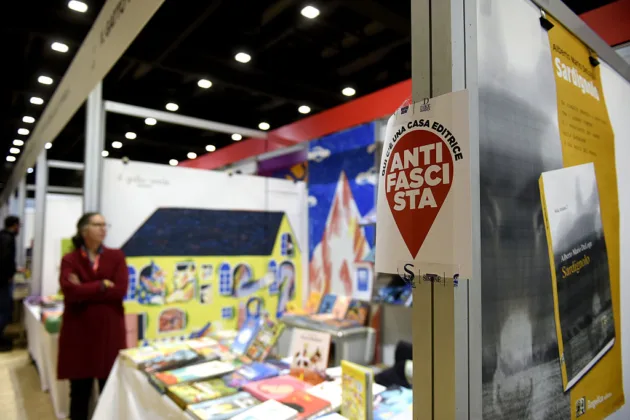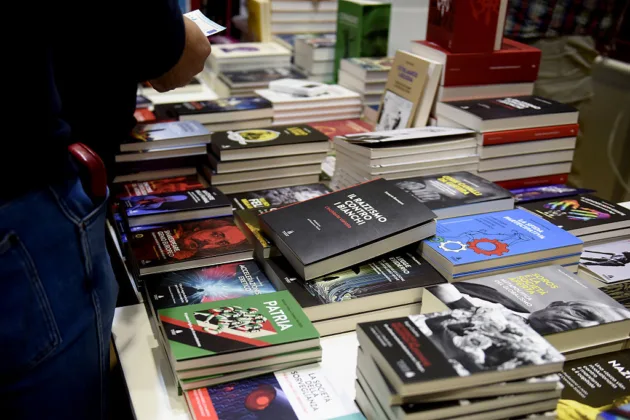






A political storm over censorship and freedom of expression has erupted in Italy after organisers of the country’s leading fair for independent publishers introduced a requirement obliging exhibitors to sign a declaration endorsing anti-fascist values.
Among the most vocal critics has been Italian Prime Minister Giorgia Meloni. In a post on X on June 14, she denounced what she called an “anti-fascist certificate” for publishers, describing the requirement as “quite simply, censorship” and adding that “censorship is incompatible with any democratic society”.
Meloni accused organisers of introducing a discriminatory criterion for participation and warned against the use of political labels to determine who is entitled to take part in public cultural life.
The fair’s organisers rejected her characterisation, saying the declaration was “not censorship at all” but a “need for clarity”. They added that the prime minister’s intervention and the wider debate had prompted them to examine the matter further out of institutional respect.
Deputy Prime Minister Antonio Tajani struck a more measured note, saying he was anti-fascist himself but that no one should be branded a fascist for holding different views.
The controversy comes ahead of the 25th edition of Più Libri Più Liberi (“More Books, More Free”), scheduled to take place at La Nuvola, in Rome’s EUR district, from December 4 to December 8, 2026. Organised by the Italian Publishers Association (Associazione Italiana Editori, AIE), the fair is Italy’s largest event dedicated exclusively to small and medium-sized publishers and attracts more than 600 exhibitors every year.
The dispute is rooted in tensions that have been building within Italy’s publishing world for several years. As publishers associated with conservative and right-wing authors have increasingly begun taking part in major literary fairs, some writers, activists and left-wing cultural figures have voiced concerns about what they see as a growing influence of the political right within Italy’s cultural sector. Campaigns have repeatedly been launched calling for some of these publishers to be excluded from book fairs and other publicly funded cultural events, arguing that they promote ideas incompatible with democratic values.
Particularly heated controversy surrounded the December 2025 edition of Più Libri Più Liberi, when Passaggio al Bosco, a publisher whose catalogue critics say glorifies figures from Italy’s Fascist and Nazi past, participated for the first time. Some 80 writers, intellectuals and cultural figures — including the historian Alessandro Barbero, the novelist Antonio Scurati and the cartoonist Zerocalcare — signed an open letter questioning its inclusion, while some authors withdrew from scheduled appearances and local officials distanced themselves from the opening ceremony. The Italian Publishers Association’s then president, Innocenzo Cipolletta, defended the decision, saying it was for readers to judge the books and for the courts to assess their legality in a country that bans the glorification of fascism.
Against that backdrop, organisers have now introduced new participation rules for the 2026 edition. Publishers applying for exhibition space are required to sign a declaration recognising and sharing the values underpinning Italy’s constitutional order, including what organisers describe as its anti-fascist foundations. The text also commits exhibitors to repudiating fascist ideology and any form of totalitarianism, and to not displaying or selling material that glorifies fascism or incites hatred or discrimination, on pain of immediate exclusion; the fair’s online system blocks any application that does not accept the clauses. Supporters of the measure argue that anti-fascism is not a partisan political position but a core principle of the Italian Republic, born out of the collapse of Benito Mussolini’s regime and the experience of the Second World War.
Critics, though, see the requirement as a form of censorship and an ideological screening process. They accuse organisers of using anti-fascism as a pretext to determine which publishers are deemed acceptable participants in major cultural events, effectively favouring certain political viewpoints over others. In their view, participation in a book fair should depend on compliance with the law rather than on the signing of political declarations.
The controversy has been further fuelled by the fact that the term “anti-fascism” does not explicitly appear in the text of Italy’s 1948 Constitution. Its transitional provisions do, nonetheless, ban the reorganisation, in any form, of the dissolved Fascist Party — a clause supporters cite as evidence of the document’s anti-fascist character. Opponents of the requirement argue that organisers are imposing a political interpretation of constitutional values rather than merely enforcing existing legal obligations. Supporters, by contrast, maintain that anti-fascism is implicit in the constitutional framework and in the post-war democratic settlement on which the Republic was founded.
With almost six months remaining before Più Libri Più Liberi opens its doors, critics say the dispute risks setting a precedent in which access to cultural platforms is conditioned on ideological compliance, turning what is meant to be a space for literary exchange into a contested test of political conformity. In their view, the affair has become less about constitutional values than about where the line is drawn between defending democracy and restricting freedom of expression.