

A new social media platform launched this week in Brussels wanting to become Europe’s answer to Elon Musk’s X. But as EU institutions openly promote the project and senior European officials flock to the platform, questions are already being raised about the relationship between Brussels and a supposedly independent private venture.
W Social, a Swedish-led platform unveiled at the World Economic Forum in Davos earlier this year, officially entered public beta on June 17.
W has already established contacts at the highest levels of the European Commission. Transparency disclosures also reveal contacts between W Social and the cabinet of Henna Virkkunen, the Commission’s Executive Vice-President responsible for technological sovereignty, security and democracy.
Those institutional ties were on display during the launch in Brussels.
The even was hosted at the Press Club Brussels, a few blocks away from the European Commission and featured senior figures from the company, representatives from the United Nations, media executives.
Some of the bloc’s most senior political figures are publicly embracing a platform whose core selling points closely mirror Brussels’ own regulatory agenda.
W executives celebrated the arrival of EU institutions on the platform, including the European Commission, European Parliament, European Council and European Central Bank.
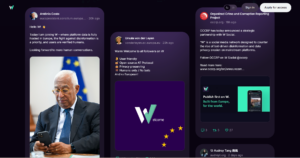
Among W’s early users are European Commission President Ursula von der Leyen, European Council President António Costa, and European Central Bank President Christine Lagarde.
Costa enthusiastically announced his arrival on the platform, praising its European data hosting, focus on combating disinformation, and verification of users as “real people”.
The Commission itself has also promoted the platform on social media, raising eyebrows among critics who question why EU institutions appear so eager to champion a newly launched private company.
Looking for a new place to debate Europe?
Follow our account on W, a freshly launched independent social media network – based in Europe and aiming for open, safer online conversations.
Join the conversation – @ https://t.co/TCNVFI3ruX
ℹ️ https://t.co/8vhVeAJ3vR pic.twitter.com/NYgHU2HInn
— European Commission (@EU_Commission) June 17, 2026
The platform presents itself as a distinctly European alternative to US social media giants.
Built on the same AT Protocol that of Bluesky, W promises “verified human interaction”, compliance with EU digital regulations, and infrastructure entirely hosted within Europe.
“We are based in Europe, we have our infrastructure and data centres in Europe, we operate under European law, and only Europeans can be shareholders,” CEO Anna Zeiter declared during the Brussels launch.
For years, EU officials have been criticising major US social media platforms over alleged failures to combat disinformation and illegal content.
W’s social media is explicitly aligned with EU digital policy.
During the launch, CEO Anna Zeiter emphasised that W was “working with European regulators together from day one”, citing cooperation with the Swedish Media Authority, Sweden’s Data Protection Authority and the European Data Protection Board. Advertising on the platform, she said, would be conducted “in line with GDPR and DSA and European advertising guidelines”.
The platform’s approach to identity verification also reflects broader regulatory concerns about online anonymity.
Users may browse anonymously, but posting and interacting requires proof that they are human through a separate verification system. Those willing to attach their real identities to their accounts receive algorithmic preference over anonymous users.
The company says these measures are necessary to combat bots, fake accounts, AI-generated manipulation and coordinated disinformation.
W is one of several European social media platforms launched in recent years, alongside Bulle, Eurosky, Monnett and eYou, or chat app like Latvian BirdyChat.