A Russian court has sentenced a prominent opposition politician to more than 11 years in a penal colony for criticising the war in Ukraine, on the same day that the country’s Supreme Court upheld a ban preventing his party from contesting September’s parliamentary elections.
Lev Shlosberg, 63, deputy chairman of the liberal Yabloko party, was convicted on August 17 by a court in Pskov, northwest Russia, of “discrediting” the Russian armed forces and spreading “false information” about them.
He was sentenced to 11 years and one month in a general-regime penal colony and barred from administering websites for six years. Prosecutors had sought a term of 12 years and one month.
The charges related to comments made during an online debate in which Shlosberg called for an end to the fighting, and to a post on his Telegram channel sharing a British newspaper front page from early in the conflict that featured an image of a bloodied woman alongside Russian President Vladimir Putin under the headline “Her blood … his hands.” The front page was that of the Daily Mirror and the repost dated from February 25, 2022, before the “fakes” law took effect.
Shlosberg, who sat in the Pskov regional legislature from 2016 to 2021, rejected the accusations, describing the proceedings as a political trial intended to punish him for his public position.
In his closing speech he repeated calls for a ceasefire and political dialogue. Closing arguments were heard on August 14 without any of his three lawyers present, after the court declined to adjourn.
It was the second trial faced by Shlosberg in the past two years. He has also been designated a “foreign agent” since June 2023, a label that carries strong pejorative connotations in Russia and subjects individuals to heightened government scrutiny and reporting requirements. He was given 420 hours of compulsory labour in November 2025 over those obligations and has been in detention since December 5, 2025.
Yabloko said Shlosberg received a “barbaric sentence” for “love of the Motherland and calls for a ceasefire”. In a statement on Telegram, the party said Shlosberg will appeal.
Amnesty International said the prosecution of Shlosberg was arbitrary and that his sentencing amounted to “blatant reprisals for exercising his right to freedom of expression to call for peace”. Its Eastern Europe and Central Asia director, Marie Struthers, called for his release.
Minutes later, the Appeals Chamber of Russia’s Supreme Court rejected Yabloko’s challenge to an earlier ruling that cancelled the registration of its federal list of candidates for the State Duma elections scheduled for September 18-20. Dozens of supporters were detained outside the building.
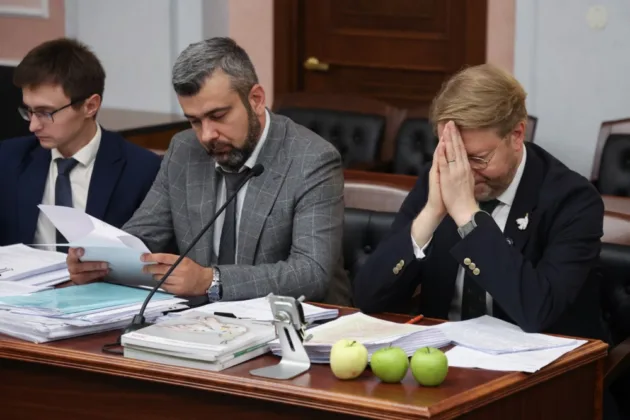
The original decision, issued on August 10, followed a lawsuit filed three days earlier by the nationalist Rodina party**, led by State Duma deputy Aleksey Zhuravlyov,** alleging electoral law breaches, copyright violations and the receipt of foreign funding. Yabloko has said the money came from donations by Russian citizens.
The party, Russia’s oldest liberal group and the only registered organisation openly campaigning for a ceasefire and peace, said it would pursue a supervisory review and other legal avenues**, taking its case to the Supreme Court presidium and possibly the Constitutional Court**.
Party chairman Nikolai Rybakov described the hearing as “an imitation of a court proceeding”.
The Central Election Commission struck Yabloko from the federal ballot paper on August 18, leaving 10 parties in the list contest.
Yabloko candidates may still stand in single-member constituencies, though success in those races is considered more difficult. The party has polled below the 5 per cent threshold required for list seats.
The European Commission called the removal further evidence of pressure on Russia’s political opposition, with spokeswoman Anitta Hipper saying in Brussels on August 11 that the ruling showed the authorities were “afraid”.
The rulings come amid a broader tightening of restrictions on dissent ahead of the parliamentary vote, which the ruling United Russia party is widely expected to dominate.
Several other Yabloko figures have faced prosecution, designation as “foreign agents” or administrative penalties in recent years.
Shlosberg is one of a number of anti-war voices to have received lengthy prison sentences under legislation introduced after Russia’s full-scale invasion of Ukraine in February 2022. Rights groups have characterised such cases as efforts to silence criticism of the conflict.
Separately, Russia’s state development bank VEB.RF has dismissed its long-serving chief economist, Andrei Klepach, after remarks in which he warned that the country could not win a prolonged “war of attrition” with Ukraine and its Western backers and was falling behind economically and technologically. The bank said his term of office had expired; The Bell, citing people close to it, reported his removal on August 16.
Klepach, who had held the post for 12 years, made the comments in a May 21 presentation to the Nikitsky Club, stating that Russia was losing ground not only to China and the US but in some respects to Ukraine, that costs were mounting, and that a social crisis was likely even if outright economic collapse was not.