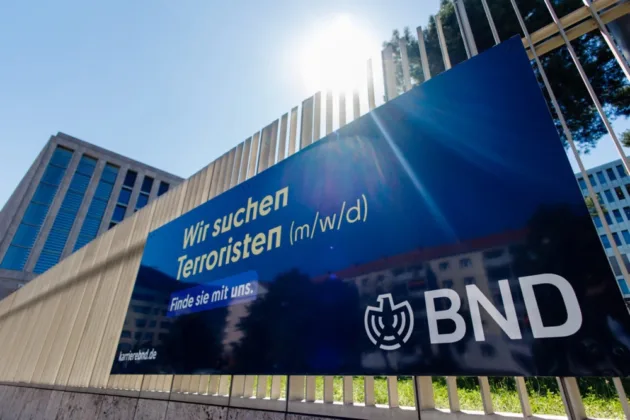






Germany has moved to give its intelligence services sweeping new powers to disrupt cyberattacks, sabotage hostile infrastructure and counter foreign interference, as Berlin seeks to confront an increasingly intense hybrid conflict with Russia.
On August 12, 2026, the German cabinet approved a major reform of the country’s intelligence legislation, expanding the powers of the Federal Intelligence Service (BND), responsible for foreign intelligence, and the Federal Office for the Protection of the Constitution (BfV), Germany’s domestic intelligence and counter-intelligence agency. The Federal Ministry of the Interior has described the draft, which runs to more than 700 pages, as the most far-reaching overhaul of the two agencies’ legal basis in the history of the Federal Republic.
The bill goes first to the Bundesrat for its opinion before the Bundestag takes it up. It does not require the chamber’s consent.
German interior minister Alexander Dobrindt presented the reform as a response to a fundamentally changed security environment. Speaking after the cabinet meeting on August 12, he said: “We are developing our intelligence services into real secret services.”
He also warned that Germany was facing daily espionage, sabotage, cyberattacks and covert actions by foreign powers aimed at destabilising the country. “We are a daily target of hybrid warfare,” he said.
The main driver is Germany’s perception of an increasingly intense hybrid confrontation with Russia. Berlin regards espionage, cyberattacks, sabotage and disinformation as part of a wider security contest taking place below the threshold of conventional war. The reform is intended to give Germany tools that can match the capabilities of hostile states and reduce its reliance on intelligence provided by foreign partners.
The proposed law would change what German intelligence services can do. Until now, their primary role has been to collect and analyse information. Under the new framework, they would also gain operational powers to actively disrupt threats.
The BND would, under defined conditions, be able to intervene against hostile digital infrastructure, including by accessing IT systems, manipulating or deleting data and disabling systems used in cyberattacks. The interior ministry cited penetrating the IT systems of chemical weapons laboratories or drone factories to sabotage production, and switching off servers run by State hacking groups or disinformation actors.
The reform would also permit measures aimed at disrupting hostile supply chains and, in particularly serious circumstances, operations abroad against infrastructure connected to hostile activities.
The agencies would also receive broader powers to access IT systems and analyse digital information. Artificial intelligence and biometric tools could be used more extensively to identify individuals, connections and patterns in large datasets. The BND would be allowed to store communications content for up to six months and traffic data, such as IP addresses, for up to 12 months.
But the most politically sensitive part of the reform may concern what these new powers mean inside Germany.
The BfV is a domestic intelligence agency under the supervision of the Federal Ministry of the Interior. This institutional relationship has become controversial in recent years, particularly because the AfD has accused the government of using the intelligence service against a political opposition party.
The dispute intensified after the BfV classified the AfD at federal level as a confirmed right-wing extremist organisation on May 2, 2025, a decision announced by then interior minister Nancy Faeser days before she left office. The party rejected the classification and accused the agency of political instrumentalisation. It also went to court and, on February 26, 2026, the Cologne Administrative Court provisionally barred the agency from applying or publicising the classification until the main proceedings are concluded.
The concern raised by critics is therefore not that the new law explicitly authorises the government to target opposition parties. Rather, it is that an intelligence service already accused of political instrumentalisation would receive greater operational powers inside Germany. Opposition politicians have warned that the reform could blur the traditional boundary between intelligence gathering and policing.
That boundary, known in German as the Trennungsgebot, dates from 1949 and is treated as a lesson drawn from the Gestapo. AfD interior affairs spokesman Gottfried Curio said the line between covert intelligence work and operational police action was being deliberately erased. Clara Bünger, interior affairs spokeswoman for the Left party, said the government was abandoning a central lesson of the Nazi era.
Berlin insists that stronger powers will come with stronger safeguards. The Independent Control Council will have an expanded role in authorising and reviewing sensitive intelligence measures, while parliamentary oversight will remain in place. The council is to absorb the G10 Commission, take over supervision of data processing from the federal data protection commissioner and approve the most intrusive measures in advance.
As of August 18, no final vote date has been announced. The government wants the legislation to move quickly, though, with the new framework expected to take effect in early 2027, provided parliament approves it and the remaining constitutional procedures are completed.
The reform ultimately reflects a broader change in Germany’s security doctrine. As the confrontation with Russia increasingly plays out below the threshold of conventional war, Berlin believes its intelligence services can no longer simply observe the hybrid battlefield.