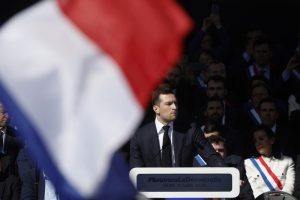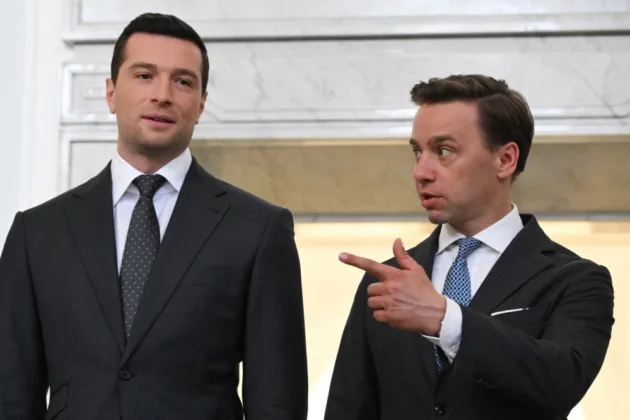


Jordan Bardella, the man who will more likely than not be the next President of France, made headlines this week when he criticised President Donald Trump for being “erratic but also extremely unsteady and constantly shifting.” He further spurned a possible endorsement from the president.
Bardella still has yet to become his party’s nominee. Marine Le Pen, who has lost the last two presidential elections, has still refused to say whether she would drop out of the presidential election even if the courts allow her to run (a decision is expected later this summer), keeping Bardella’s chances in a hazy cloud. But if she continues to be blocked, or simply gets out of the way, then he has a strong chance, if current polls are reflective of the final result, of taking up residence at the Élysée Palace.
Bardella’s desired independence from Trump has given air to those who are sceptical of the “nationalist international”. To observers, this seems reasonable: Unlike the socialist international, which effectively is working toward a gigantic world government, the nationalist international can’t survive – it can only collapse, due to infighting. And why should nationalist governments seek to work together in the first place? Isn’t the point of nationalism to put one’s own country first?
These things are all true. But they also obfuscate the point of a nationalist cooperation.
Firstly, one criticism does ring true: There is not, and cannot be, a nationalist international. They cannot work seamlessly together as the Left can, as they do not wish to subvert their own national interests. Doing so would be entirely antithetical to their values and would be a betrayal of the voters who have thrust them into office.
This is why Bardella is wary of Washington. France historically sees itself as something of a great power; Suez is famous for breaking the power of the British, but the French were involved as well. The 20th century was an incredibly painful one for Paris: They won World War I with the help of America, were occupied by the Germans and freed by the Americans in World War II, lost Algeria, and had to hand off southeast Asia to the Americans after losing control of Vietnam. They are desperate to mount a comeback in the 21st century.
And an increasingly creaky European Union, wobbly due to the pressures of multipolarity, is a prime example of that. Already, friction between France and Germany ended cooperation on a fighter jet – and France has been busy seeking to expand its nuclear umbrella and hanging onto the remnants of empire in Africa. Bardella seeking to come to power seemingly with an endorsement from President Trump, or even with financial aid, would almost hinder him in his ability to win (the French would likely react negatively to extended American involvement) and would hinder his ability to act as President. Eric Zemmour, who recently visited Washington and held events at several conservative think-tanks, was similarly (though politely) dismissive of the idea of needing the Trump administration’s help, saying, “When he talks about anti-migration politics, I see the same ideas that I talked about even before Trump entered onto the scene….This isn’t something that is just the exclusive purview of MAGA and the Trump administration.”
This has not been the case with all European leaders. Polish President Karol Nawrocki, for example, actively sought Trump’s endorsement, getting photos in the Oval Office weeks before the vote. No one will know how many Poles were swayed, but with Nawrocki’s razor-thin margin, it did not hurt. Now, Nawrocki has used his personal relationship to secure troop movements and to garner further invites, such as to the recent UFC 250 fight on the White House lawn (Trump-hating Prime Minister Donald Tusk has been locked out of this relationship).
But Nawrocki’s politics – clearly nationalist – do not become invalidated by working with Trump. Instead, they illustrate exactly what a nationalist foreign policy looks like: Acting in the interest of one’s country. To Nawrocki, someone who believes greatly in Polish independence – from Moscow as well as Brussels – gaining American support is critical. His nationalism allows him to be against Brussels, which seeks to seriously change Poland (if Brussels got its way, Poland would have taken significantly more migrants, for example) while supporting American troops being placed on his soil.
So what does this mean? Is an international nationalist alliance dead because countries have different national interests?
Well, yes, but also no. Again, the notion that all nationalists can work together is foolhardy. They can, and should, communicate, which is why organisations like Patriots Network – which bring together nationalist groups from around the world – are so useful. It is also why the Trump administration has not sought to set up any sort of nationalist international organisation: Because it’s simply not necessary. When nationalists have worked together in the past – or nations in general – it was usually ad hoc. The Berlin Conference of the mid-1880s was not the result of an international organisation, but by states realizing that their national interests coincided. Contrast this with ideology-driven alliances such as NATO or the Warsaw Pact.
The people who usually deride the idea of nationalists working together are often liberal internationalists, who see the world through a liberal internationalist lens. To them, alliances are fundamentally ideological, and they cannot square nationalists coming together in a permanent ideological alliance.
They’re right – nationalists won’t be doing that anytime soon. But a President Bardella would certainly accept an invite from President Trump to attend an ad hoc conference – if it were in France’s national interest.