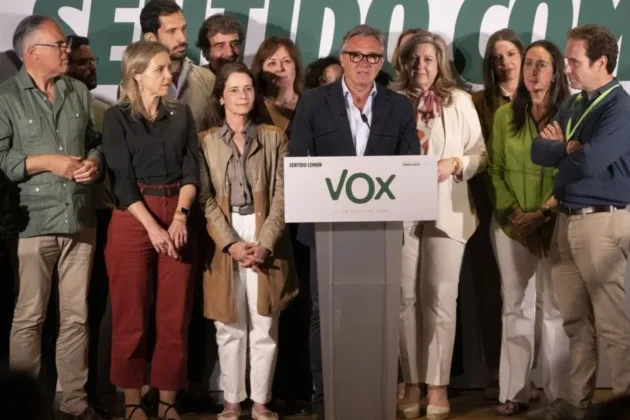






Andalusia, the most populous region in Spain, has become the fourth to adopt “national priority” in a governing pact with Vox, tying access to welfare, housing and subsidies to long-term local roots.
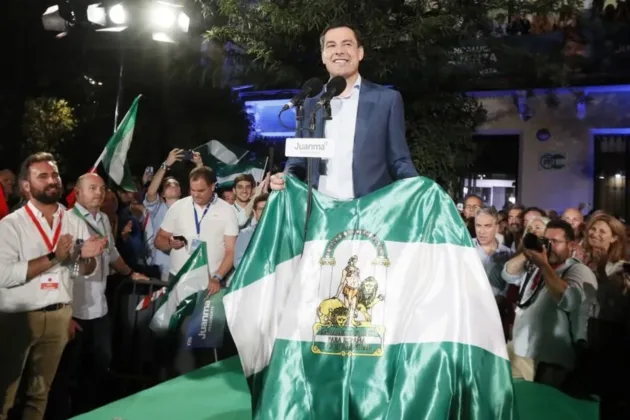
The right-wing party entered the southern region’s government for the first time on July 2, when Partido Popular (PP) leader Juanma Moreno was sworn in as president of the Junta de Andalucía. He prevailed in a second parliamentary vote, having fallen short at an initial attempt on June 30, when Vox withheld its support to press for concessions.
Moreno secured 68 votes, combining his party’s 53 seats with the 15 held by Vox, the strongest backing any Andalusian government has won, worth 62.4 per cent of the chamber and a tally that surpassed a Socialist record standing for more than four decades. At the first attempt his 53 votes had fallen short of an absolute majority, with Vox joining the left to block him. The deal brought Vox’s regional leader Manuel Gavira, until now its spokesman in the chamber, into the executive as vice-president and regional minister for tourism, deregulation, justice and local administration.
The arrangement followed a snap election on May 17 that left the PP two seats short of the absolute majority Moreno had governed with alone since 2022, forcing three weeks of talks with the party he had hoped to keep at arm’s length. The two sides first met on June 9 and thrashed out the 150 measures in near-secret in parliament offices, after an early fortnight of stalled contact. Moreno pressed for a quick deal to spare Andalusia a repeat election he had warned could fall in October. The result extended a run of Socialist reverses across regional Spain that has steadily widened Vox’s reach into government.
A FORMULA THAT KEEPS SPREADING
Styled the Acuerdo de Gobierno y Estabilidad para Andalucía (Government and Stability Agreement for Andalusia), the 150-measure text places prioridad nacional (“national priority”) at its heart. The clause steers public aid, subsidised housing and social rents towards those who can show, in its wording, “real, lasting and verifiable ties to the territory”.
Andalusia now mirrors the model Vox already holds in Extremadura, Aragón and Castilla y León, where it governs alongside the PP. In each case national priority has become the price of the party’s support, and in Extremadura the formula was translated into a ten-year residence requirement for access to subsidised housing. The most recent of the three, sealed in Castilla y León in June, ran to more than 300 measures.
That concession runs against the softer line once favoured by the PP’s national leadership, which had preferred to speak of arraigo (rootedness) rather than adopt Vox’s harder wording. Moreno, who during the campaign had dismissed national priority as rhetoric for Vox’s base, defended the finished deal as “reasonable, sensible and legal”.
In return, the PP secured Vox’s votes for the next four regional budgets, locking in the region’s finances until 2030 alongside income-tax cuts for lower earners, relief on inheritance and gift duties, a bigger tax break for large families and a pledge to build at least 20,000 subsidised homes. Three regional environmental levies would be scrapped, and Vox also takes an Andalusian-designated seat in the Senate.
IMMIGRATION AT THE CORE
Immigration runs through roughly a tenth of the document and forms its second chapter. The new government would reject further arrivals of unaccompanied migrant minors, set aside no funding for their care and seek their return to countries of origin.
It would withdraw public money from NGOs judged to facilitate illegal immigration, pay for age tests on those who claim to be minors and audit immigration-related spending each year. Migrants without residence papers would be shut out of structural social services, save for emergency care. The text also creates a unit to check fraud in the municipal register and in benefit claims, tightens the internal rules of minors’ centres, and commits the region to press Madrid for regular figures on the expulsion of foreign nationals convicted of crimes.
A ban on the burka and niqab in regional public spaces and buildings features as well, echoing the earlier accords, alongside the scrapping of an Arabic-language and Moroccan-culture programme in schools.
The pact drew a written question from Spanish Socialist MEPs asking whether the formula squared with the EU’s ban on nationality-based discrimination. EU justice commissioner Michael McGrath replied that the European Commission would stay alert to any such breach, though it does not comment on party deals and had no record of legislation being adopted to put the clauses into force. Whether a residence-based preference could survive a challenge in Spain’s Constitutional Court remains untested.
For Moreno, who had once questioned the measure’s legality, the pact marks a pointed reversal. It also embeds national priority in Spain’s most populous region, handing the formula its widest reach yet.