




National Rally (RN) MP Jean-Philippe Tanguy, one of the party’s most prominent figures and its leading voice on economic policy, has warned that France’s largest opposition party risks losing its political identity if it becomes embourgeoisé, drawing a distinction between broadening its electoral appeal and drifting away from its anti-establishment roots.
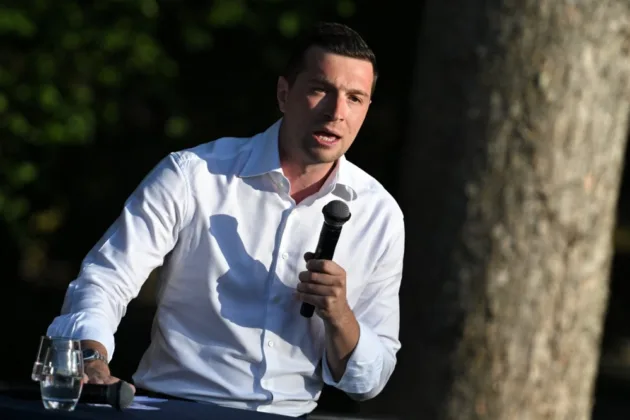
In a podcast — the franceinfo programme Dans les yeux d’Agathe — Tanguy defended Jordan Bardella’s role in expanding the party’s electorate ahead of the 2027 presidential election, but cautioned against the “perversion” of that strategy.
“Bardella had the mission of broadening our political spectrum,” Tanguy said. “Embourgeoisement is the perversion of a good idea,” he insisted.
Tanguy, who joined Marine Le Pen’s movement from the souverainist party Debout la France (DLF) in 2020 after years as a close aide to its leader Nicolas Dupont-Aignan, argued that losing touch with popular France would be fatal.
“My public position is that if the RN were unfortunately one day to become bourgeois — which is not the case today, obviously — it would be finished,” he said.
Invoking his Gaullist roots, he argued that former president Georges Pompidou, who came from the world of banking, “killed Gaullism” through its embourgeoisement.
To many French conservatives, Pompidou’s presidency symbolises the moment Gaullism began trading its nationalist appeal for closer ties to high finance and the business establishment.
The comments came after Tanguy was questioned on Bardella’s increasingly high-profile public image — including his appearance at the Monaco Grand Prix in June and his relationship with Maria Carolina de Bourbon des Deux-Siciles, an Italian princess of the House of Bourbon-Two Sicilies whose romance with the RN president was revealed by Paris Match in April 2026.
During the podcast he insisted that Bardella’s mission had been entrusted to him by Marine Le Pen herself and praised the RN president as “a political prodigy”, dismissing suggestions of rivalry between the two RN leaders.
Still, his remarks underline one of the central challenges facing the RN before 2027. They also come at a delicate moment: Le Pen is awaiting the July 7 appeal verdict in her embezzlement case, which will determine whether a five-year ineligibility ruling stands and bars her from standing. Tanguy has said that, were she prevented from running, Bardella would be the candidate.
According to Tanguy, while expanding the party’s appeal, the RN could risk alienating its core electorate if it came to be seen as culturally or socially part of France’s elite.
Since Marine Le Pen’s takeover of the then-National Front in 2011, the French right-wing party has transformed itself.
While her father gradually increased the party’s support among blue-collar workers over three decades, Marine Le Pen turned them into the RN’s strongest electoral base, winning a majority of working-class voters in the 2017 run-off — 56 per cent, according to Ipsos — and remaining their leading choice in 2022.
At the same time, she broadened the party’s coalition beyond its traditional electorate, attracting conservative voters from the mainstream right as well as former abstentionists and disillusioned voters from the Socialist Left.
Political scientists have described the shift as a move from a traditional vote de classe (class vote) to a vote de classement (status vote): a coalition united by a shared perception of social decline, insecurity and distrust of the political establishment.
Yet important electoral bastions remain largely beyond the RN’s reach.
Even as Marine Le Pen has dominated the blue-collar vote, the party has struggled to break through among voters over 65, senior executives and small-business owners. These groups are more economically cautious and continue to view the RN’s economic programme with suspicion.
It is those voters Bardella is now courting.
He has signalled greater flexibility on pensions. He has also distanced himself from the Alternative for Germany (AfD) — whose alliance with the RN in the European Parliament collapsed in 2024 — while stressing common ground with Chancellor Friedrich Merz’s Christian Democratic Union (CDU) on migration and the economy, as he seeks to project a more business-friendly, government-in-waiting image to executives and investors.
It is precisely that coalition of blue-collar workers, disillusioned voters and conservative middle-class supporters that Tanguy appears anxious to preserve as Bardella and the RN prepare for the next presidential election.
France will elect a new president on April 18 and May 2, 2027, marking the end of Emmanuel Macron’s decade in power and opening one of the country’s most unpredictable presidential contests in decades. https://t.co/ddSMbp4iGw
— Brussels Signal (@brusselssignal) July 1, 2026