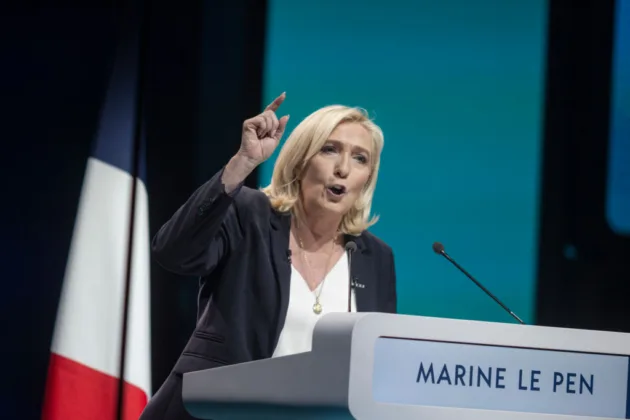






Marine Le Pen has formally launched her campaign for the French presidency, ending months of speculation after a Paris appeals court ruled she remains eligible to stand despite upholding her conviction in the European Parliament fake jobs case.
The decision has transformed what could have been a succession race inside the National Rally (RN) into a highly unusual presidential campaign in which the frontrunner will simultaneously fight for the Élysée Palace and continue a legal battle.
Appearing on TF1 shortly after the July 7 ruling, Le Pen declared: “Tonight I am a candidate for the presidential election. I will not change my mind.”
“I was happy that the court returned to the French people their freedom to vote and restored my eligibility,” she said after the verdict.
She also announced she would appeal to the Court of Cassation, France’s highest judicial authority for criminal and civil matters, insisting she remains innocent and intends to “pursue every avenue of appeal.”
The Paris Court of Appeal confirmed Le Pen’s conviction for the misuse of European Parliament funds intended for parliamentary assistants.
The court sentenced her to three years in prison, with two years suspended and one year to be served under electronic monitoring.
Judges, though, shortened the period during which she is barred from holding public office, allowing her to register as a candidate in the 2027 presidential election.
By immediately appealing to the Court of Cassation, Le Pen also expects the execution of her sentence to be suspended while the case is reviewed. That means she believes she will campaign without wearing the electronic monitoring bracelet she had previously said would make a presidential campaign impossible.
“I said I would not campaign wearing an electronic bracelet. I will campaign without one,” she told TF1.
Le Pen enters the campaign carrying both the status of convicted politician and favourite in many early opinion polls.
France will elect a new president on April 18 and May 2, 2027, marking the end of Emmanuel Macron’s decade in power and opening one of the country’s most unpredictable presidential contests in decades. https://t.co/ddSMbp4iGw
— Brussels Signal (@brusselssignal) July 1, 2026
The legal appeal means the final judicial outcome may not arrive until well into the presidential campaign, creating an unprecedented situation under France’s Fifth Republic.
Every major campaign event is now likely to unfold alongside questions about the timing and outcome of the Court of Cassation’s decision.
The ruling also settles speculation over whether National Rally president Jordan Bardella would replace Le Pen as the party’s presidential nominee. For months, senior party figures had quietly prepared contingency plans should Le Pen remain ineligible.
Le Pen made clear Bardella remains central to her political project, saying he will play a prominent role in her campaign and would become prime minister if she wins the presidency.
The arrangement reflects the RN’s broader strategy of presenting both continuity and generational renewal, with Le Pen remaining the movement’s electoral figurehead while Bardella continues expanding its appeal.
Le Pen’s decision to continue her campaign represents the latest chapter in a political career spanning more than three decades.
The daughter of National Front founder Jean-Marie Le Pen inherited leadership of the party in 2011.
She expelled her father from the movement in 2015 following repeated controversial remarks, including comments about the Holocaust that had long isolated the party from mainstream French politics.
Three years later, she renamed the National Front as the National Rally, presenting it as a broader nationalist movement capable of governing.
That strategy gradually eroded what French commentators long described as the “Republican front” against her party.
After losing presidential run-offs to Emmanuel Macron in both 2017 and 2022, Le Pen appeared closer than ever to power following the RN’s historic breakthrough in the 2024 legislative elections, where it became the largest single party in the National Assembly.