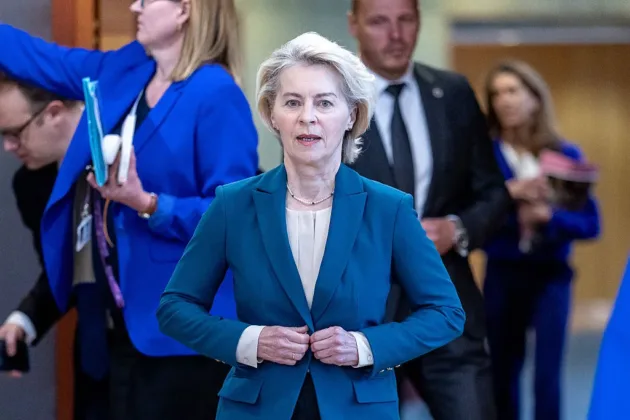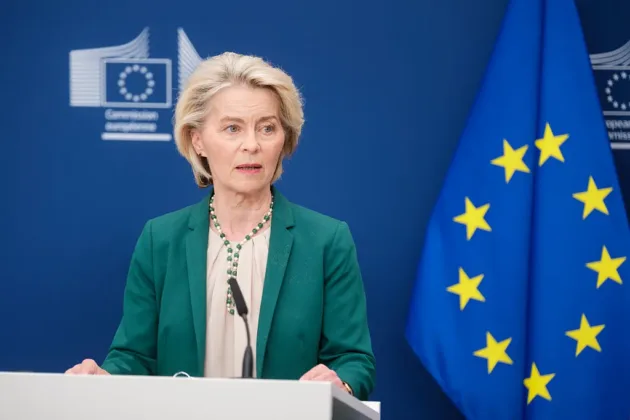











Children should have “phased and gradual access” to social media, EU chief Ursula von der Leyen said today, as experts recommended under 13s only use online platforms under supervision.
The European Union has been mulling a social media ban since a push by EU states, including Greece and France, for limiting access, with pressure intensifying for a bloc-wide ban like Australia.
To help the EU take decisions based on evidence, von der Leyen tasked an expert panel of doctors, academics, youth representatives and parents to give their advice. They delivered their recommendations today.
“What we already have is a consensus that there needs to be a start date for the age children can join social media,” von der Leyen said, calling for “age-appropriate restrictions”.
“This is not about whether children can access social media. It is about whether and when social media can access our children.”
A legal proposal will come in the second half of the year, von der Leyen added, but she is expected to give an indication of what the restrictions will look like in September.
“We need to consider a phased and gradual access for different age ranges,” she said, adding children should only be allowed access to “safe” platforms from the age of 13 onwards.
The report by co-chairs child psychiatrist Jorg Fegert and epidemiologist Maria Melchior offered a glimpse of how the EU’s proposal could look like as they recommended:
— No screens at all for babies and toddlers;
— Supervised use of “age-appropriate social media” and devices children aged between three and 12 by parents or teachers;
— For those aged 13 to 18, “evolving autonomous use” of social media and other digital platforms that have “key safety features”.
Many social media and video sharing platforms including TikTok and Meta’s Facebook and Instagram are only available to children aged 13 and over.
Platforms “must prove that their services do no harm. In Europe, whoever develops a product is responsible for its safety”, von der Leyen said.
“We are convinced that Europe must introduce protective measures to ensure the safety of children and adolescents in the digital world,” Melchior said, standing next to von der Leyen.
The EU has already ramped up the pressure on social media platforms to change in recent months, telling Facebook and Instagram Friday to dismantle their “addictive” features, after a similar warning to TikTok in February.
The report did not recommend a blanket ban on digital platforms including social media, and von der Leyen did not back such a move.
What the panel found was the Australian ban faced difficulties as children found ways around the limits, forcing the EU to reconsider its approach.
Instead, it wants platforms to remove or limit features like autoplay content, infinite scroll, and push notifications.
The European Parliament in October called for a ban on social media for children under the age of 16, a position some EU lawmakers continued to back — although divisions remain over the age.
“I still believe the age should be 15, not 13. 13 is already the minimum age used by most major social media platforms today,” EU lawmaker Christel Schaldemose said in a statement after the panel’s report.
There will likely be difficult negotiations since any EU proposal will only become law after talks between the parliament and member states.
A dilemma for the EU is how to avoid different age limits across 27 countries. For example, Spain wants to ban under-16s accessing social networks, while France proposes prohibiting children aged 15 and under.
And then there are EU nations such as Estonia that oppose a ban.
Von der Leyen said the European Commission, the EU’s executive arm, would “have a very careful look” at the national proposals.
Brussels will “integrate” their work, she said, and then prepare its own proposal to “harmonise the approach and to find a common solution”.
The EU already has a bolstered armoury to rein in Big Tech and protect users online, and the commission has said more rules are on the way.
EU consumer protection chief Michael McGrath vowed a new law, expected later this year, will give children stronger protection against addictive design.