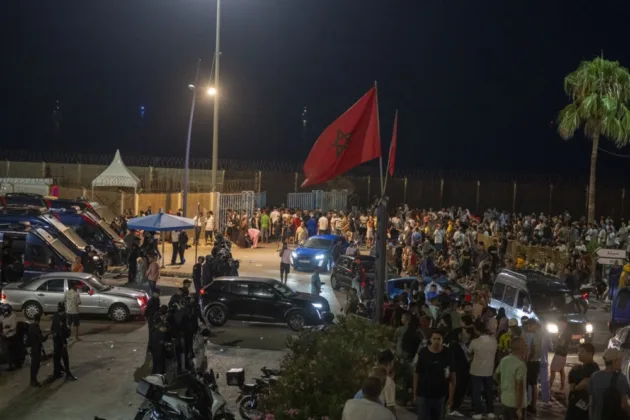










France has ordered an immediate tightening of controls along its border with Spain and activated a rapid-response border force after tens of thousands of migrants entered the Spanish enclave of Ceuta from Morocco in what authorities describe as the largest crossing since 2021.
French Interior Minister Laurent Nuñez announced that he had instructed authorities to reinforce checks at the Franco-Spanish border “without delay” and had activated the country’s Force Frontière d’intervention rapide (rapid border intervention force) to conduct deeper inspections.
“We will obviously take measures if there are movements towards national territory,” Nuñez wrote on X.
Face à la situation constatée dans l’enclave de Ceuta, j’ai, dès hier soir, donné des instructions pour renforcer sans attendre les contrôles à la frontière espagnole. Par ailleurs, j’active la Force Frontière d’intervention rapide pour des contrôles en profondeur.
— Laurent Nuñez (@NunezLaurent) July 31, 2026
The force was created in 2023 under then prime minister Élisabeth Borne and first deployed in the Alpes-Maritimes department on the Italian border. It rests on a national command structure that allows several hundred officers from the police, gendarmerie, customs and the armed forces to be moved to the frontier, with reservists available if required.
Speaking on RTL, the minister said he had already spoken with his Spanish counterpart and expected to hold further discussions later in the day as the situation unfolded.
His announcement came after Spanish authorities reported that approximately 49,000 migrants entered Ceuta over a 24-hour period by land and sea, according to Spain’s Interior Ministry. Spanish police described the influx as unprecedented, saying it was impossible to count arrivals in real time.
The majority of those arriving were reported to be young men and teenagers crossing from neighbouring Morocco. Ceuta, a city of about 83,000 people on the north African coast, forms with Melilla the European Union’s only land border with the African continent.
Spanish authorities have also reported fatalities during the crossings. Initial official figures put the death toll at nine, rising to at least 19 on July 31 after further bodies were recovered near the Tarajal breakwater.
The Guardia Civil and the maritime rescue service recovered 18 bodies in 24 hours, taking to 49 the number of people who have died this year trying to swim into the city, more than the 46 recorded across the whole of 2025.
The scale of the arrivals has prompted Madrid to deploy additional military personnel to secure the territory. Spanish Prime Minister Pedro Sánchez travelled to Ceuta on July 31 alongside Interior Minister Fernando Grande-Marlaska to meet security forces and regional officials overseeing the response.
The Interior Ministry said 200 specialist police officers and 60 troops had been sent from the mainland, with further civil guards, eight divers, a boat and drones to follow. Authorities also closed the Beni Enzar crossing with Melilla overnight as groups gathered near the border.
Madrid has pointed to a Supreme Court ruling issued on June 29 and made public on July 8 as a constraint on its response. The court held that the summary rejection procedure used at the Ceuta and Melilla fences cannot be applied to people intercepted at sea while swimming in, because they have not crossed any physical containment barrier.
France already maintains temporary controls at its border with Spain, measures that have been repeatedly extended in recent years as part of efforts to combat irregular migration and cross-border crime. Paris renewed them for a 24th time since 2015 in April, notifying the European Commission of a further six months running to October 31, 2026.
Nuñez stressed that these controls had already been reinforced in recent months but said the latest developments required an immediate increase in security measures.
The developments have also triggered political tensions within Europe. Italian Prime Minister Giorgia Meloni said Rome was ready to use extraordinary instruments including suspending the Schengen free-travel area with Spain over Madrid’s handling of the crisis.
In response, Madrid summoned the Italian ambassador in protest. Spanish Foreign Minister José Manuel Albares said the Italian remarks were unworthy of a partner country from which Spain expected European solidarity rather than party demagogy.
In May 2021 about 10,000 people entered Ceuta over two days after Moroccan border controls were eased, at the height of a diplomatic dispute over Spain’s decision to allow Polisario Front leader Brahim Ghali to receive hospital treatment in Spanish territory.
The sudden influx into Ceuta has renewed concerns over the management of the EU’s external borders. The European Commission said it had offered Spain financial, technical and operational support, including through Frontex, the bloc’s border agency.
Migration Commissioner Magnus Brunner said protecting the Union’s external borders was “a crucial part of our efforts to fight illegal migration” and that he was in contact with the relevant authorities. Brussels is also in touch with Rabat, which says it is cooperating with Madrid on the rapid return of those who entered irregularly.