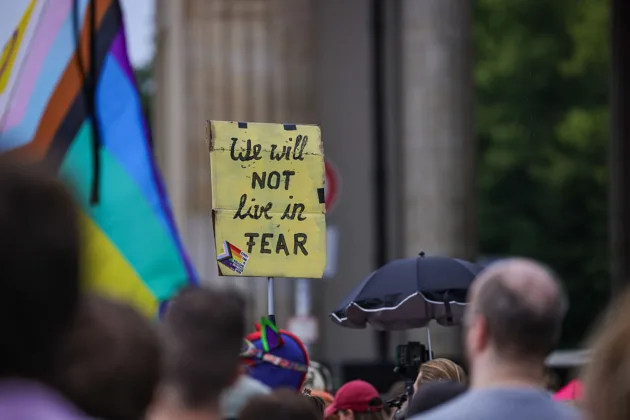






German Chancellor Friedrich Merz has called for an examination of whether German citizenship could be revoked in cases involving dangerous dual nationals convicted of the most serious terrorist offences, following the Islamist attack at Berlin’s Christopher Street Day (CSD) celebrations on July 25 in which one woman was killed and 29 people were injured.
A white van was driven into a crowd on the Ahornsteig path in Berlin’s Tiergarten park at about 10pm, shortly before the parade wound up. Federal interior minister Alexander Dobrindt said the driver then went at passers-by with a machete.
The woman who died was a 65-year-old Polish national. Prosecutors in Warsaw opened their own terrorism investigation on July 27 and the federal prosecutor’s office in Karlsruhe has taken over the German inquiry.
Speaking in Berlin on July 27, two days after the attack, Merz said the State had to do everything it could to restrict the freedom of movement of potential offenders and of suspects classified as dangerous where they could not be held in custody. Following a meeting of the Christian Democratic Union (CDU) leadership, he announced that Dobrindt had been tasked with drawing up an assessment within days, including whether German citizenship could be revoked for dual nationals convicted of the most serious terrorist offences.
Merz said the measure could not have been applied to the suspected attacker, who held German nationality only. For dual nationals, he said, revocation was in his view possible without amending Germany’s Basic Law.
“These criminals, these extremists, have no place in the heart of our society,” Merz said on July 26, adding that the government would do “everything possible to defend the freedom, openness and liberal values of our society.”
Merz’s proposal comes in response to the fact that the alleged attacker was not a foreign national. Abdul Ballout, 21, was born and raised in Berlin and was a German citizen of Lebanese origin. He was shot dead by police on July 26 at a garden colony in the Spandau district of the city after a manhunt lasting almost a day.
For supporters of stricter citizenship rules, the case is an example of the gap between legal nationality and integration.
Until now, Merz and the CDU had largely rejected the idea of treating German citizens differently based on their background or origin, maintaining that a German passport represented full legal membership of the nation. Mainstream parties had opposed citizenship-stripping measures as constitutionally problematic and incompatible with the principle that German citizens have equal rights and obligations under the law.
By contrast, the Alternative for Germany (AfD) has long argued that legal citizenship and genuine integration are two different things, pointing to people with foreign family backgrounds who hold German passports but, in the party’s view, have not embraced the country’s democratic values.
Merz’s decision to reopen the debate after the Berlin attack represents a move closer to a position historically associated with the AfD. It also reflects an attempt to balance conservative demands on migration and security, issues that have become increasingly important among German voters, with the more open-border approach traditionally associated with the Social Democrats (SPD), whose support he needs to maintain the coalition agreement.
During the election campaign, Merz promised stricter border controls, faster deportations and a tougher response to violent offenders. His position has revived debate over whether he is pursuing a long-term strategy on migration and security or adjusting policy in response to electoral pressure.
Berlin votes for a new State parliament on September 20 and the CDU has been slipping nationally. In the ARD-DeutschlandTREND survey conducted by infratest dimap between June 29 and July 1, 13 per cent of voters said they were satisfied with the work of the federal government and 13 per cent rated Merz positively, a low for the Chancellor. The CDU and its Bavarian sister party stood at 22 per cent, their weakest reading since November 2021, behind the AfD on 27 per cent.
The Ballout case has become a turning point in this discussion. He had been known to security authorities for several years because of his Islamist radicalisation and had been convicted twice.
On May 12, 2026 a juvenile court at the Tiergarten district court sentenced him to one year and 10 months for preparing a serious act of violence endangering the State, after he planned to travel to Syria to join Islamic State, and for promoting the group online. The court did not suspend the sentence but deferred the decision on whether he would serve it, placing him under supervision, requiring him to attend deradicalisation counselling and setting a review for November.
Investigative reports indicate that the Federal Criminal Police Office (BKA) had classified him as a high-risk individual, while Berlin’s State Criminal Police Office (LKA) was monitoring him and had installed covert surveillance outside his home shortly before the attack. The reports have intensified criticism of Germany’s preventive security system, raising questions over risk assessment, intelligence-sharing and why authorities were unable to stop an attack by a man already known as a potential threat.
Merz has called for a broader review of Germany’s counter-terrorism framework, including stronger surveillance powers, tighter controls on extremist suspects and closer coordination between federal and state authorities. He has argued that the attack targeted not only the LGBTQ+ community but Germany’s liberal democratic order itself.
The citizenship proposal is expected to face legal scrutiny. Article 16 of the Basic Law states that German citizenship may not be withdrawn, and that any loss against the will of the person concerned requires a law and must not leave them stateless. Any future legislation would therefore apply only to dual nationals.