
Polish President Karol Nawrocki has pressed for NATO’s fuel pipeline network to be extended to the alliance’s eastern flank at the alliance’s summit in Ankara, addressing what military officials see as one of the biggest challenges in the event of a conflict with Russia.
“The dual-use nature of pipelines […] provides the opportunity to build security for NATO’s entire eastern flank, so this is also an opportunity for me and all of central Europe to raise this issue once again,” Nawrocki said on arrival at the two-day gathering, which opened on July 7.
Senior NATO officials have called for an extension of the alliance’s Cold War-era fuel pipeline network hundreds of kilometres eastward towards Poland and the three Baltic states, with further extensions towards Finland in the north and Romania in the southeast.
In the event of conflict NATO’s fuel consumption would likely exceed the capacity of the existing infrastructure even before full-scale hostilities, due to the movement of land forces, airlift operations and fighter jet sorties.
The current 10,000-kilometre pipeline, buried 80 centimetres underground, known as the Central Europe Pipeline System (CEPS), spans 12 countries but ends in western Germany, where it serves military bases such as the US Ramstein Air Base, but also major civilian hubs such as Germany’s biggest airport in Frankfurt.
It was originally built to serve primarily Western air forces in a conflict with the then-Soviet Union.
In wartime, air forces are expected to account for as much as 85 per cent of total military fuel consumption and senior military officials believe fuel and ammunition are the two supply items most critical to running an operation, citing NATO estimates that a full-scale conflict would require hundreds of thousands of cubic metres of fuel per day.
The jet fuel running through the NATO pipelines can also be used by ground vehicles, as mixing it with additives makes it suitable for trucks and tanks that normally run on diesel.
Extending the network would also help address shortfalls in storage capacity, as the fuel inside the pipeline is additional to fuel held in storage tanks.
If implemented, the pipeline extension to the eastern flank would become one of Europe’s biggest infrastructure projects.
Though such a project faces significant hurdles, with an estimated cost of €21 billion and taking 20 to 25 years to complete, according to German magazine Der Spiegel.
Poland sees the project as bringing long-term security, together with the creation of a permanent US military base in the country and the construction of the central airport that would facilitate a faster transfer of NATO troops in the event of conflict.
Nawrocki is attempting to use his increasingly close relationship with US President Donald Trump to make progress on both the pipeline and military base issues.
Trump backed him in the 2025 Polish presidential election and has had several meetings and calls with Nawrocki since the Polish head of state took office on August 6 that year.
The US President has committed the US to increasing the number of soldiers stationed in Poland. In May 2026 the Pentagon halted the rotation of a 4,000-strong armoured brigade, but on May 21 Trump announced on his Truth Social platform that Washington would send an additional 5,000 troops, citing his relationship with Nawrocki. That would take the American contingent to about 11,000. Around 8,000 US troops currently operate in Poland, most of them on a rotational basis.
Progress has also been made by Nawrocki and the Polish government with regard to creating a permanent US base in Poland. A final decision on that is expected by the end of this year. Polish defence minister Władysław Kosiniak-Kamysz submitted a formal proposal for the base to US Defence Secretary Pete Hegseth on June 3.
“This matter is looking very good, especially after the final letter from Secretary Hegseth to the Minister of National Defence, Mr Władysław Kosiniak-Kamysz. I have been working toward this since September 3, since my first visit to the United States. President Trump is fulfilling his declarations. Now everything lies with the Polish Ministry of Defence,” said Nawrocki.
In return for Trump’s favour Nawrocki has backed the US President’s insistence that NATO allies spend 5 per cent of GDP on defence, the target set at the Hague summit in June 2025 for 2035. Poland already spends 4.8 per cent, the highest share in the alliance.
He has also supported Trump’s views on migration and climate change, has called for dialogue over future US ownership of Greenland and has avoided criticising the US over its actions on Iran.
As a result of the close relations established, Nawrocki, a former amateur boxing champion, was among the guests at Trump’s 80th birthday on June 14, when the White House South Lawn was turned into an arena for a UFC cage-fighting card.
Nawrocki has been telling the US President that Poland sees Russia as a great threat but has not joined other Western leaders in close support for Ukraine over that country’s membership of the EU.
In contrast to his relations with Trump, the Polish President’s relations with Ukraine’s President Volodymyr Zelensky are ice cool.
Nawrocki and Zelensky met in Ankara for the first time since the dispute erupted, with the Polish President saying that it was important to “remain in dialogue” given that Poland and Ukraine “share a common enemy, Russia”, though there was no talk of partners or friends.
The Polish president added that his “position on our bilateral tensions remains unchanged: Poland, and I believe all of Europe, cannot accept the reference to UPA soldiers who are responsible for the deaths of 120,000 Poles. However, this does not preclude dialogue and discussion.”
The chill in relations between Poland and Ukraine began on May 27, when Zelensky conferred the honorary title “Heroes of the UPA” on a special operations unit, in tribute to the Ukrainian Insurgent Army (UPA).
In Ukraine, the UPA is remembered primarily for its role in fighting for Ukrainian independence from Moscow-imposed Soviet rule during and after the Second World War, but it was also focused on fighting to remove Poles from what it considered to be Ukrainian territory.
In Poland the UPA is held responsible for the Volhynia massacres of 1943-45, in which around 100,000 Polish civilians, mostly women and children, were slaughtered. Poland has officially recognised the massacres as a genocide, but Ukraine has rejected that interpretation.
In response to Zelensky’s decision, Nawrocki on June 19 stripped him of Poland’s highest honour, the Order of the White Eagle, which prompted Zelensky to cancel plans to attend the Ukraine Recovery Conference, held in Gdańsk, northern Poland, on June 25-26, and to declare defiantly that “no one will dictate which heroes we honour”.
Ukrainian foreign minister Andrii Sybiha on July 3 visited Warsaw to propose an “anti-crisis package” of measures to de-escalate the dispute but Poland has signalled that it expects a “correction” of the decision to name a unit after the UPA.
On July 7 the head of Zelensky’s office, Kyrylo Budanov, warned Poland against issuing any ultimatums.
“The last one who tried to give us an ultimatum was Russia,” he told RBC-Ukraine. “No offence to Poland, but Russia is more powerful than Poland and we didn’t accept its ultimatum either.”
Budanov, a lieutenant general who ran Ukraine’s military intelligence before taking over the presidential office, also claimed that Poland will take “a whole series of immature escalatory steps” this week given that it will be marking the anniversary of the start of the Volhynia massacres on July 11 but said he hoped the two countries could move towards “de-escalation”.
But just as Zelensky does not seem too worried about upsetting Poland over UPA so Nawrocki has no worries about upsetting the Ukrainian head of state.
First, cool relations with Ukraine’s President do him no harm with Trump, who himself has a very fraught relationship with Zelensky whom he regards as ungrateful and unhelpful.
Second, Polish public opinion has been shocked by Zelensky’s doubling down on UPA and Nawrocki’s firm response has met with high approval ratings, now running at 55 per cent, the highest level since his election in June 2025.
Third, Nawrocki’s stance has helped Poland to raise the visibility of Volhynia on the international stage. On July 8 the European Parliament adopted a report on Ukraine’s EU accession which expressed regret at the “recent unnecessary and unprovoked escalation” by Zelensky over the naming of the unit. The text passed by 460 votes to 136, with 59 abstentions.
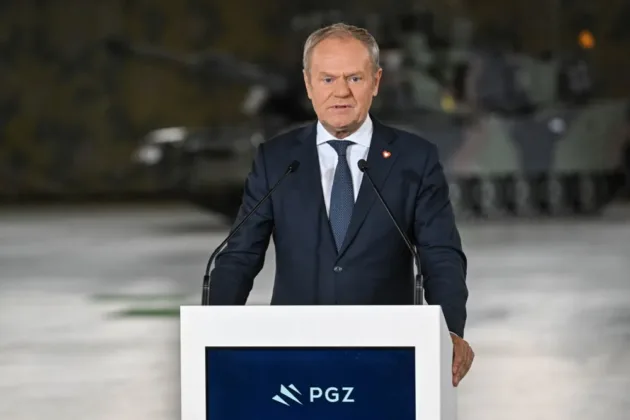
The opposition Law and Justice (PiS)-backed Nawrocki’s high popularity ratings and good relations with Trump have strengthened his position in domestic politics against the centre-left government led by Donald Tusk.
Tusk is persona non grata in the White House because of the Polish PM’s past remarks in which he called Trump a Russian asset but his government has to support the US presence in Poland because of Poland’s terse relations with Russia.
Since Poland joined NATO in 1999 it has always been represented at the alliance’s summits by its President rather than the government and in the present situation where it is Nawrocki who holds all the cards with regard to Poland’s relationship with the US there was no question that it would be Nawrocki and not Tusk who would be in Ankara.
The campaign for a permanent military base and more NATO infrastructure in Poland is part and parcel of Poland showing Ukraine that its views cannot be ignored and sending the message to Russia that NATO will support Poland should its eastern neighbour decide on any action in central Europe.