





Belgium’s 10-year government bond yield has risen above 3.8 per cent, reaching around 3.82 per cent on August 18, its highest level since the eurozone debt crisis of 2012. France’s equivalent yield has moved above 4.1 per cent, a level last seen in June 2009. Both countries now face economic headaches.
The increases form part of a broader rise in eurozone long-term rates. The French benchmark first crossed 4 per cent on July 23.
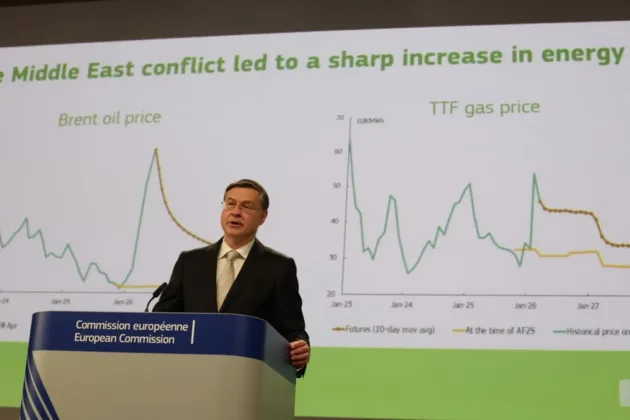
The underlying fear is that higher oil and energy prices will erode the competitiveness of Western industry, worsen the trade balance through more expensive energy imports, and simultaneously stoke inflation. Brent crude traded at about $91 (€78) a barrel on August 18.
When inflation and uncertainty rise, banks and investors respond by demanding higher yields. They do so to protect the real value of the money they lend or invest, ensuring that the purchasing power of repaid loans and bonds is not eroded by rising prices.
These market pressures are amplified by investor concerns over fiscal sustainability in high-debt countries.
Both France and Belgium combine elevated public debt with sizeable budget deficits, leaving them more exposed to negative effects.
Belgium’s debt-to-GDP ratio stood at 107.9 per cent at the end of 2025, according to the National Bank of Belgium, while France’s reached 117.5 per cent in the first quarter of 2026, the statistics office INSEE has reported, and is still rising.
Deficits in both remain close to or above 5 per cent of GDP. France closed 2025 at 5.1 per cent, or €152.5 billion, and Belgium’s federal Monitoring Committee has projected the Belgian deficit rising towards 5.8 per cent by 2029 without corrective measures. Higher yields raise the cost of new borrowing and refinancing, adding to interest expenditure at a time when governments already face limited fiscal space.
Jean Deboutte, director of Belgium’s Federal Debt Agency, has pointed to negative investor expectations regarding the Middle East situation.
“Investors now fear high inflation for a long time, and a firm reaction from the central banks, which will raise their policy rates as a result of that inflation,” he told the news agency Belga.
Similar dynamics are at play for France, where the yield rise has also reflected a country-specific risk premium tied to persistent deficits and political uncertainty ahead of the 2027 presidential election. Fitch reviews its A+ rating of France on August 28.
Germany’s 10-year Bund yield has risen too, to roughly 3.25 per cent, its highest since 2011, and Italy’s stands above 4 per cent.
Yet Germany’s much lower debt ratio (around 63 per cent) and Italy’s improving primary balance leave them in comparatively stronger positions. The sharper pressure falls on Belgium and France.
Higher long-term rates increase the cost of government issuance.
Belgian interest expenditure has already been rising. Federal interest costs reached €10.78 billion in 2025, about 1.68 per cent of GDP.
Projections indicate further increases in coming years as older, lower-coupon debt is refinanced at higher rates. The Monitoring Committee has forecast federal interest charges climbing by €11 billion between 2026 and 2031, to €23.7 billion a year.
Prime Minister Bart De Wever’s Government is due to open talks on a consolidation of some €10 billion.
France faces a parallel challenge on a larger scale: Interest payments are climbing as older, lower-coupon debt is refinanced, with the effect expected to intensify if yields remain elevated. The 2026 budget puts the charge at €74 billion.
Because a significant share of both countries’ debt has medium-to-long maturities, the full impact on annual interest bills builds gradually. Persistent primary deficits combined with yields above nominal growth rates risk amplifying debt dynamics over time.
Long-term government yields serve as an important reference for fixed-rate mortgages.
In Belgium, 20- and 25-year fixed rates have reached their highest levels in more than a decade. The average 25-year fixed rate stood at 4.13 per cent in May, according to the broker Immotheker Finotheker.
For a typical €300,000 loan, the total interest cost over the term can exceed that of a year earlier by more than €25,000.
In France the pass-through has so far been more gradual. Average fixed rates for 20- to 25-year terms sit in the 3.3 to 3.5 per cent range, according to broker data published in early August, as banks have absorbed part of the rise in the OAT (obligation assimilable du Trésor, the French benchmark bond) and competition has limited the increase.
Analysts note that a sustained OAT above 4 per cent is likely to push new mortgage rates higher in the months ahead.
The direction of travel is the same in both countries though: Higher sovereign yields eventually raise the cost of new fixed-rate home loans and reduce borrowing capacity for households.
Most outstanding mortgages in Belgium and France remain fixed-rate, limiting the immediate effect on existing borrowers. New lending and housing market activity are more directly exposed.
The European Central Bank might have to intervene in France following the fall of prime minister François Bayrou because political instability is worsening and prospects for debt reduction seem less likely. https://t.co/rUCSHWJzMK
— Brussels Signal (@brusselssignal) September 9, 2025