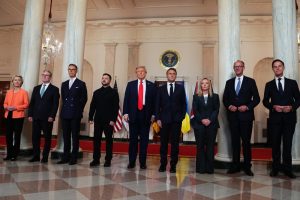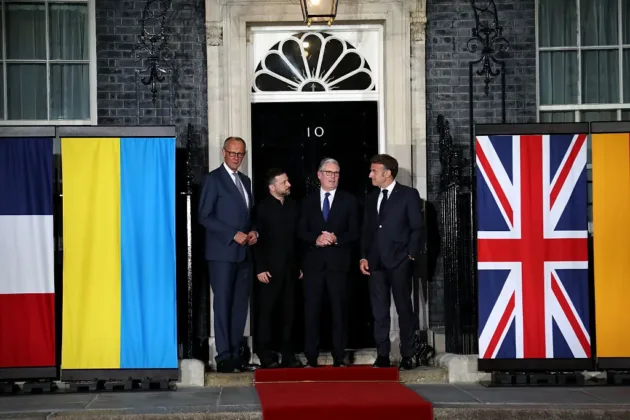
Warsaw is smarting from having been excluded from discussions aimed at ending the war in Ukraine, which took place this week in London and were held between the leaders of Britain, Germany, France and Ukraine.
The talks hosted by British Prime Minister Keir Starmer were attended by German Chancellor Friedrich Merz, French President Emmanuel Macron and Ukrainian President Volodymyr Zelensky. They were held to thrash out a joint position on talks with Russia on a ceasefire to stop the ongoing war in Ukraine.
In a joint statement, Starmer, Merz and Macron commended Zelensky’s call for an end to the war and the proposal for direct dialogue between Ukraine and Russia, with active US and European participation.
Poland has been a staunch supporter of Ukraine, its eastern neighbour, in its more than four-year-old war against invading Russian forces, contributing financial and military help. It has also emerged, in regard to its GDP, as the highest defence spender in NATO.
The holding of the talks with Poland absent has been interpreted in Warsaw as the country being side lined as west European powers attempt to have their influence over Kyiv in talks with Moscow to end the war.
This interpretation has led Polish Prime Minister Donald Tusk, who leads a centre-left government, to signal Warsaw’s displeasure.
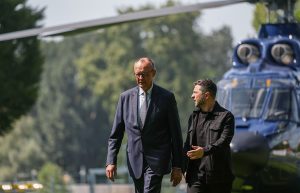
Speaking to reporters on June 9 Tusk said that he had discussed the matter with Merz who explained to him the motivation behind the talks held in London but Tusk remained unconvinced, saying that any exclusion of Poland would entail that it would not automatically support any outcome.
“I said that from Poland’s perspective, any agreements in which Poland does not participate will not be respected by us, meaning they will not bind us, and Poland is an absolutely essential link for serious discussions about the future of Ukraine and the region”, said Tusk.
He was clearly alluding to the fact that Poland is the host for a hub for military and humanitarian aid for Ukraine and has been engaged actively since the start of the war in supporting the Ukrainian war effort.
Tusk also expressed dissatisfaction with the E3 format which comprises Britain, France and Germany but excludes Ukraine’s other European allies.
“I spoke with Italian Prime Minister Giorgia Meloni, who is not thrilled that this format exists,” Tusk said in support of his stance.
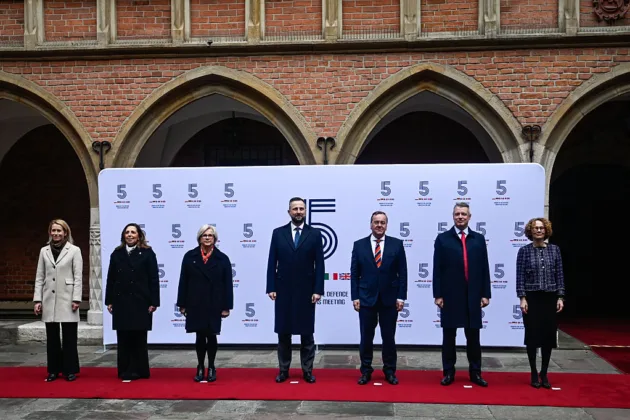
In conclusion Tusk promised a meeting on Ukraine would take place in the “coming days” that would include Poland and Italy as well as Britain, Germany and France.
British Prime Minister Starmer responded to Tusk’s concerns indirectly saying: “There is ample evidence of the UK’s months of cooperation with a wide range of countries as part of the ‘coalition of the willing’, and that the UK is committed to continuing to work with a wider range of European partners.”
The “coalition of the willing” is a loose alliance of countries which have decided to back the Ukrainian war effort after the US administration led by President Donald Trump insisted the Europeans should take a leading role in militarily and financially in backing the defence of Ukraine.
A spokesman for the British Embassy in Warsaw added that “the United Kingdom and Poland are determined to jointly counter the threat from Russia, as evidenced by last month’s signing of the Northolt Treaty.”
The embassy official was alluding to an agreement signed by Tusk in Britain which commits Britain to assist Poland in event of conflict with Russia.
That agreement has however been questioned by the opposition Conservatives (PiS) and President Karol Nawrocki who argue that it is strange Poland is signing separate defence treaties with France (back in April), the UK and negotiating a similar treaty with Germany rather than relying on NATO.
They fear that such treaties could undermine the importance of NATO and Nawrocki has complained that he was not consulted by the government over the agreement with the British.
Commentators in Poland note that this is not the first time Poland has been excluded from talks about Ukraine. The country was excluded from the Normandy and Minsk format negotiations over a ceasefire in the Donbas back in 2014 after the Russian annexation of Crimea and the separatist rebellion in eastern Ukraine as well as the talks held between Trump, European leaders and Zelensky in the summer of last year.
However there is disagreement among experts s to what has caused Poland to be excluded again, despite Poland being Ukraine’s neighbour, a key part of the NATO eastern flank and a hub for support of Ukraine.
Former diplomat and present commentator for liberal portal Onet, Witold Jurasz, said that the cause is “Poland’s refusal to countenance any participation of its military in an eventual peace-keeping mission in Ukraine after the end of the war.”
Jurasz points the finger of blame for this at developments on the Polish Right where PiS has lost votes to the more Ukraine sceptic parties such as Confederation and the MEP Grzegorz Braun’s Confederation of the Polish Crown and also Tusk’s party, the Civic Coalition (KO) and the centre-right Polish People’s Party (PSL) for “following rather than leading Polish public opinion on Ukraine”.
Łukasz Warzecha, commentator for leading conservative weekly Do Rzeczy takes a different view. He feels it is Ukraine which has decided that Poland should be excluded and the western powers had no objections.
“Ukraine does not see Poland as a partner. It believes that it owes Poland nothing and that Poland will do what the US, Germany and Brussels want anyway, so why bother wasting time on persuading it? And Germany and France especially have no desire to see Poland’s position in Europe and the world rising, especially given the fact they suspect it of being too susceptible to American influence”, he argues, and adds that “Poland made the mistake of giving the Ukrainians too much help without any conditions attached at the start of the war.”
In a book published last month titled “The trouble with Zelensky” Zbigniew Parafianowicz charts the way Zelensky has behaved towards Poland, describing how on the Ukrainian President’s orders Tusk was made to travel in a separate train from that in which Merz, Starmer and Macron travelled together during a joint European leaders trip to Kyiv.
The book also describes how Zelensky attempted to draw Poland into the war when he attempted to persuade Poland and its NATO allies that a Russian missile which killed two people came from Russia when in fact it had been a stray Ukrainian defence rocket, and the way the Ukrainians have been deaf to Polish sensitivities over the Volhynia massacre initiated by Ukrainian nationalists for whom ethnic cleansing of Poles in western Ukraine was a rallying cry.
It is the dispute over history between Poland and Ukraine which seems the most intractable aspect of relations between the two countries. The latest incident in that dispute was Zelensky’s decision to name a crack Ukrainian military unit in honour of the Ukrainian nationalist liberation army (UPA).
Polish President Karol Nawrocki reacted to this by threatening to rescind a top Polish honour bestowed on Zelensky by Poland in 2022, though he has yet actually to do so.
The Ukrainians attempted to counter Polish anger by arguing the decision reflects the view of Ukraine that UPA was primarily an anti-Soviet resistance and was not meant to insult Poles. However, in the aftermath of the spat Zelensky, who had since the start of the war used the Rzeszów Jasionka airport in the south-east of Poland when travelling abroad, travelled to the meeting in London via the Moldovan capital of Kishinev and is yet to confirm whether he will attend a donors conference organized by Poland in Gdańsk on 26 June.
Another tricky issue ahead are potential negotiations over Ukrainian membership of the EU. Poland has not thus far resisted the opening of EU accession talks with the EU but it is hardening its stance on any fast-tracking of Ukraine into the community. Economic fears of unfair competition in agriculture and road haulage and the disputes over history are the reasons for Poland’s change of heart.