



Polish President Karol Nawrocki has vetoed legislation that would have created a new legal status for unmarried couples, arguing that it would weaken the special constitutional status of marriage.
The proposed law would have marked the first time that Poland recognised same-sex relationships in domestic law and was the first bill of its kind to clear both chambers of the Polish parliament.
The measures were approved in parliament with the support of Prime Minister Donald Tusk’s ruling coalition, which ranges from left to centre right.
The government’s legislation would have allowed two adults, regardless of their sex, to sign a cohabitation agreement before a notary and register it with a civil registry office.
Couples would have gained rights including joint tax returns, exemption from inheritance and gift taxes, access to medical information, health insurance coverage, survivor’s pensions and the right to arrange a partner’s burial. An annex containing both partners’ wills could also be attached. The legislation did not allow couples to adopt children jointly or to adopt a partner’s child.
The two main opposition parties, Law and Justice (PiS) and the Confederation, voted against the legislation, and Nawrocki, a PiS ally, had made clear in advance that he intended to veto these measures.
“I do not agree to introducing civil partnerships through the back door, which are intended to replace or substitute the institution of marriage,” said Nawrocki, justifying his veto on July 17.
The President argued that the proposed status would reproduce the main legal benefits of marriage without imposing the same range of responsibilities. He also noted that the new contract could be terminated far more easily than a marriage. A further objection, he said, was the scale of the change: the accompanying bill would have amended 238 other statutes, which he called disproportionate to its stated “technical” purpose.
“Marriage, which best secures family stability, cannot become one of many equally valid options offered by the state administration,” he said. “The family is a community fundamental to the survival of the nation.”
The conservative legal think tank Ordo Iuris argues that the proposal was about creating a new institution that rivalled marriage rather than plugging any “legal gap” for couples. According to Ordo Iuris, the most important practical rights in matters such as healthcare, property, inheritance and banking have been available for years to people living in informal relationships. They can authorise each other to receive information about their state of health and access medical records, draw up a will, hold a joint bank account, take out a loan together, name a partner as an insurance beneficiary, succeed to a tenancy after a deceased partner, or refuse to give testimony incriminating a partner.
Nawrocki said the veto did not end discussions about helping people in informal relationships solve practical problems. He added that he could support narrower rules covering issues such as medical information, representation and hospital visits.
Under the Polish constitution, marriage is defined exclusively as a union between a man and a woman.
Nawrocki’s decision was condemned by Tusk, who called it “an expression of contempt toward people and their right to happiness and a normal life”. The Prime Minister added that the vetoed text had been “the absolute minimum” the coalition had worked towards.
Government plenipotentiary for equality Katarzyna Kotula, one of the bill’s authors, criticised the veto, accusing Nawrocki of “turning his back” on around two million people living in unmarried relationships. She said the decision would delay rather than stop changes to Polish law, arguing that public support for civil partnerships and same-sex marriage was continuing to grow. Kotula added that she would continue working to expand the rights available to same-sex couples married abroad, whose marriages are recognised in Poland but do not yet give them access to all benefits.
The Left have not made any secret of the fact that they see civil partnerships as a stepping stone towards the final goal of full marriage equality. The government’s ability and willingness to act, even where it cannot be vetoed by Nawrocki, is hampered by internal disagreements within Tusk’s centre-left coalition. The Left, from which Kotula hails, and Tusk’s centrist Civic Coalition (KO) generally favour strengthening LGBT rights, but they have met resistance from more conservative elements in the coalition, in particular the centre-right Polish People’s Party (PSL).
The measures vetoed by Nawrocki were themselves a compromise within the government. Earlier plans to introduce same-sex civil partnerships were watered down to instead allow same-sex couples simply to sign contracts granting them certain rights.
Polish public opinion has moved in favour of legal recognition of same-sex couples through civil partnerships, with around 60 per cent now in favour, though about 50 per cent still oppose same-sex marriage and over two-thirds oppose the idea of same-sex couples adopting children.
The Polish right, like Poland’s influential Catholic Church, is firmly opposed to legal changes in favour of the LGBT community. Both PiS and the Confederation have gone on the record pushing for legislation that would block any education about LGBT in schools, which has attracted the ire not only of the local LGBT lobby but also the European Commission.
When several local councils controlled by the right passed resolutions making their territories areas free of LGBT education, viewed by the Polish right as indoctrination, the EC threatened them with defunding. Most of these resolutions were later withdrawn as a result. Not before the EC managed to mislead in its rule-of-law reports by claiming that there were LGBT-free zones operating in Poland, and a campaign by LGBT activists showing photographs of road signs that read “LGBT Free Zone”. In fact there were no such zones, and the signs in the photographs had been made by the LGBT activists themselves. The local councils in question were merely signing a family charter that confirmed the rights of parents to bring up their children in line with their beliefs, which are enshrined in Poland’s constitution. Any attempt to ban LGBT people from an area would have been illegal, especially since Poland has never made homosexuality illegal and there could be no legal basis for exclusion.
LGBT rights have become a bone of contention between the right and the centre-left in Poland. This was especially evident in the 2020 presidential election, when the PiS-backed incumbent Andrzej Duda, who went on to win that election, said of the movement: “They are trying to convince us that these are people, but this is simply an ideology,” casting it as a form of “neo-Bolshevism”. He was criticised for the remarks, though he said he was not denying the existence of gay or transgender people but arguing that LGBT had become a political cause pushing an ideology to reshape society.
At a press conference on May 23, 2026, PiS leader Jarosław Kaczyński, commenting on the government’s move to allow the transcription of same-sex marriages contracted in other EU states into Polish law, called homosexuality “a kind of anomaly, a pathology” against which Poland should be defended.
Both the Church and the Polish right argue that the EU has no right to interfere in Polish family law, since the treaties do not make family law the domain of the EU and Poland was assured in the pre-accession period that the area would remain out of bounds. The Lisbon Treaty’s Article 2, though, lists the maintenance of human rights and equality before the law as core values of the EU, which has led EU institutions and courts to treat LGBT rights, and also women’s abortion rights, as core values within their power to enforce in member states. In a related case, an advocate general at the Court of Justice of the European Union (CJEU) advised in April 2025 that EU law requires member states to recognise same-sex marriages contracted elsewhere in the bloc, though not necessarily to transcribe them into national registries.
According to European integrationists, the constitutions of member states are subordinate to European law and European courts. This is disputed by the Polish right and the majority of Poland’s constitutional court, who point to the fact that the country’s constitution does not envisage being subordinate to external laws.
There has also been resistance to corporations imposing LGBT training and celebrations of Pride month on staff. In a highly publicised case, an IKEA employee dismissed by the firm for refusing to participate, and for citing the Old Testament on the subject of homosexuality, won his battle against his dismissal in the courts.
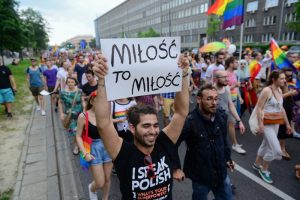
There seems to be little controversy any more over Equality parades in Polish cities. They still attract some counter-demonstrators, but there have been no attempts to ban them, although there have been protests about alleged blasphemy in mixing religious symbols with LGBT rainbow symbolism.