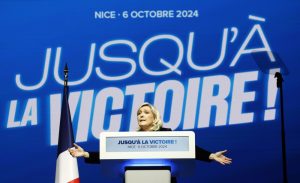







Left-wing mayors across France have said they are preparing to mount legal challenges and acts of civil disobedience should National Rally (RN) leader Marine Le Pen win the 2027 presidential election.
Several municipal leaders said they were ready to enter “resistance” to counterbalance the policies of a potential RN-led government, drawing comparisons with hundreds of Democratic-run cities in the United States that opposed US President Donald Trump’s immigration policies.
With Le Pen consistently polling well ahead of her rivals, credited with 37 to 38 per cent of the first-round vote in the latest Ifop-Fiducial poll for Sud Radio, local left-wing officials are increasingly treating a National Rally victory in the spring as a realistic scenario.
Among those warning of a confrontation between town halls and the Élysée Palace are municipal leaders from both the Socialist Party (PS) and the French Communist Party (PCF).
“There will be a legal battle relying on European law, the Council of State, the Constitutional Council, and certainly civil disobedience in a number of cities,” Philippe Rio, the PCF mayor of Grigny, south of Paris, told AFP, adding that “the judiciary is going to become a major political arena”.
Jean-François Debat, the Socialist mayor of Bourg-en-Bresse, eastern France, echoed that view, arguing it would be legitimate for local authorities to oppose any “circumvention of democratic rules”. “A government cannot stand against a mass of determined elected officials,” he said.
The Socialist mayor of Bavilliers, eastern France, Léo Prassel, intends to serve as an “umbrella” for his population in the face of measures that he considers “discriminatory”, he told AFP. He said he feared an RN victory would unleash racist and xenophobic impulses and that he wanted to “protect the most vulnerable inhabitants”.
The unaffiliated left-wing mayor of Trélazé, western France, Lamine Naham, said he was drawing up a “resistance budget” and would challenge in court any attempt to apply “national preference” in policies ranging from social housing to school museum visits.
Constitutional law expert Benjamin Morel told AFP that local authorities’ room for manoeuvre was real but limited.
The prospect of a clash between central government and local authorities is sharpened by the outcome of France’s municipal elections on March 15 and 22.
While the National Rally expanded its territorial footprint nationwide, it failed to capture most of France’s major urban centres.
The Socialist Emmanuel Grégoire won in Paris, where he declared that the capital “is not and never will be a city of the far right”. The Left also held Marseille, where Benoît Payan was re-elected, while Lyon re-elected its Green mayor, Grégory Doucet.
The most notable exception is Nice, where Le Pen ally Éric Ciotti defeated incumbent Christian Estrosi to become mayor.
Le Pen’s frontrunner status was cemented on July 7 after the Paris Court of Appeal upheld her conviction in the European Parliament funds case but cut her ban on holding office to 45 months, 30 of them suspended, allowing her to stand in the 2027 race.
With centrist and traditional right-wing parties splintered and struggling to coalesce behind a single candidate, polling currently points to a potential second-round showdown between Le Pen and left-wing France Unbowed (LFI) founder Jean-Luc Mélenchon, a prospect that has further fuelled anxiety among moderate and left-wing local officials across the country.
Marine Le Pen has accused Jean-Luc Mélenchon’s LFI of seeking to dismantle France, criticising its proposals on immigration, policing, energy and national sovereignty.
The latest polling puts both candidates in the lead in first-round scenarios for 2027.
Read more ⬇️…
— Brussels Signal (@brusselssignal) November 9, 2026