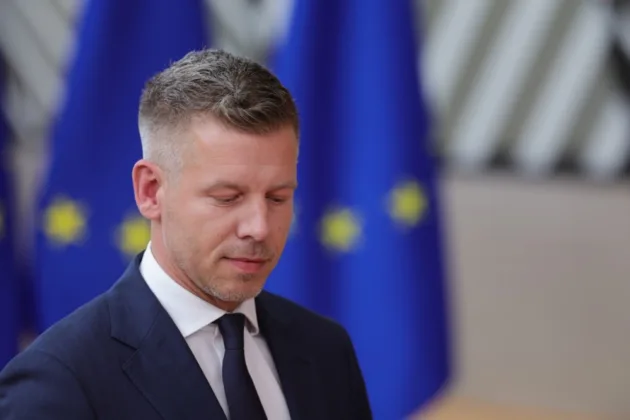



What is an “illiberal democracy”? Ever since Viktor Orbán coined the term, it has sparked endless debate. In reality, though, the answer is simple: It is the opposite of a liberal autocracy. And what is a liberal autocracy? Even simpler: It is what his successor, Péter Magyar, has been putting in place since taking power on May 13, 2026, under the complicit silence of Brussels and other European capitals that, until recently, were crying “totalitarian wolf” every other day.
Sorry to disappoint you, but Hungary’s autocratic drift is happening now, not before. In the span of two highly productive weeks, Péter Magyar, the darling of the self-proclaimed virtuous camp, managed to force out the country’s legitimate president after harassing him from the moment of his election victory, prevent half of the opposition from running in the 2030 parliamentary elections, remove four Constitutional Court judges from office, pull the plug on the news output of the public media and launch a judicial raid on the offices housing Fidesz’s servers in order to seize all of its databases, taking its website offline. An autocratic grand slam achieved in record time.
Let us take a closer look. The first victim of what might be called the Magyar whirlwind was president Tamás Sulyok, who had been elected by the Hungarian parliament in February 2024 and whose term was supposed to run until 2029. His powers were extremely limited, and he exercised them with restraint and neutrality. He oversaw an exemplary transition to the new government, without obstruction or delaying tactics of any kind. And yet Magyar had targeted him from the moment of his victory speech and did everything possible to force him to resign, setting a May 31 deadline for him to stand down. He even went so far as to forbid his ministers from appearing in photographs with the president during the formation of the government and had him removed from official pictures, as in the good old days of Comrade Stalin. When Sulyok refused to step down, the new all-powerful Prime Minister simply terminated his mandate through a constitutional amendment, justified by a “serious loss of public confidence”. As if that were not enough, a megalomaniac Magyar, governing the country as though it were a reality show, then proposed on Facebook that Judit Polgár, the eight-time Olympian and chess grandmaster, replace him, after 16 public figures put her name forward. Embarrassed by the suggestion, she immediately declined on the same social network.
Checkmate was not achieved, but that did nothing to curb Magyar’s destructive zeal. First, he decided to pull the plug on the news output of public media on July 7 while it was “cleaned up” and purged of all pro-Orbán elements. It is true that these public television and radio channels were deferential to the previous government, but one has to admit that turning on the television and finding a black screen displaying the message, “Public media must not lie. We apologise for having done so for many years,” with its distinctly Maoist undertones, is hardly reassuring. Coverage on the public sports channel ran on undisturbed.
Meanwhile, the hyperactive Magyar found another way to decapitate the opposition: Amending the Fundamental Law to limit MPs to three terms, or 12 years. In principle, why not? The problem is that this rule is being applied retroactively all the way back to 1990. As a result, half of the current opposition would be barred from running again, while Tisza’s 141 MPs, who are all political newcomers, would be unaffected. After the “Lex Orbán”, the 16th constitutional amendment, adopted on June 15, a tailor-made measure that permanently bars the former prime minister from office by capping the premiership at eight years counted back to 1990, the new government has clearly developed a taste for retroactive legislation. Never mind that this is Autocracy 101.
The next target? The Constitutional Court, which Magyar describes as being filled with “Orbán puppets”. The solution? Impose a retirement age, retroactively, as you may have guessed, in order to remove four of the court’s 15 judges on September 1, including its president, Péter Polt, who was Orbán’s prosecutor general until 2025. That is enough to bring the remaining judges into line. And to cap off these eventful two weeks, investigators raided the offices housing Fidesz’s servers on July 21, as part of an inquiry into an alleged 17 billion forint (about €46 million) fraud at the National Cultural Fund, seizing the party’s internal communications network, databases and internal messaging infrastructure. As of this writing, Fidesz’s website remains offline. The next day, the prosecutor general resigned, saying he would not let his office become an instrument of political struggle.
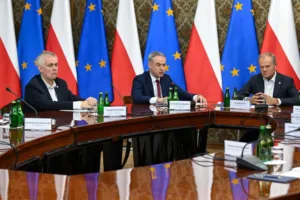
Is this alarming? Without a shadow of a doubt. Is it surprising? Not really, because the Polish Government under Donald Tusk has been using similar tactics since returning to power in December 2023, and almost no one seems particularly troubled by it. Police raids on public television, the dismissal of the national prosecutor without the approval of the president, the refusal to recognise Constitutional Court rulings since 2024 and what critics describe as arbitrary arrests around the former justice minister and some of his associates, the minister himself having been granted asylum in Hungary before a Warsaw court ordered his detention in February: The list is long but far from exhaustive.
And while Magyar carries out his campaign, the European Commission is clearing the way for the release of the funds it had conveniently frozen from Orbán since his last electoral victory, with EU finance ministers signing off on a €10 billion recovery envelope on July 10, celebrating that Hungarians have “chosen Europe” and that the rule of law is being restored. Orwell, if only you could see us now…
The lesson is clear: In Brussels, all means are considered acceptable when dealing with a dissenting government, including the instrumentalisation of the rule of law and its selective application. The method may be subtle, but the pattern has now become far too obvious: Demonise certain governments from all angles so that their successors can freely commit all kinds of violations, as long as they remain obedient to the EU. It is a reflex that reveals Brussels’ authoritarian streak whenever someone dares to challenge it. Of course, Hungarians wanted a change after 16 years, and Magyar won the April 12 election decisively. But let us hope they do not come to regret that choice too quickly while being told loudly and repeatedly that democracy has returned, when in reality it is beginning to disappear.