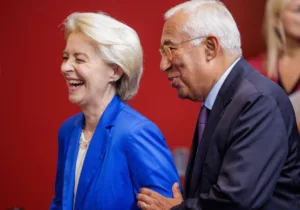

European Council President António Costa has taken charge of the European Union’s next long-term budget after leaders ended more than five hours of debate in Brussels on October 15 without narrowing their differences. He has told member states that new EU-wide taxes must form part of any deal on the 2028-2034 Multiannual Financial Framework (MFF).
The summit was never meant to seal an agreement, though it confirmed that the Irish presidency’s compromise had run aground. Its negotiating box, which cut the European Commission’s proposal by 8 per cent, or about €141 billion, won no significant backing.
Diplomatic sources said the route of spending cuts was close to exhausted and that attention had turned to own resources, the levies that flow directly into the EU budget. Several delegations said the question had been neglected in the Irish text.
Costa will now run the talks himself, taking over from the rotating presidency, and will hold bilateral contacts before producing a revised negotiating box in the coming weeks. No date has been fixed and it is unclear whether the overall volume would rise or fall.
The package on the table keeps the five own resources proposed by the Commission, among them contributions from large companies, tobacco excise duties, electronic waste and a bigger share of carbon border levies. Together they are expected to raise about €55 billion a year.
It leaves out the European Parliament’s preferred targets of digital platforms, crypto assets and online gambling, estimated to be worth up to €32 billion a year. Leaders agreed to keep examining those options despite reservations in several capitals.
Even with the Irish cut, the next budget would still be roughly 30 per cent larger than the current one. The turn towards own resources means the gap would be closed by new taxes on European companies and consumers rather than by lower spending.
Net contributors remain unconvinced. Germany has accused Costa of losing touch with reality over his push for EU-level taxes, while Czech Prime Minister Andrej Babiš has described the Commission’s revenue plans as unacceptable for his country.
Leaders also dropped the explicit end-of-year deadline from their conclusions, inviting their president instead to carry the talks forward with a view to a “timely agreement”. A special summit has been called for November 26, after an informal European Council in Dublin on November 13 and three days before the Spanish general election.
A deal before the end of 2026 would allow the necessary legislation to be adopted in 2027 and EU funds to reach beneficiaries from January 2028, the conclusions note. French President Emmanuel Macron was reported to have warned colleagues that there would be no political room for a deal from January onwards.