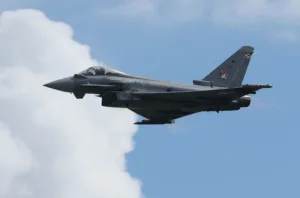





Yemen’s Houthi movement has claimed that its forces hit a Royal Saudi Air Force Eurofighter Typhoon with a surface-to-air missile over Saada Governorate, northwest Yemen, on the night of October 14, releasing infrared footage that appears to show a proximity detonation near the aircraft.
Houthi military spokesman brigadier general Yahya Saree stated that the jet, which had taken off from Taif Air Base in western Saudi Arabia, was “struck directly” and was “at risk of crashing”.
In a statement, Saree said: “By the grace of God, our armed forces were recently able to target a Saudi warplane of the ‘Typhoon’ type that took off from Taif Air Base. It was targeted in the airspace of Saada Governorate with an air-to-air missile, struck directly, and is now at risk of crashing.”
Saree’s own account describes an air-to-air missile, while Houthi-affiliated media have presented the engagement as a surface-to-air launch. Neither version has been corroborated.
Infrared imagery published by Houthi-affiliated media shows a missile detonation close to a fighter consistent with a Typhoon, followed by a visible plume from the starboard wing, consistent with possible shrapnel or fuel damage.
Analysts note that the engagement appears to have been a proximity detonation rather than a direct hit, and that the pilot manoeuvred and deployed flares.
No wreckage, crash site or confirmed pilot status has been independently verified.
Unconfirmed footage shows the launch of what may be a Barq-1/2 surface-to-air missile (SAM) toward a Royal Saudi Air Force (RSAF) Eurofighter Typhoon over Saada Governorate. https://t.co/FNvGhlsg8Z pic.twitter.com/MAxIFJSv37
— OSINTWarfare (@OSINTWarfare) October 14, 2026
In a statement, Saree said: “By the grace of God, our armed forces were recently able to target a Saudi warplane of the ‘Typhoon’ type that took off from Taif Air Base. It was targeted in the airspace of Saada Governorate with an air-to-air missile, struck directly, and is now at risk of crashing.”
Saree’s own account describes an air-to-air missile, while Houthi-affiliated media have presented the engagement as a surface-to-air launch. Neither version has been corroborated.
Infrared imagery published by Houthi-affiliated media shows a missile detonation close to a fighter consistent with a Typhoon, followed by a visible plume from the starboard wing, consistent with possible shrapnel or fuel damage.
Analysts note that the engagement appears to have been a proximity detonation rather than a direct hit, and that the pilot manoeuvred and deployed flares.
No wreckage, crash site or confirmed pilot status has been independently verified.
Circulating videos do show a Eurofighter Typhoon, but they do not show it being destroyed. Instead, open-source analysts say, they show the fighter jet’s self-defence system at work.
Saudi authorities have not confirmed that any aircraft was hit, damaged or lost. Riyadh neither confirms nor denies Houthi shoot-down claims, though it reports attacks on airports and energy sites in detail.
The precise type of surface-to-air missile used has not been confirmed; analysts have pointed to possible Iranian-supplied or locally adapted systems such as the Barq series. Specialists assess the Barq-2 to be an Iranian Taer-2 or a close derivative; the Houthis say it is built in Sanaa.
If substantiated, it would mark one of the first known instances of a Eurofighter Typhoon sustaining notable hostile fire in flight.
The aircraft type has been supplied to Saudi Arabia under long-standing British arms arrangements, including the Project Salam deal for 72 jets. That agreement was struck in 2007 at a reported £4.4 billion (€5.1 billion) and deliveries were completed in 2017. A memorandum of intent signed in 2018 covered 48 more aircraft.
The Typhoon is not a solely British product. It is built by a consortium of the United Kingdom, Germany, Italy and Spain, with BAE Systems, Airbus Defence and Space and Leonardo as industrial partners, tying the Saudi fleet to three EU member states.
Berlin blocked deliveries to Riyadh for years over the kingdom’s conduct in Yemen, lifting that objection in January 2024. No firm follow-on order has been confirmed since.
The incident follows a Houthi claim in September that the group had downed a Saudi F-15 over Marib province, central Yemen. Saree announced it on September 16 and Houthi media published images of wreckage identified as an F-15SA. The defence publication Janes called it the first combat loss of the variant.
The claimed engagement comes amid a sharp escalation in the Saudi-Houthi conflict.
After Houthi forces seized territory along Yemen’s Red Sea coast in a September surprise offensive, Saudi Arabia resumed airstrikes in support of the internationally recognised Yemeni Government. Saudi-backed forces answered on October 4 with the “Dawn of Yemen” offensive to retake Mocha and the island of Mayyun.
The movement has since declared Saudi airspace a military zone in which any aircraft outside the approaches to Mecca and Medina is a target — the framing under which the Typhoon engagement is claimed.
In response, the Houthis have launched a sustained campaign against Saudi infrastructure, including repeated strikes on King Khalid International Airport in Riyadh that killed at least 12 people and wounded 309 on October 10, plus further hits on Abha, Jizan, Najran and Dammam airports, and an assault on Aramco headquarters in Dhahran, eastern Saudi Arabia. The Energy Ministry called the fire there limited and reported no casualties; sources cited by Reuters described flames across several floors.
The Saudi-led coalition has reported intercepting dozens of ballistic missiles, cruise missiles and drones, while both sides have traded warnings and reciprocal strikes on oil facilities and military sites.