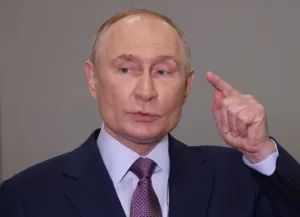


Russia has placed the local assets of five European companies under temporary state administration, under a decree signed by President Vladimir Putin on October 15.
The decree covers the Russian operations of French flooring manufacturer Tarkett, German plastics and packaging producer Menshen, and paper packaging producer Kappa Rus — a Swedish-owned company run by businessman Patrik Ström and formerly part of Ireland’s Smurfit Kappa.
It also covers metal packaging maker Eviosys Packaging Kuban, owned by the Dutch unit of United States-based Sonoco Products since December 2024, and Ontex RU, the Russian subsidiary of the Belgian group.
The five businesses generate a combined annual revenue of more than 50 billion roubles (around €532 million). Tarkett, the third-largest flooring maker in the world by sales, has two of its 34 plants in Russia, in the Moscow and Samara regions.
The assets were transferred to Centre Capital (Tsentr Kapital), a management company registered in Moscow on February 3, 2026 with a charter capital of 10,000 roubles and led by Marat Mirkhaydarov, a former first deputy chairman of the government of Zabaykalsky, a region in southeast Siberia, who stood down in March 2025 after being injured in Russia’s war in Ukraine.
Mirkhaydarov, the company’s sole founder and director, volunteered for the war in January 2024 and spent four months with the Akhmat unit, according to Russian investigative outlet The Insider.
The Kremlin said the decree was a response to EU nations’ role in “direct battlefield hostilities” in Ukraine, but stressed that the temporary management arrangements were “reversible”.
Kremlin spokesman Dmitry Peskov previously linked such takeovers to companies from what Moscow terms “unfriendly countries”.
The mechanism was established by presidential decree No 302 of April 25, 2023, which authorised temporary administration over Russian assets of foreign companies as “retaliatory measures” for the confiscation of Russian property in the United States and allied countries.
The first targets, in July 2023, were Danish brewer Carlsberg and French dairy group Danone.
The businesses were subsequently transferred to entities linked to the Russian authorities.
Western governments and international legal experts have described the takeovers as unlawful expropriation.
Affected companies can in principle seek compensation through international arbitration under bilateral investment treaties Russia has signed with EU member states, although enforcing judgments against the Kremlin is close to impossible.
Ontex, based in Aalst, East Flanders, and listed on Euronext Brussels, confirmed on October 16 that it had been informed of the decree and that “a government-appointed interim administrator has assumed operational control of Ontex Russia”.
Ontex Russia employs around 350 people and operates a production facility in Noginsk, east of Moscow, as well as a sales office in the Russian capital.
The unit accounts for around 5 per cent of group revenue and 7 to 8 per cent of adjusted earnings before interest, tax, depreciation and amortisation (EBITDA), and provides a limited cash contribution.
“Ontex is investigating the situation and will consider appropriate actions to safeguard its assets and the continuity of Ontex Russia’s operations, in the interest of its employees and other stakeholders,” the company said.
Belgium’s financial markets regulator, the Financial Services and Markets Authority (FSMA), suspended trading in Ontex shares shortly before the company’s statement.
The Swedish owner of Kappa Rus, Patrik Ström, who bought the Russian factories a year or so ago after working there for many years, has lost control of his entire Russian operation under the decree. “It’s just so crazy,” he told Swedish business daily Dagens industri.
Smurfit Kappa sold its four Russian plants, in St Petersburg and Moscow, to local management in March 2023.
The decree is the latest in an escalating series of seizures.
On September 17, Putin placed the Russian assets of Nestlé, Metro, Auchan and Leroy Merlin under temporary administration, with the assets transferred to LEV Management, a company established shortly before the decision and reported by Russian media to have links to the security services.
A plastic packaging unit of France’s Aptar was targeted in the same month.
According to Reuters, citing sources in the Russian government and business community, major European companies that chose to remain in Russia have become a tool for the Kremlin to pressure the EU in response to sanctions and support for Ukraine.
One Russian official said of possible next targets, which reportedly include the Russian subsidiaries of UniCredit and Raiffeisen Bank: “Let them be afraid”.
The latest move came ahead of Ukrainian President Volodymyr Zelensky’s appearance at the October 15-16 EU summit, amid reports that the United States could seek control of some Russian assets frozen in Europe.
The EU froze around €210 billion in Russian sovereign assets in response to the war. Most of that money sits in Belgium, which has resisted using it to finance Ukraine unless other member states share the legal risk.
On October 12, the Council of the European Union adopted the largest-ever package of listings against Russia’s military-industrial complex, covering 826 companies and 743 individuals, the latter mostly chief executives of the listed firms.
Belgium has separately found itself in Moscow’s sights. Russia’s foreign ministry summoned the Belgian ambassador on October 13, accusing Belgian officials of “openly aggressive statements” that “contribute to a further escalation” and risk “the confrontation spiralling out of control”.
Moscow rejected Belgian allegations of hybrid threats, sabotage and growing military threats.
Approximately one third of the 103 enterprises involved in the production of Russia’s Su-57 multirole fighter jets are not subject to sanctions by any country in the international sanctions coalition, according to Ukraine’s Defence Intelligence (HUR). https://t.co/BaQg40yZeB
— Brussels Signal (@brusselssignal) April 22, 2026