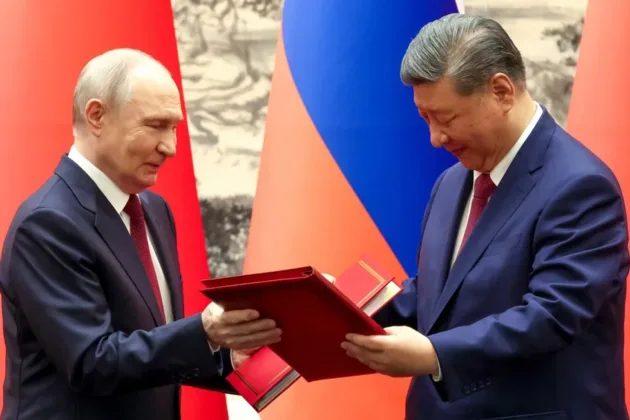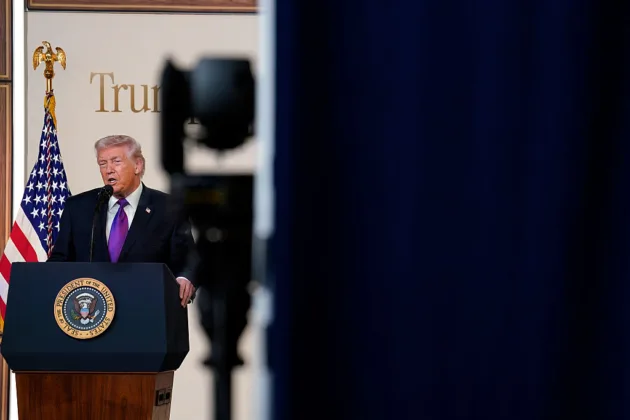

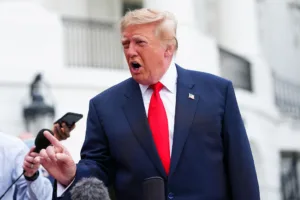

US President Donald Trump has said Washington is holding talks with Moscow and Beijing aimed at reducing the nuclear arsenals of the countries with the largest stockpiles.
Speaking in an interview with Newsmax broadcast on October 15, Trump said: “The whole thing is a shame, because I’d love to denuclearise if possible, but we’re actually talking to Russia about that, and we’re talking to China about that denuclearisation.”
He added that he expects China to “catch up” with the United States within the next five years, though he said Beijing remained “substantially behind” and was “probably less inclined” to negotiate because its arsenal is smaller.
Asked whether the discussions involved Chinese President Xi Jinping and Russian President Vladimir Putin directly, Trump said they did but gave no further detail.
Trump also said the United States might launch another strike against Iran’s nuclear facilities, including a heavily fortified site known as Pickaxe Mountain. “We may have to go there,” he said, adding that Washington would “knock it out fast”.
The site, Kuh-e Kolang Gaz La in Persian, sits south of the Natanz enrichment plant and is thought to run at least 100 metres beneath the mountain. Its main tunnel complex was not among the targets hit in June 2025, according to the Institute for Science and International Security.
He added that he was considering using the “mother of all bombs” against Iran, the GBU-43 conventional munition. “The mother of all bombs is not nuclear,” he said, calling it “just an extremely large bomb”. Asked whether he would use nuclear weapons, he said: “No, I wouldn’t use nuclear. We don’t have to.” He also ruled out sending ground troops.
CNN, citing unnamed sources, reported that the administration was weighing such a strike, possibly after the midterm elections of November 3.
According to the Stockholm International Peace Research Institute (SIPRI), Russia holds the largest number of stored nuclear warheads, followed by the United States and China.
Russia also keeps slightly more deployed warheads than the United States — 1,796 against 1,770 as of January 2026, SIPRI estimates. Russia’s total inventory stands at 5,420 warheads, the United States’ at 5,042 and China’s at 620.
SIPRI’s latest figures put the global total at around 12,187 warheads as of January 2026, with Russia and the United States accounting for the large majority of those in military stockpiles. The institute counts 9,745 warheads in military stockpiles worldwide and 4,012 deployed with missiles and aircraft.
Trump’s comments come months after the New START treaty expired on February 5, 2026.
The 2010 agreement, which limited strategic nuclear weapons between the United States and Russia, had been extended once for five years under former president Joe Biden and Putin. It capped each side at 1,550 deployed strategic warheads and 700 deployed missiles and bombers.
No further formal extension was possible.
Russia has said it will continue to observe the treaty’s numerical limits as long as the United States does the same, while Trump previously indicated he preferred a new agreement rather than a simple extension and has long expressed interest in involving China in arms-control discussions.
Putin made that offer on September 22, 2025 and Foreign Minister Sergey Lavrov told the Russian parliament on February 11 that Moscow was abiding by the ceilings. On the day the treaty lapsed Trump said Washington would seek a “modernized Treaty” lasting well into the future.
No detailed timetable or formal proposals have been made public. China has previously resisted trilateral arms-control talks on the grounds that its arsenal remains substantially smaller than those of the United States and Russia. Its disarmament ambassador, Shen Jian, said on February 6 that Beijing would not join nuclear disarmament negotiations at this stage.
The exchanges follow Trump’s instruction to the Department of War, issued on October 30, 2025, to begin testing nuclear weapons “on an equal basis” with Russia and China. The United States has not carried out an explosive nuclear test since 1992.