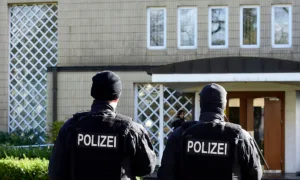





Berlin is struggling to recruit enough police officers because too many applicants fail German-language tests, the city’s police president has said.
Police president Barbara Slowik Meisel told RBB’s Abendschau that the problem was not a shortage of applications but a shortage of suitable candidates.
“We are in really fierce competition for suitable applicants, the emphasis is on suitable,” she said.
Of 1,224 training places in 2025, only 936 were filled, leaving about a quarter vacant. The Senate has since confirmed that 288 of those places went unfilled for want of qualified candidates.
The force received more than 6,300 applications in 2025 against those 1,224 places, according to the police academy.
The German test, a dictation plus grammar, remains the main filter. About 40 per cent of applicants fail it.
Candidates sit the test at a computer and hear a text of about 200 words read aloud in short bursts. More than 14 mistakes is a fail for middle-rank entry; the threshold for the higher tier is 11.
Slowik Meisel said standards could not be lowered. “We have applicants, but we also have high requirements that we cannot reduce.”
She argued that officers must be able to explain their actions to the public and, where necessary, record them in writing. “We have to explain our police measures day after day,” she said.
Recruits also had to understand the legal basis of their work well enough to explain it. “And possibly also put things down in writing.”
The force already posts practice dictations on YouTube and uses social media to prepare candidates for the multi-stage selection process. It has also offered voluntary German tutoring to serving trainees since 2019.
Applicants who fail only the dictation may retake it once, on another day and with a different text. Whether that will raise intake is not yet clear.
Slowik Meisel made a similar assessment in early 2026 before the interior committee of the Berlin House of Representatives.
“We have a quite considerable problem with German-language skills, entirely independent of nationality,” she said.
Many candidates already failed the written computer tests; about 80 per cent of those failures were due to “inadequate German skills”.
“I do not want to engage in school-bashing, but there is a problem with the educational levels with which young people leave school,” she added. Lowering the bar, she said, would only raise dropout rates later.
Nancy Boy-Seifert, head of the Berlin police academy, has put the failure rate for middle-rank entry at about the same level.
“40 per cent of all applicants fail either the dictation or the German test, or miss both of these minimum requirements.”
She has said the weaknesses lie in spelling, punctuation and grammar, and that scrapping the dictation is not an option because written German underpins the work.
Parliamentary figures released on February 16, 2026 for the 2024 and 2025 intake cycles show that of 10,874 applicants, 4,271 failed the German test (39.3 per cent). The data came in answer to a written question from Tommy Tabor, education spokesman for the Alternative for Germany (AfD).
Among candidates with the Abitur, a vocational university entrance qualification or a completed degree, the fail rate was still about 30 per cent.
The Senate answer showed a steep gradient by qualification. Applicants holding a degree failed at 14 per cent, those with the Abitur or an equivalent at 31 per cent, those with an intermediate school certificate at 47 per cent and those with a basic vocational certificate at 69 per cent.
A Senate reply stated that recent test cycles showed no significant difference in dictation pass rates between applicants with and without a migrant background.
Almost all applicants hold German citizenship; migrant background is recorded only on a voluntary basis.
Leonard Maier, the psychologist who runs the selection procedure, told taz that neither migration background nor school qualification appeared to account for the failures. Many young applicants were simply unused to writing at a keyboard, he said.
Berlin recorded the highest share of new recruits with a migrant background of any German force that publishes such data, at 37 per cent, according to Mediendienst Integration. Among 240 cadets who began training in spring 2025, 132 were assessed as needing extra German tuition.
The academy says the share of first-semester recruits needing that support is routinely around half and falls with each term.
Hamburg dropped the dictation from its entry test in 2025, after 65 per cent of applicants there had failed on spelling. Berlin has said it will not follow.
The force says it will keep quality ahead of numbers. Recruitment targets for the police academy have been missed for several years running.
A Berlin café and “intersectional” co-working space that explicitly bars white people from entry has received more than €662,000 in German taxpayer subsidies from the federal Demokratie leben! (Live Democracy!) programme, sparking outrage over state-funded racial exclusion in…
— Brussels Signal (@brusselssignal) April 30, 2026