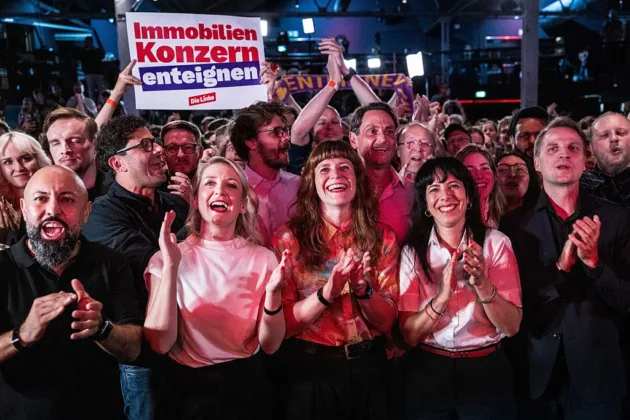
On the evening of September 20 the Left Party (Die Linke) won Berlin with 25.7 per cent of the vote, doubling its result of 2023, while 200 kilometres to the north, in the state of Mecklenburg-Vorpommern, Alternative for Germany (AfD) doubled its vote share to over 38 per cent in regional elections. Throughout the West, the divisions between left-leaning urbanites and right-leaning rural voters are emerging, and given current trends it is unlikely that this polarisation will stop anytime soon. Let’s take a look at what is going on and why it matters:
Berlin is a story of disgruntled academics and mass migration, as well as a major gender gap. According to infratest dimap, 43 per cent of voters under 25 chose the Left, and among women under 25 the figure was 51 per cent, against 34 per cent of their male contemporaries. If you add the 12 per cent of young female voters that opted for the Greens, you have a voting bloc of 63 per cent for left-wing parties among that subgroup. A significant part of these under-30s are university students who struggle to find affordable housing or an income fit for their expectations. As Nate Silver has pointed out in a recent article, there is no more reliable voting bloc for left-wing parties than people with advanced degrees and low incomes, as the mismatch between their credentials (whether you want to call it an “education” can be discussed) and their expected salaries makes them particularly susceptible to left-wing promises of expropriating the rich and other redistribution schemes they hope to profit from.
Another stronghold for Die Linke are the districts with the highest share of residents with a migration background, Mitte, Neukölln and Friedrichshain-Kreuzberg. In the latter it took all five direct mandates and 44.2 per cent of the list vote. Its lead candidate, Elif Eralp, born in Munich to Turkish trade unionists who fled the 1980 coup, told the election party in Turkish as well as German that “we have written history, friends.” Apparently these friends in the capital of Germany needed to hear those words in Turkish, which is telling. Also at that party, according to the Berlin press, were Issa Remmo, whom the same press calls an Arab clan boss and part of Berlin’s criminal underground, and Ibrahim Ibrahim, an alleged terror supporter. Although the party claims that he was not invited, one understands why he felt like partying. Just take a look at the official programme of Die Linke: Its 336 pages mention deportation on a single one of them and the word Straftäter (German for offender) on none. Crime, for this party, is a non-issue, so not surprisingly professional criminals are delighted. This goes double for imported criminals, as the party states explicitly “that nobody gets deported” and “every deportation is one too many”, whether the person in question is a criminal or not. Around half the suspects in Berlin rape cases are either foreigners or have a foreign background, yet 51 per cent of young Berliner Fräuleins voted to keep them in their city. But the party does not stop there: Citizenship is to be granted regardless of income and without supposedly “degrading” practices like language tests, and a city ID modelled on New York’s is to be issued to people without papers (also known as illegal immigrants), plus special entry programmes are promised for people from Syria, Iraq, Afghanistan, Sudan, Gaza and Lebanon, and non-citizens should get the vote after five years. The police chapter, drafted with input from what the text itself calls the “abolitionist movement”, wants the “ever more expensive arming of the police” stopped, replace police forces with social workers, and abolish the weapons-ban zones and designated crime hotspots as they could be gateways to racial profiling. The party’s entire programme is as if someone wrote down the worst fears of the right and turned it into a checklist. Sadly, a quarter of the electorate voted for it. I did not even mention that the party is also openly anti-Semitic, with members describing October 7 as legal resistance or calling for an “election intifada”. All of this would be funny if it were not so tragic. Eight weeks before the vote a 21-year-old Berliner named Abdul Ballout, known to the authorities as an Islamist, drove a minivan into the closing crowd of the Christopher Street Day, killed a woman and injured 31. And now the party that would not only enable the import of more Islamists but also oppose their deportation has become the strongest party in the capital of Europe’s most powerful country, although this (the most powerful part) is most likely only a matter of time before it ends.
Mecklenburg-Vorpommern, on the other hand, appears to be the reverse mirror image of Berlin. It is a rural state where fewer than one resident in twelve holds a foreign passport, against roughly one in four in Berlin, and its winners were not young women with degrees but men in the middle of their working lives. The AfD took 47 per cent of the 45- to 59-year-olds, 51 per cent of workers on infratest dimap’s count and 44 per cent of men, while the SPD held strong among women and voters over 70, 52 per cent of whom stayed with Manuela Schwesig, the current state premier. The SPD won the major cities and the AfD won everything between them. The Left, fresh from conquering the capital on the same night, managed a meagre 6.5 per cent. Two hundred kilometres of motorway separate a polling district that gave two-thirds of its votes to a party that wants fewer police from a village that gave 78.6 per cent to the party that wants more. Both are in Germany, but they could not have less in common.
David Betz, the King’s College strategist, whose civil-war arithmetic I discussed in these pages last year, wrote in 2023 that “the cities are radically more heterogenous than the countryside. Thus, logically, we may conclude that civil wars in the West that burn across ethnic cleavages will have a distinctively rural vs. urban character.” If so, Germany is about to enter the foothills of civil war. Betz describes the emergence of an “asymmetric multiculturalism” in which in-group preference, ethnic pride and group solidarity, “notably in voting”, are acceptable for every group except one. Running campaign ads in Arabic to appeal to Middle Eastern identity is accepted, while appealing to a genuine German identity “is considered to represent supremacist attitudes that are anathematic to social order”. For example, a candidate with Turkish roots may therefore be celebrated as a “Turkish” success in a German election, while the villager in Vorpommern who finds that very behaviour suspicious will be watched by the domestic intelligence service.
Many commentators are claiming that the Left’s success was not due to identity politics but because of a housing crisis in Berlin. But I am not so sure. Many people voted for the party that helped cause the housing shortage in the first place, and was now running on the promise to cure it. In May 2004 the governing city Senate of SPD and PDS (the former name of Die Linke) sold the municipal housing company GSW with 65,700 flats to Cerberus and Goldman Sachs’s Whitehall fund for €405 million. It was the Left’s housing senator Katrin Lompscher who announced the Mietendeckel (a price cap on rent), in force from February 23, 2020 until the Federal Constitutional Court voided it on April 15, 2021 because Berlin did not have the legal authority to pass it. The ifo Institute measured what those 14 months alone had done to the housing market: The supply of rental flats on offer in Berlin fell by up to 60 per cent and stayed there after the cap was lifted. Then in September 2021 Berliners voted 59 to 41 per cent to expropriate the big landlords, and the Left, still in the Senate, could not deliver that either, as there still is such a thing known as “the constitution” that prevents the majority from simply expropriating a minority. So the party that sold the flats, capped the rents, shrank the supply and promised the expropriation it could not perform is now running on doing the same thing all over again, only this time they will fail more successfully.
The rural and urban divide will be a defining factor not only in Germany in the years to come. Whether it will remain peaceful, we will see.