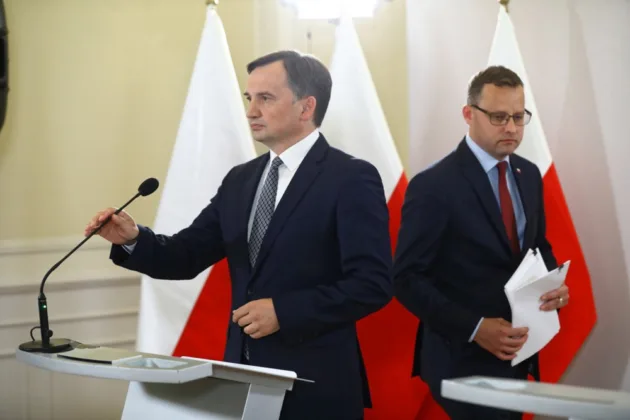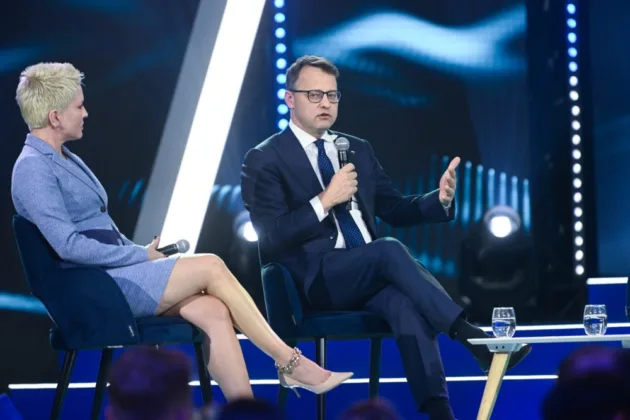

Former Polish deputy justice minister Marcin Romanowski, who is wanted for alleged misuse of public funds, has written to a Polish court claiming that he is currently residing in Moldova’s Russia-backed breakaway region of Transnistria.
Romanowski was one of the deputies to former Law and Justice (PiS) justice minister Zbigniew Ziobro and, despite leaving Poland in 2024, is still a member of parliament for PiS.
In his letter, sent from Tiraspol, the capital of the Transnistrian region, Romanowski has asked the Warsaw Regional Court, in a document received on August 4, for safe conduct that would allow him to face questions from prosecutors while remaining at liberty.
National Public Prosecutor’s Office spokesman Przemysław Nowak on August 12 confirmed that prosecutors had received a copy personally signed by Romanowski in which the former deputy minister claimed that he was currently staying at a specific address in Tiraspol.
Nowak said prosecutors had no certainty the letter had in fact been sent by Romanowski, describing the handwritten signature as similar but not subjected to expert examination. On the question of the suspect’s whereabouts, he said, the prosecution had only Romanowski’s own declaration.
Romanowski declared himself willing to appear before a court or prosecutor at an appointed time on condition that he remain free while the proceedings continue.
A judge has been assigned to the case and on August 7 asked prosecutors for the case files so that the court can review both Romanowski’s application and the prosecutor’s findings.
Safe conduct under Polish criminal law allows a suspect or defendant who is abroad to return to Poland without being detained in the case covered by the arrangement, provided that conditions set by the court are met, such as appearing when summoned and avoiding obstructing the investigation.
Romanowski faces charges in an investigation into alleged irregularities involving the Justice Fund, a State fund administered by the justice ministry which is used to help the victims of crime and for initiatives aimed at preventing crimes.
Prosecutors accuse him of offences including “participation in an organised criminal group” and manipulating grant competitions so that selected organisations received public money, and of steering public money towards initiatives aimed at supporting their political allies in elections.
Romanowski is not being accused of having taken any money for himself and the alleged crime group consists of officials at the ministry.
His former boss, Zbigniew Ziobro, has been accused of similar offences and has also had his parliamentary immunity lifted and left the country before parliament voted to facilitate his arrest and temporary detention.
Both Romanowski and Ziobro deny the charges, arguing that all the appropriate procedures were followed in decisions made with regard to the fund and that the money was used by organisations for the purposes stipulated in the grant agreements.
As for the charge that they steered money towards places in which their political allies stood for parliament, they insist no money was directed towards the campaigns of these individuals and that actions such as the purchase of fire engines for certain municipalities do not favour the voters of any party.
The courts have nonetheless approved the government prosecutors’ requests for them to be detained in order to stop them from absconding or interfering with the investigation.
In Romanowski’s case the attempt to remove his parliamentary immunity had a chequered history. Parliament lifted his domestic immunity in July 2024, but his detention on July 15 lasted barely a day because prosecutors had not taken account of the international immunity he held as a member of the Parliamentary Assembly of the Council of Europe (PACE).
PACE waived that immunity on October 2, 2024, at the request of the then justice minister Adam Bodnar, clearing the way for his arrest.
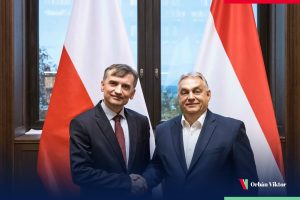
Before a court could confirm that arrest, though, Romanowski left the country and claimed asylum in Hungary, then still governed by prime minister Viktor Orbán, who later also gave asylum to Ziobro and who argued that the behaviour of the Tusk government made holding a fair trial in Poland unlikely.
The court nevertheless confirmed the detention order and a European Arrest Warrant was issued on December 19, 2024, the day Budapest announced Romanowski had been granted asylum. A Warsaw court revoked that warrant on December 19, 2025, before a differently composed bench reissued it in February 2026 at the prosecution’s request.
Romanowski’s travel documents and refugee status were revoked on July 2 by the new Hungarian government led by Prime Minister Péter Magyar, who said after his April election victory that his administration would find a way to send both Ziobro and Romanowski back to Poland.
Both left Hungary in May. Ziobro, who was not covered by the warrant, flew from Milan to the US on May 9, the day Magyar was sworn in, after US deputy secretary of state Christopher Landau instructed officials to facilitate a foreign media visa, Reuters reported. He now works as a commentator for Polish conservative broadcaster TV Republika.
Romanowski, who is covered by the warrant, dropped off the public radar after leaving the Budapest flat he had been staying in at the end of May.
There have been a number of Polish media reports speculating that he may be staying in Serbia, Croatia, Spain or even the US, but none were confirmed.
On August 12 Romanowski’s lawyer, Bartosz Lewandowski, confirmed that his client had applied for safe conduct and had declared that he was outside the territory of the European Union, but did not state that Romanowski was residing in Transnistria.
In the declaration itself, reported by news portal Wirtualna Polska, Romanowski says he is using a passport issued under a different identity, on a similar basis to that given to crown witnesses, in order to move freely outside the EU.
Moldova’s foreign ministry has said Romanowski did not enter the country through crossing points controlled by the constitutional authorities, that further checks were under way and that its police were in contact with Polish institutions. The government’s reintegration bureau said it had no information and had received no formal request.
This has made some commentators speculate that Romanowski may be using the Transnistrian postmark as a false trail masking his real whereabouts. Entry to the region is in practice straightforward for EU citizens, with buses running from Chișinău to Tiraspol and no registration required for short stays, according to Piotr Oleksy of the Institute of Central Europe.
News that he may be in Transnistria was in any case seized on by allies of Prime Minister Donald Tusk. Deputy defence minister Cezary Tomczyk told broadcaster TVN24 that Romanowski was in all probability under the influence of the Russian services, while Paweł Wojtunik, a former head of the Central Anti-Corruption Bureau (CBA), said nobody could enter the territory, let alone live there, without the approval of the local security service.
They have said Polish security services should examine what secrets Romanowski had access to while in government, to ascertain the likelihood of a security breach in favour of Russia.
The news of Romanowski’s possible presence in Transnistria was commented on by the right-wing opposition parties too.
In an interview with commercial broadcaster Polsat News, PiS deputy leader Przemysław Czarnek, the party’s candidate for prime minister at the 2027 parliamentary election, said he did not know where Romanowski was and that the matter was of no significance to Poles.
Put to him that a stay in Transnistria would amount to crossing a line, Czarnek replied that this was “a very good statement”, while maintaining that anyone could have posted the letter.
Krzysztof Szczucki, an MP in the Rozwój Plus grouping of former PiS prime minister Mateusz Morawiecki, told the same broadcaster he would be “in shock” if the reports were substantiated and that it would be a situation that discredited a person in public life. He added that the failure of the Polish services to locate Romanowski for months pointed to the ineffectiveness of the State.
Rafał Bochenek, the PiS media spokesman, said he had no information on Romanowski’s whereabouts and no contact with him, but that if he returned he could not count on a fair and impartial trial.
PiS has consistently argued that charges being levelled at former PiS officials for their actions when in office are politically motivated and an attempt to please an electoral base that had for the eight years of PiS rule been told that the PiS government were committing crimes.
Not a single former PiS government official has been charged with embezzling or in any way profiting themselves from any public expenditure. They are being accused of channelling public funds to causes they supported.
Polish media today is full of reports of Tusk party activists and officials benefitting personally from favourable treatment and outright corruption, as well as of channelling funds to organisations that support the present administration.
If Romanowski is actually living in Transnistria his extradition from there will be more than difficult for Poland to achieve.
The Tusk government does have an extradition treaty with Moldova, the country of which Transnistria is officially a part. But the Moldovan authorities do not have any power to enforce an extradition from Transnistria, which is a breakaway republic.
Poland cannot attempt to extradite anyone from Transnistria directly either, as it does not recognise that region as a separate country.
Transnistria, which borders Ukraine, broke away from Moldova following Russian military intervention and a brief war in the early 1990s.
The region, inhabited by an estimated 360,000 people, has its own government, security forces and currency, but no United Nations member state, including Russia, recognises it as an independent country. About 1,500 Russian troops are present as peacekeepers, the region has been receiving political and economic support from Russia and Transnistria’s flag and national emblem feature the Soviet hammer and sickle.