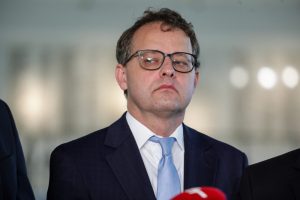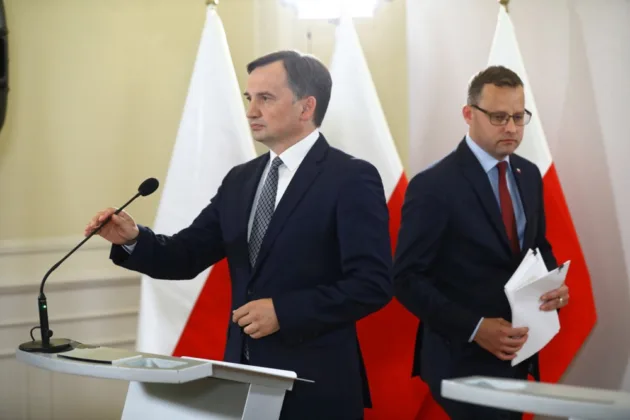











Poland’s justice minister Waldemar Żurek has criticised a decision taken by a Warsaw regional court to approve a request from opposition Law and Justice (PiS) MP Marcin Romanowski to receive safe passage back to Poland to answer charges levelled at him without being detained.
Żurek has announced that prosecutors will appeal the court’s decision, which he claims was issued by an illegitimately appointed judge and in violation of regulations.
Romanowski is a former deputy justice minister who is facing 11 charges for alleged offences committed while he served in the government. He, like the former justice minister Zbigniew Ziobro MP, has been accused of misappropriation of public funds from the Justice Fund (Fundusz Sprawiedliwości) and participating in an organised criminal group composed of state officials.
Prosecutors allege he disposed of more than 107 million złoty (€25 million) of entrusted funds and attempted to dispose of a further 58 million złoty (€13.6 million), in decisions taken between November 2018 and December 2023.
Both Romanowski and Ziobro deny the charges against them saying they are politically motivated. They maintain that all procedures regarding the Justice Fund were followed when money was awarded for projects aimed at preventing crime or helping the victims of crime.
Neither Ziobro nor Romanowski has been accused of themselves benefiting materially from the alleged offences but of deriving “political benefit” from helping their political allies and their associated civil society organisations.
It is also claimed they illegally purchased the Israeli Pegasus spyware out of the Justice Fund which it is alleged was later used to illegally investigate politicians from the then liberal opposition.
Though Ziobro argues that the purchase of Pegasus helped in the investigation of hundreds of crimes and that the investigations against the small number of politicians were all made with the approval of court judges who have to sign off on any planned surveillance.
Romanowski left Poland just before he was to be detained and after his parliamentary immunity was lifted and a year later Ziobro also left Poland for Hungary. Both were granted asylum in Hungary on the grounds that they would not be tried fairly in Poland after the prosecution service was taken over by the government without the legally required approval of the President. Romanowski received refugee status there in December 2024.
After the arrival in power of the new Hungarian government led by Prime Minister Péter Magyar who promised he would send both Romanowski and Ziobro back to Poland, both Polish politicians left that country. Hungary withdrew their refugee status and invalidated their travel documents on July 2, 2026, as Polish foreign minister Radosław Sikorski confirmed. Ziobro travelled to the USA where he was granted an entry visa in May 2026 to work as a commentator for Polish conservative news channel TV Republika, and Romanowski’s whereabouts are undisclosed. Polish prosecutors have since lodged a formal extradition request for Ziobro with the United States.
The Polish prosecutors were eventually granted permission to seek European Arrest Warrants against both politicians but not before they had left the territory of the EU.
It has been alleged that Romanowski is staying in the Russian dominated enclave of Transnistria, internationally recognised as part of Moldova but outside the control of the government in Chișinău, because a letter asking for safe passage had been sent from there. No confirmation of his presence there has emerged, and Moldova’s Reintegration Policy Office said it held no information on Romanowski and had received no official request about him from the Polish authorities, noting that the territory remains outside the effective control of the constitutional authorities.
Polish prosecutors have opposed his request for safe conduct, arguing that he cannot be trusted to comply with its terms given that he has repeatedly sought to evade the law by leaving Poland.
In fact Romanowski had on a previous occasion before leaving Poland gone to the prosecutors’ offices offering himself for interrogation but was turned away.
He was also detained in Poland unlawfully when the prosecutors in 2024 had failed to recognise that he was covered by immunity arising from his membership of the Parliamentary Assembly of the Council of Europe (PACE). He was held on July 15, 2024 and a court refused to arrest him the following day. PACE lifted his immunity on October 2, 2024 and the prosecutors then sought his detention from a Polish court.
Romanowski has been seeking safe passage back to Poland for months through his lawyer Bartosz Lewandowski but Poland’s prosecutors have argued that there were no grounds to grant it.
Safe passage, known in Polish as a list żelazny, or iron letter, is governed by articles 281 and 282 of the code of criminal procedure. These allow a regional court to guarantee that an accused person living abroad remains at liberty provided he appears when summoned, stays at his declared address and does not obstruct the case.
The spokesman for Poland’s National Prosecutor’s Office, Przemysław Nowak claimed “the suspect has evaded legal proceedings, questioned the legality of the authorities’ actions, left Poland and then Hungary to avoid arrest, and publicly declared his lack of intention to return to the country due to the ongoing criminal proceedings against him”.
Though on September 30, the Warsaw regional court approved Romanowski’s request stating that the decision had been made as “previous methods used to secure Romanowski’s return were ineffective” and safe passage would “allow the case to be clarified”.
Romanowski’s lawyer, Bartosz Lewandowski, said that safe passage meant his client could not be detained in Poland and that a European Arrest Warrant against him, which applies in other EU countries, would no longer be valid.
In a subsequent justification for the ruling judge Konrad Mielcarek wrote that Romanowski had pledged to “voluntarily return to the country”.
The judge argued that prosecutors had failed to provide adequate arguments as to why Romanowski’s request should be denied and found that Romanowski was not engaged in obstructing proceedings against him, but had merely exercised available legal remedies.
The fact that Romanowski had fled Poland does not count against him, argued the judge, because “the very nature of safe passage is to provide a person residing abroad with a legal guarantee in exchange for voluntarily submitting to the jurisdiction of the Polish authorities”.
The judge also said that safe passage is neither a “reward” nor a “privilege” and that, given that evidence in the case is already secured and Romanowski no longer has influence over justice ministry officials, the risk of him tampering with the process is low. He also held that the prosecution’s objection was not binding on the court, citing judicial independence and the need to avoid an imbalance between the parties.
Conditions for Romanowski’s safe passage include him having to report to the court and prosecutors at designated times and places, staying at his declared place of residence, and avoiding obstruction of the criminal proceedings against him. The guarantee can be withdrawn immediately if any of them is broken.
The National Prosecutor’s Office immediately issued a statement declaring its opposition to the ruling and its intention to appeal against it.
“These circumstances do not provide assurance that the suspect will comply with the conditions of the letter of safe conduct,” wrote the prosecutors, who also pointed to Romanowski having allegedly admitted to using travel documents issued under a false identity.
Justice minister Waldemar Żurek, meanwhile, called the ruling “the height of hypocrisy” on Polsat News and questioned the legitimacy of judge Mielcarek arguing that he had been appointed on recommendation of the KRS which the government believes was elected illegitimately.
The Tusk government regards judges appointed by the President during the lifetime of the last PiS government (2015-2023) as illegitimate, despite the fact that the constitution grants the President the sole responsibility and power of appointing judges.
The government however argues that since the about 3,000 appointments in question were made on recommendation of the National Council for the Judiciary (KRS) which in their view was overtaken by the then PiS majority in parliament when they changed the method of election of that body so it was carried out by parliament rather than senior judges.
But the Polish constitution does not stipulate the method of election of the KRS and says that the members elected must be judges, a provision which has not been violated.
In his statement, the justice minister also argued that, under the law, safe passage cannot be issued without a prosecutor’s consent but Romanowski’s attorney Bartosz Lewandowski cited examples of case law that he said disproved this.
Lewandowski also said that prosecutors had not filed any motion to recuse Mielcarek from the case in advance of the hearing. Żurek himself conceded the point, saying openly that he considered it a mistake.
Since the arrival in power of the Tusk government in late 2023 many rulings made by judges appointed during the period of 2015-2023 under the PiS government have been questioned and overturned on the grounds that they were made by illegitimate judges. These include criminal cases involving murder as well as civil family law cases of divorce.
The government has proposed legislation to regulate wholesale the issue of the judges appointed during the time of the PiS government by which some judges could be removed altogether, others demoted and some allowed to stay.
That government proposal was criticised by the Venice Commission, the advisory body to the Council of Europe, on the grounds that it introduced collective responsibility. The commission and the Council of Europe’s human rights and rule of law directorate set out their objections in an urgent joint opinion adopted on February 27, 2026, dealing with judges appointed or promoted between 2018 and 2025.
The European Court of Justice (ECJ) has also, in its ruling involving challenges to the rights of individual judges in Poland to rule in cases, said that every case has to be examined on its merit and that no judge or his actions can automatically be regarded as illegitimate because of the way they were appointed.
In its regular reports on rule of law observance in Poland the European Commission has repeatedly asked successive Polish governments to reduce the use of temporary detention which is prevalent in the country and according to international experts is used excessively and in a punitive manner.
Paweł Musiałek from Polish think tank Klub Jagielloński speaking on YouTube current affairs channel Kanał Zero argued that temporary detention was being used as a way of punishing people in advance of them being sentenced.
“Too often the sanction of temporary detention is used against people who pose no threat to society or the state and purely as a means of making an example of someone and to satisfy the political need for action”, said Musiałek.
He also felt that safe passage for both Ziobro and Romanowski would be beneficial to the state because both could then return to face trial and such a trial with their presence would have more credibility.
Politicians from Tusk’s ruling coalition have condemned the ruling, with Civic Coalition MP Roman Giertych writing on X that it was, to put it mildly, not very wise and would encourage suspects to flee and then apply for safe passage. The coalition was not unanimous: Paweł Śliz, an MP for Poland 2050 and a practising lawyer, said it was right that the court had issued the letter, arguing that justice sometimes requires compromises.
Other politicians in the coalition have suggested that Romanowski is a threat to national security because he may have been helped by the Russian authorities that control Transnistria, where it is claimed he has been staying.
Romanowski’s allies fear that the justice minister, who in Poland doubles up as prosecutor general, will use his influence and powers to ensure that a judge friendly to the government and its case will be on the bench when the appeal against Romanowski’s right of safe passage is heard.
Żurek has been criticised by both the opposition and conservative media for having made changes in the district courts by putting judges he trusts in the role of chairmen and it is chairmen of the courts who have now been given discretionary powers to suspend the process of random assignment of judges to cases, a process which was brought in by the last PiS administration as a means for reducing the powers of the chairmen of individual courts.
The Tusk government is currently also engaged in a stand-off with the Constitutional Tribunal (TK) over membership of that body. Its ministers have threatened to use the police in order to allow judges elected by parliament but whose appointment has not been confirmed by the opposition-allied President Karol Nawrocki, to take up office and adjudicate.
Justice minister Żurek has gone as far as threatening Bogdan Święczkowski, the chief justice of the TK, with being prosecuted for illegally tampering with the membership of the court.
President Nawrocki’s administration has reacted angrily to those threats and warned that it would take action against the government if it attempts to take over the TK by the use of force and the opposition PiS and their supporters have for several days been demonstrating outside the TK to stop any police moves against the institution.