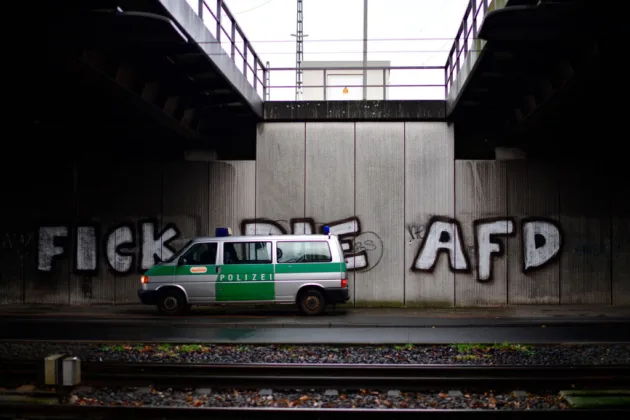








More than 1,000 German lawyers, judges, prosecutors and other jurists have signed an open letter calling on Germany’s political institutions to begin proceedings aimed at banning the Alternative for Germany (AfD), arguing that the party represents a threat to the country’s constitutional democratic order.
The appeal was organised by the Republican Lawyers’ Association (Republikanischer Anwältinnen- und Anwälteverein, RAV), a German legal association associated with progressive and left-wing legal circles.
Founded in 1979, it describes itself as a political lawyers’ organisation and part of the civil rights movement. Its founding members included Otto Schily and Gerhard Schröder, later German interior minister and chancellor respectively.
The organisation has historically taken leftist positions on issues including migration law, restrictions on freedom of expression, campaigns against right-wing political parties and state surveillance.
The open letter was published in mid-July 2026 with more than 500 signatures. The RAV said on August 3, 2026 that 1,051 lawyers, judges, prosecutors, jurists working in public administration and business and trainee lawyers had signed by the time the list closed on July 31.
It represents the latest escalation in a campaign by sections of Germany’s legal community, NGOs and media organisations to push for a constitutional case against the AfD. The party holds 151 of the 630 seats in the Bundestag, making it the largest opposition group, and leads national opinion polls at federal level.
The initiative follows the publication on June 25, 2026 of a legal opinion by the Society for Civil Rights (Gesellschaft für Freiheitsrechte, GFF), a Berlin-based non-profit organisation focused on strategic litigation and legal campaigns aimed at defending constitutional rights.
The document runs to some 1,500 pages, with a further 1,500 pages of annexes, and was compiled over 13 months by eight specialists in constitutional law, right-wing extremism and data analysis. It draws on more than three million data points, according to the GFF.
The GFF report argued that the AfD violates core constitutional principles, including human dignity under Article 1(1) of Germany’s Basic Law and the democratic principle under Article 20(2), and could therefore meet the legal threshold for a party ban under Article 21(2). It concluded that an application to ban the party would probably succeed.
The signatories of the letter argue that the question is no longer whether enough evidence exists to justify action, but whether Germany’s constitutional institutions are willing to act before, rather than after, what they describe as a further erosion of democracy.
RAV chair Angela Furmaniak, a co-initiator of the letter, said the Basic Law had given Germany an instrument that “must now finally be used”. She added that politicians could no longer hide behind pretexts and had to act before it was too late.
The debate has also moved into regional political institutions. The justice committee of the Thuringian state parliament has scheduled a public hearing on a possible AfD ban for September 30, 2026, at the request of the Die Linke group.
It will be the first such hearing held by a committee in any German parliament. Among the 15 experts nominated by the parliamentary groups is Hans-Georg Maaßen, a former head of the domestic intelligence service, put forward by the AfD.
Under Germany’s Basic Law, only the Federal Constitutional Court has the authority to ban a political party. Proceedings can only be initiated by the federal government, the Bundestag or the Bundesrat.
None of the three has moved to do so. The RAV said responses from members of the Bundestag had so far been limited.
The timing of the initiative is politically sensitive. The call for an AfD ban comes weeks before state elections in Saxony-Anhalt on September 6, 2026 and in Mecklenburg-Western Pomerania and Berlin on September 20.
In Saxony-Anhalt the AfD stood at 41 per cent, against 24 per cent for the Christian Democratic Union (CDU), in a poll by Infratest dimap for MDR, WDR, Mitteldeutsche Zeitung and Volksstimme published on July 30, 2026.
The party took 20.8 per cent there in 2021, when the CDU won 37.1 per cent. It has entered several state parliaments but has never led a regional executive.
The controversy has exposed a tension in Germany’s political system: Whether banning a party in order to defend democracy strengthens democracy, or risks undermining the very principles it seeks to protect.
Supporters of a ban point to Germany’s post-war constitutional doctrine of “militant democracy” (wehrhafte Demokratie), created after the collapse of the Weimar Republic. The principle holds that a democratic state does not have to remain passive towards movements that seek to use democratic freedoms to destroy the constitutional order itself.
The argument is rooted in German history. Adolf Hitler’s National Socialist German Workers’ Party (NSDAP) became the largest political force in the Reichstag after the July 1932 elections.
Following Hitler’s appointment as chancellor on January 30, 1933, the Nazi regime used legal mechanisms, emergency powers and parliamentary procedures to dismantle democratic institutions and establish a dictatorship.
Critics warn, though, that banning a party supported by millions of voters, and currently leading national polls, would create a precedent and could deepen political polarisation by allowing citizens to believe that electoral choices are being overturned through judicial action rather than democratic debate.
The push for a ban is taking place at a moment of electoral strength for the party. The AfD polled 28 per cent against 21 per cent for the CDU and its Bavarian sister party, the Christian Social Union (CSU), in an INSA survey for Bild am Sonntag published on August 2, 2026.